

Remove water from oil.
Extend equipment life.
Vacuum dehydration removes free and emulsified water and entrained gases from hydraulic, lubricating, turbine and transformer oils, helping reduce oil degradation and equipment wear.
Continuous dehydration. Less maintenance.
Removes free and emulsified water
Removes entrained gases and reduces oil degradation
Suitable for hydraulic, lubricating and other industrial oils
Rental trials are available to verify performance with your own oil.
Read More
Free water appears only after the oil is saturated and can no longer bind additional moisture. It then settles at the bottom of the tank and may be carried through the system as small droplets when the pump circulates the oil. These unbound droplets can be removed by suitable filtration or separation methods.
Advantages at a glance:
- Reduces machine wear by removing water from the oil.
- Lowers residual water content to below 50 ppm.
- Efficiently removes water, gases and particles.
- Fast and straightforward system installation.
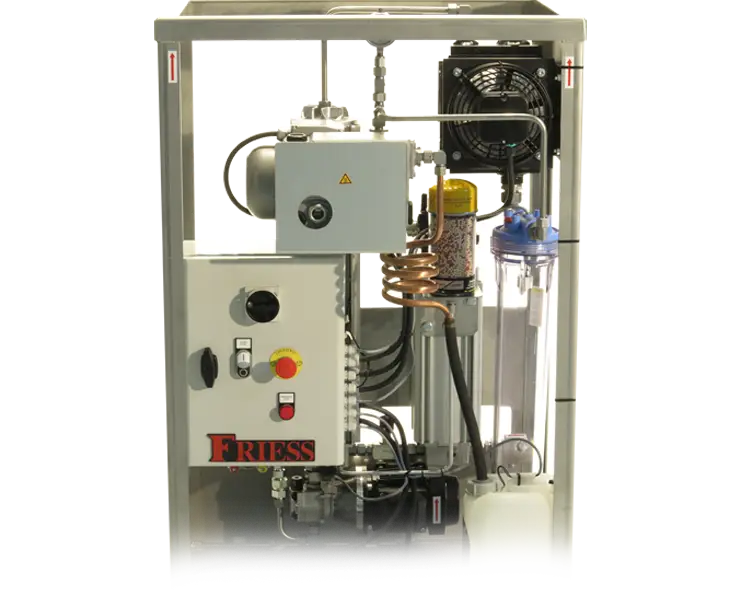
Using vacuum technology, the VOD 16 deeply dehydrates hydraulic, lubricating and other industrial oils to below 50 ppm residual water, improving oil cleanliness and overall system reliability.
Case Studies
Applications for Vacuum Oil Purifiers
FRIESS VOD vacuum oil purifiers are designed for applications including:
- Water ingress in hydraulic systems: ageing seals, condensation or external moisture cause the hydraulic oil’s water content to exceed acceptable limits.
- Water-contaminated lubricating oil: gearbox and bearing oils absorb water through cooling-water leaks or humid operating environments.
- Transformer-oil treatment: moisture in insulating oil reduces dielectric performance and requires deep dehydration.
- Cement, mining and other dusty environments: hydraulic oil remains exposed to humidity and persistent water contamination.
Free Water and Emulsified Water
Free water exists as droplets and can often be removed by settling or conventional filtration. Emulsified water is bound within the oil and cannot be removed by ordinary filters; vacuum dehydration is required. FRIESS VOD systems handle both conditions.
Frequently Asked Questions
What is the difference between a vacuum oil purifier and a conventional oil filter?
A conventional filter removes solid particles but cannot remove water dissolved in the oil. A vacuum oil purifier heats the oil under vacuum so that moisture evaporates and is separated, allowing emulsified water to be removed and residual water content to be reduced to below 50 ppm.
How can I tell whether hydraulic oil needs dehydration?
Typical indicators include cloudy or milky oil, an oil-analysis result above 500 ppm water, unusual system noise or unstable pressure, and corrosion on metal components.
How long does treatment take?
Treatment time depends on the oil volume and degree of contamination. As a guide, approximately 1,000 litres of moderately contaminated hydraulic oil normally require 8–24 hours.
Can the equipment be rented?
Yes. FRIESS offers rental trials so the performance can be verified before purchase. Up to two months of rental fees may be credited toward the final purchase price.
How is the removed water discharged?
The water evaporated during vacuum dehydration is condensed and collected. It is clean water without oil contamination and can be discharged in accordance with local requirements.
In addition to reducing operating costs, FRIESS oil skimmers, electrostatic oil cleaners, magnetic filters, coolant purification systems, oil-water separators and vacuum oil purifiers provide many further benefits.
We will be pleased to explain how these solutions can improve your process.