

Vacuum Oil Purifiers
for Industrial Oil Dehydration
Vacuum dehydration removes free and emulsified water and entrained gases from hydraulic, lubricating, turbine and transformer oils, helping reduce oil degradation and equipment wear.
Continuous dehydration. Less maintenance.
Removes free and emulsified water
Removes entrained gases and reduces oil degradation
Suitable for hydraulic, lubricating and other industrial oils
Rental trials are available to verify performance with your own oil.
Read More
Free water appears only after the oil is saturated and can no longer bind additional moisture. It then settles at the bottom of the tank and may be carried through the system as small droplets when the pump circulates the oil. These unbound droplets can be removed by suitable filtration or separation methods.
Advantages at a glance:
- Reduces machine wear by removing water from the oil.
- Can reach 50 ppm or better under suitable conditions; verify with oil analysis.
- Efficiently removes water, gases and particles.
- Fast and straightforward system installation.
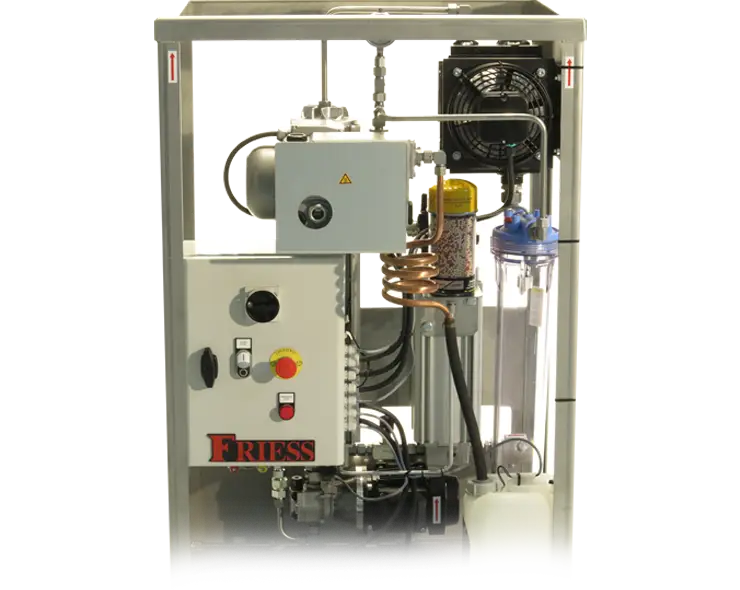
The VOD 16 uses vacuum dehydration to remove water from hydraulic, lubricating and other industrial oils. The data sheet specifies a residual water content of 50 ppm or better; actual results depend on the oil, initial water content and operating conditions and should be verified with an oil sample or site trial.
Oil Cleaner Applications


Applications for Vacuum Oil Purifiers
FRIESS VOD vacuum oil purifiers are designed for applications including:
- Water ingress in hydraulic systems: ageing seals, condensation or external moisture cause the hydraulic oil’s water content to exceed acceptable limits.
- Water-contaminated lubricating oil: gearbox and bearing oils absorb water through cooling-water leaks or humid operating environments.
- Transformer-oil treatment: moisture in insulating oil reduces dielectric performance and requires deep dehydration.
- Cement, mining and other dusty environments: hydraulic oil remains exposed to humidity and persistent water contamination.
Free Water and Emulsified Water
Free water may settle or appear as visible droplets. Emulsified water is dispersed as fine droplets in the oil and is not usually removed effectively by ordinary particle filters. The treatment method and target water content should be selected using oil analysis and a site trial.
How Does Vacuum Oil Dehydration Work?
The VOD operates in a bypass circuit. Oil passes through a particle prefilter and is heated as required before entering the vacuum chamber. Reduced pressure allows water in the oil to evaporate; the vacuum system extracts the vapour, which is condensed and collected separately. The treated oil returns to the system through a heat exchanger.
Particle filtration and vacuum dehydration perform different tasks: the prefilter captures solids, while the vacuum stage removes water by evaporation. Confirm operating temperature, oil compatibility and the target water content for the selected model and application.
Frequently Asked Questions
What is the difference between a vacuum oil purifier and a conventional oil filter?
Particle filtration primarily removes solid contaminants. Vacuum dehydration primarily removes water and entrained gases. Performance depends on the oil, initial water content and operating conditions; an oil sample helps establish a suitable treatment plan.
How can I tell whether hydraulic oil needs dehydration?
Cloudy oil, visible water droplets or water collected at the bottom of a reservoir are reasons to take an oil sample. The need for dehydration should be assessed against the analysis results and the equipment requirements.
How long does treatment take?
Rated oil flow through a vacuum dehydration unit is not its water-removal rate. Dividing tank volume by this flow does not predict the time to reach the target water content. Estimate treatment time from oil volume and type, starting and target water content, temperature and continuing water ingress, then verify with oil analysis or a site trial.
Can the equipment be rented?
Please ask about a rental trial to verify performance with your oil and operating conditions. The model, rental period and fees are subject to the project quotation.
How is the removed water discharged?
Water removed during vacuum dehydration is normally condensed and collected. The condensate may contain oil or other contaminants; it should be tested and handled under the site requirements rather than assumed suitable for direct discharge.
First Check: Water in Oil or Oil in Water?
This page concerns vacuum dehydration where industrial oil is the main fluid and water must be removed. If the main fluid is water, coolant or washing liquid and the contaminant is floating or coalescible tramp oil, assess industrial oil-water separation instead. The two equipment types should not be compared on throughput alone.
From Dehydration Assessment to VOD16 Model Specifications
Provide the oil grade, system oil volume, temperature, initial water content, required result, water-ingress source and available connections. Investigate continuing water ingress where possible, then use an oil-sample trial to assess treatment time. Set the water-content target from equipment and oil requirements; the residual-water figure in a data sheet is not a universal acceptance limit for every system.
After selecting vacuum dehydration as the treatment method, review the VOD16 vacuum oil purifier specifications and data-sheet request. Where sludge, resin or ultrafine particles are also present, separately assess the compatibility requirements for electrostatic oil cleaning; the processes do not replace each other. Consult the hydraulic oil analysis guide when reviewing samples. Dehydration does not restore depleted additives or aged base oil.
In addition to reducing operating costs, FRIESS oil skimmers, electrostatic oil cleaners, magnetic filters, coolant purification systems, oil-water separators and vacuum oil purifiers provide many further benefits.
We will be pleased to explain how these solutions can improve your process.