
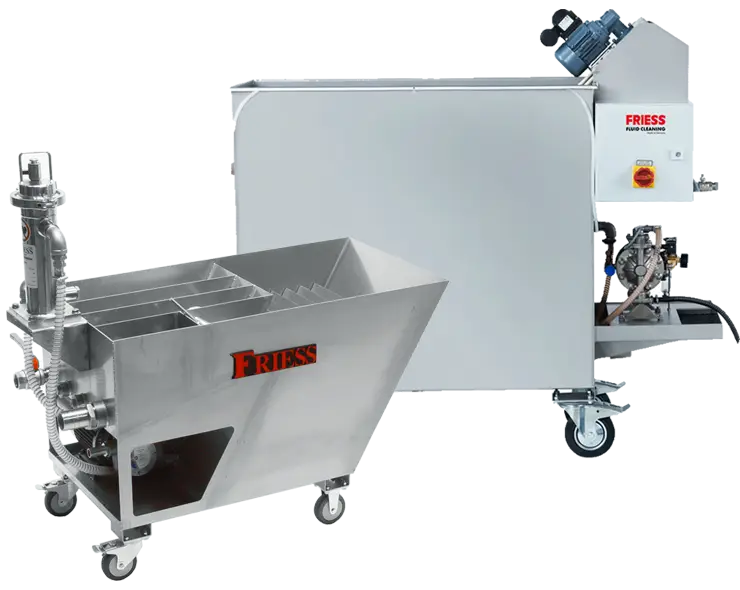
Separate oil droplets.
Extend process-fluid life.
Removes floating oil, free oil and coalescible dispersed oil from cutting fluids, washing liquids and degreasing baths. Systems are matched to tank size and flow rate, returning cleaned fluid to the process.
Continuous separation. Clean fluid returned.
Coalescence separates free oil and dispersed droplets
Continuous bypass operation returns cleaned fluid
Configurations matched to tank size and flow rate
Read More
How the FRIESS Skimmtelligent Works
The Skimmtelligent calms the bypass flow, allowing heavier particles to settle at the bottom while oil droplets rise to the surface. To improve oil–liquid separation, coalescing media combines fine oil droplets into larger droplets, increasing their buoyancy. The rising oil is retained by a baffle, while the cleaned liquid flows beneath the baffle and returns to the process tank.
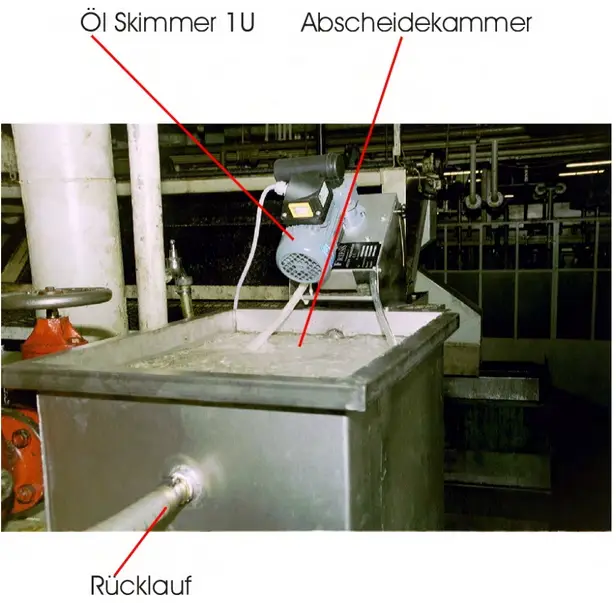
Conventional separators often remove oil by overflow, for example across a separation weir. This method can be less reliable and more prone to operating errors. The FRIESS Skimmtelligent therefore also incorporates a FRIESS 1U tube skimmer, which continuously and reliably discharges the separated oil.
- Advantages at a Glance:
- Operates independently of the production process and removes even very small quantities of tramp oil
- Continuously removes oil, significantly extending the service life of emulsions and wash water
- Substantially reduces purchasing and disposal costs for coolant concentrate and cleaning agents
- Robust stainless-steel construction for reliable use in most industrial applications
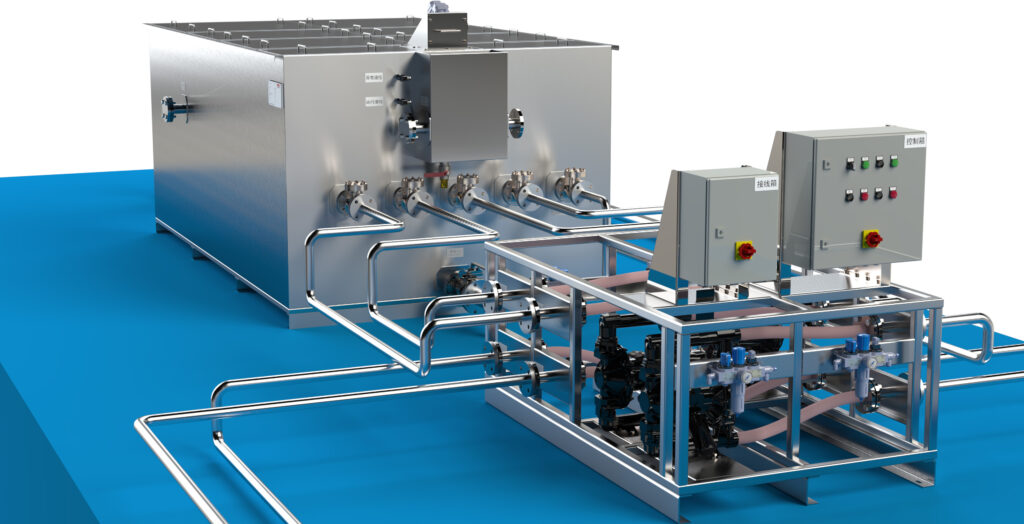
This compact bypass separator captures fine oil droplets that do not readily rise to the surface. It suits space-limited individual tanks, helping stabilize fluid quality and reduce changeovers.
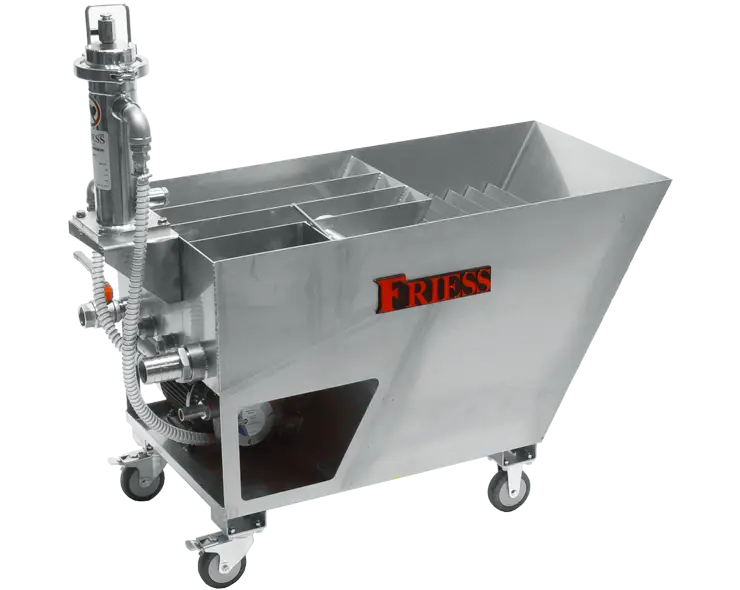
Combining proven FRIESS 1U skimming technology with continuous separated-oil discharge, the SKT serves industrial tanks and circulation systems while helping extend wash-liquid and coolant life.

Coalescence separation efficiently removes free oil and fine droplets from wash and degreasing liquids. Continuous bypass operation improves fluid cleanliness and process stability.
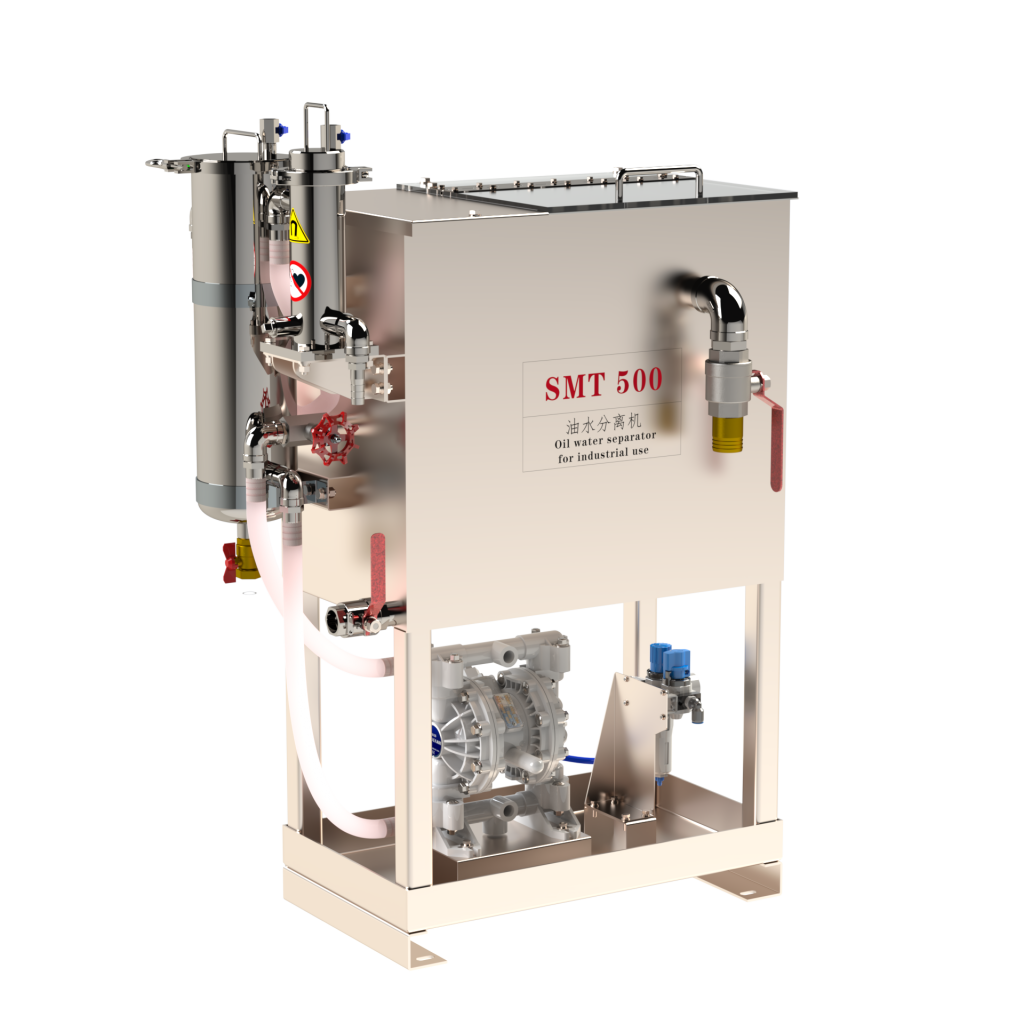
Designed for individual tanks and small-to-medium flow rates, the SMT-FB coalesces oil while its V-shaped base simplifies settled-solids discharge, supporting cleaner circulation fluids and easier maintenance.
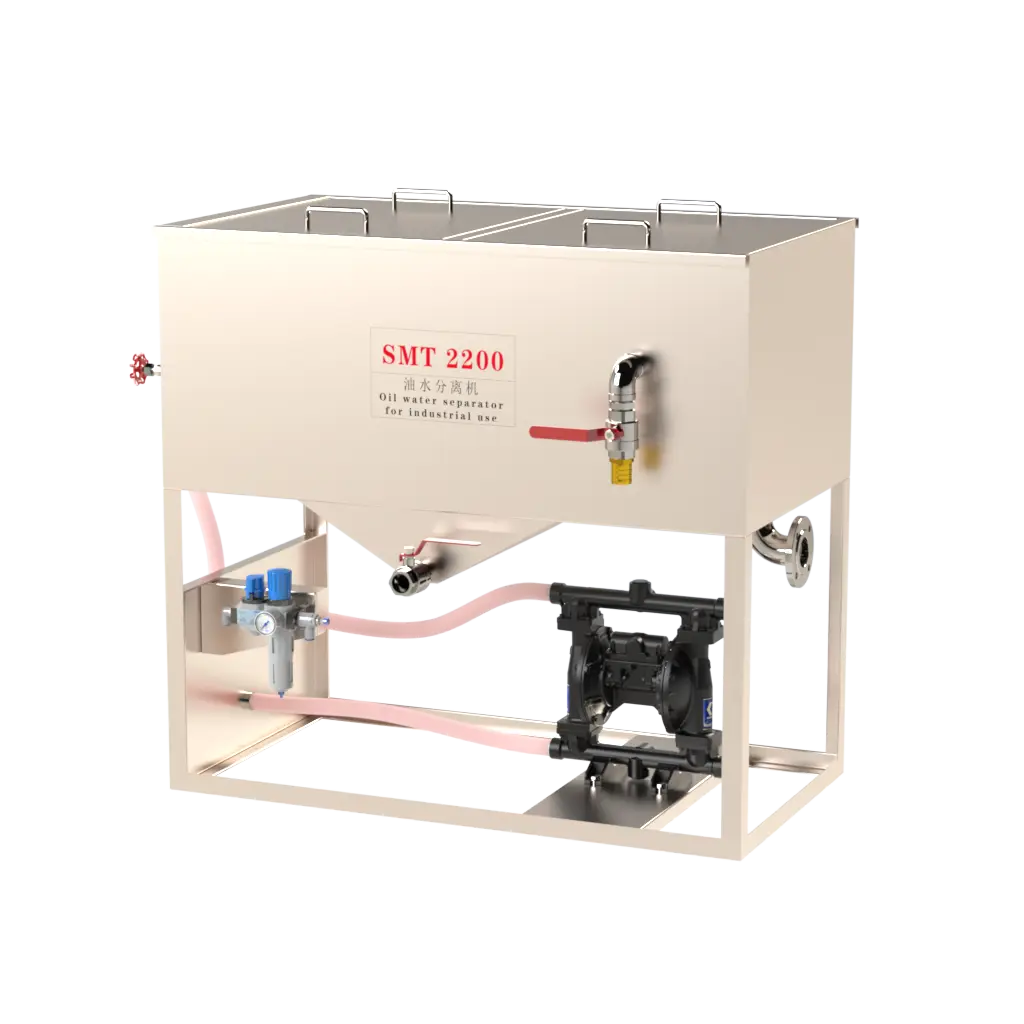
For large central or multi-compartment tanks and industrial circulation systems, the SMT-FL connects multiple floating suction devices to continuously recover oil-bearing surface liquid at higher flow rates.
Application Examples



How an Oil Separator Works
An oil separator works by using the density difference between a light liquid, such as mineral oil or gasoline, and another medium, such as wash water.
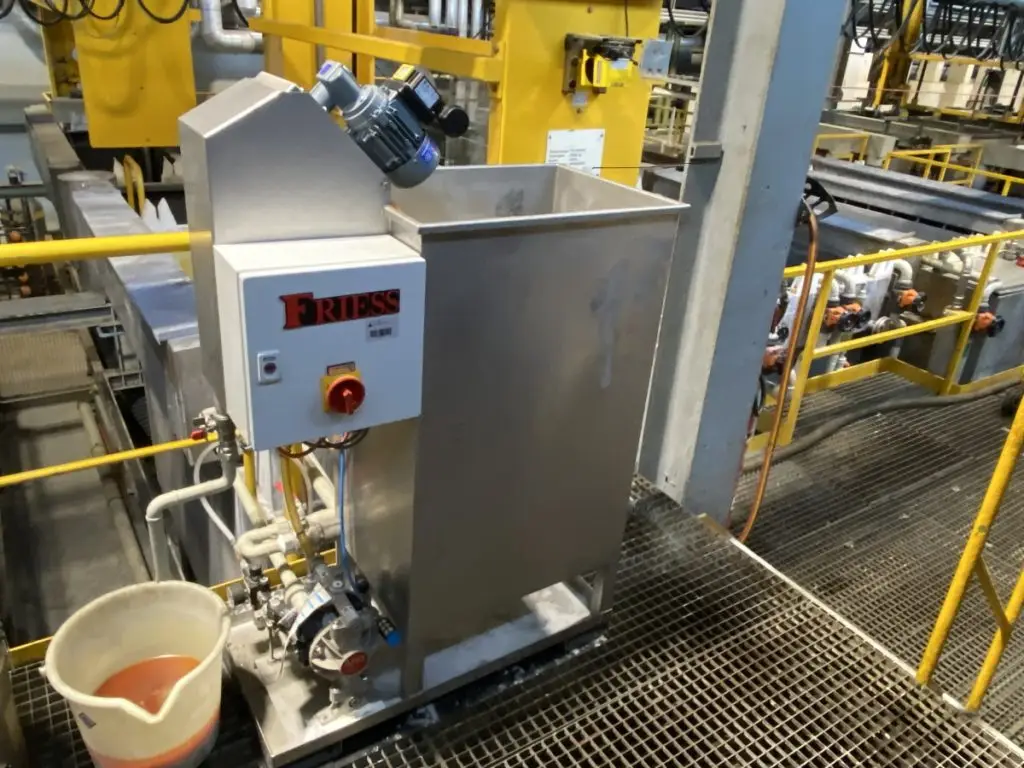
A positive-displacement pump transfers the oil-contaminated liquid from the on-site tank into the Skimmtelligent oil separator. Buoyancy causes the tramp oil to collect at the surface, where it can be separated from the process fluid.
Advantages of the Mobile Skimmtelligent Oil Separator
The FRIESS Skimmtelligent oil separator calms the water in a bypass stream. Fine oil droplets that may be partially emulsified can then stabilize, rise to the surface and be removed.
A coalescing separator further improves oil-water separation. Coalescence reunites dispersed droplets, allowing very small oil particles to combine and rise more readily.
At the surface, the separated light liquid is collected and removed by an integrated tube skimmer. This prevents excessive oil from accumulating in the separator and being carried back into the process stream.
Heavier solids settle in the inlet section. If metallic contaminants are present, an optional FRIESS magnetic filter can be integrated.
The FRIESS Skimmtelligent oil separator is mobile and can serve several machines in sequence, keeping multiple systems free of tramp oil.
Industrial Oil Separators vs Light-Liquid Separators
Light-liquid separators are manufactured in accordance with standards such as DIN 1999-100/-101 and DIN EN 858-1/-2. They are used primarily to treat oily wastewater and surface drainage.
FRIESS industrial oil separators cover a wider range of applications. In addition to separating oil from water, they are suitable for operating conditions in which oil droplets do not separate naturally from the aqueous phase. Conventional light-liquid separators mainly calm the flow so that oil and water can separate by gravity; industrial oil separators generally also use coalescing elements that combine fine droplets into larger ones, accelerating separation and improving efficiency.
FRIESS industrial oil separators can also handle corrosive media with either low or high pH values.
- Key features of oil separators for industrial applications:
- A coalescing module is recommended for many applications.
- Corrosion-resistant, durable materials withstand aggressive media over the long term.
- An optional sludge collector captures heavier contaminants.
- Automation options can also reduce manual workload.
Applications for Mobile FRIESS Oil Separators
Cutting Fluid and Coolant Maintenance
During metal machining, tramp oil enters cutting fluids and coolants. If it floats on the coolant tank surface, it can be removed with an oil skimmer.
Modern cutting-fluid and coolant systems often use compact tanks to save space. High pump capacity relative to tank volume keeps the fluid turbulent, preventing tramp oil from forming a stable surface layer that a skimmer can remove.
The liquid must first be calmed so the tramp oil can rise. A bypass oil separator stabilizes the cutting fluid or coolant, removes oil at the surface and allows entrained sludge to settle in the collection zone. The cleaned fluid then returns to the tank for continued use.
For more information, see our cutting-fluid purification systems.
Reconditioning Wash Liquids
Washing processes are widely used in manufacturing to remove oil and particles from components. In many installations, the oil is discharged only when the entire wash bath is replaced, so the wash liquid is rarely reconditioned continuously.
To maintain cleaning performance, the wash liquid should be treated continuously. An oil separator continuously removes incoming tramp oil, significantly extending wash-liquid service life and reducing both operating and waste-disposal costs.
Wash tanks are generally highly turbulent. Tramp oil cannot collect at the surface and sludge cannot settle at the bottom, so some contamination remains suspended in the liquid and may go unnoticed.
To remove these hidden contaminants, the liquid must first be calmed in a bypass stream so that oil droplets can rise and sludge can settle in the collection area. Oil and solids can then be separated from the wash liquid, extending its service life.
Mobile Oil Separators and Their Advantages
If several small tanks accumulate tramp oil, installing a separate separator or skimmer on every tank is usually uneconomical. It increases investment cost and is often neither technically necessary nor practical.
Our mobile oil separators are designed to move from one system to another and can be commissioned in just a few steps. A self-priming pump makes connection and start-up at each new tank particularly simple.
All FRIESS oil separators are mobile as standard. Fixed installations are also available on request.
Lower Disposal and Operating Costs
Mobile oil separators and fixed oil-separation systems can significantly extend the service life of process fluids. Continuous treatment keeps the medium at the required performance level for longer without adversely affecting the production process.
Longer fluid life reduces the frequency of fluid replacement and disposal. It also decreases purchases of fresh media such as cutting fluids, coolants and degreasers, lowering both waste-disposal and operating costs.
Actual savings depend on the on-site fluid conditions and the amount of tramp oil entering the system.
Oil Separators vs Oil Skimmers
Oil skimmers and oil separators serve different applications and cannot be compared directly. Both remove oil from another liquid, but they operate in fundamentally different ways.
An oil skimmer is used when oil already floats on the liquid surface and can be removed directly.
An oil separator is used when the oil has not yet reached the surface. The separator calms the water and usually adds a coalescing stage, causing free oil droplets to rise and be retained by a baffle.
Learn more about how our oil skimmers work and where they are used.
Oil Separator Manufacturer — FRIESS GmbH
For more than 50 years, FRIESS GmbH has manufactured equipment for pretreating wastewater and process fluids. Its portfolio includes oil separators, oil skimmers, magnetic filters, electrostatic oil cleaners and other proven technologies.
FRIESS GmbH equipment is made in Germany and operates at the sites of many satisfied customers. Purchasing directly from the manufacturer offers numerous advantages.
Buying an Oil Separator — How It Works
What to Consider Before Purchase
Before purchasing an oil separator, the on-site operating conditions should be assessed so that the right unit can be selected for the application.
Key parameters include the medium, temperature, liquid volume and the amount of tramp oil entering the system.
In many cases, one of the following two mobile oil separators is suitable:
Expert Advice Before Purchase
Do you need an oil separator? We will be pleased to help with a no-obligation consultation. Explore our website or contact us by phone or email. We will answer your questions and work with you to find the most suitable solution.
Service
Do you need spare parts or have questions about your Skimmtelligent? Responsive service and customer satisfaction are central to our support.
FAQ — Frequently Asked Questions
Why should an oil separator be used?
If the oil content of a process fluid continues to increase unchecked, its performance deteriorates. Removing tramp oil keeps the fluid effective for longer and maintains the intended process result.
This saves costs and resources while helping to protect workpiece quality.
How much does an oil separator cost?
The price of an oil separator varies considerably with unit size, treatment capacity, functional configuration, and the required control and safety equipment.
Small units generally start at a few thousand euros. Special applications are quoted individually based on the medium, required capacity, and control and safety requirements; prices for the Chinese market are subject to a formal quotation.
When is an oil separator required?
Oil-separation equipment is required wherever oils, greases or other substances hazardous to water may be released. The separator captures these substances before they can enter the environment.
Light-liquid separators are commonly used at filling stations, vehicle workshops and car washes, where rainwater may contain oil or fuel. The contaminants must be retained before the water enters the sewer system.
Applicable standards include DIN 1999-100, DIN EN 858-1 and DIN EN 858-2.
How is an oil separator maintained?
Maintenance and inspection requirements depend on the design and function of the unit.
Trained personnel may perform weekly, monthly or six-monthly maintenance; larger inspections should be carried out by a specialist company.
FRIESS mobile oil separators require little maintenance and are easy to operate.
We will also be pleased to provide individual advice and answer your questions.
Beyond cost savings, FRIESS oil skimmers, electrostatic oil cleaners, magnetic filters, cutting-fluid purification systems, oil separators and vacuum oil purifiers offer many additional benefits.
We will be pleased to explain how they can benefit your process.