
Industrial Oil Skimmers
for Coolant and Process Water
Continuously removes floating oil, tramp oil and grease from machine-tool tanks, washing tanks and industrial basins, helping keep process fluids clean and reduce manual cleanup.
Continuous skimming. Less manual cleanup.
Tube and belt designs for different tank sizes
Designed for continuous industrial operation
German-made equipment with robust construction
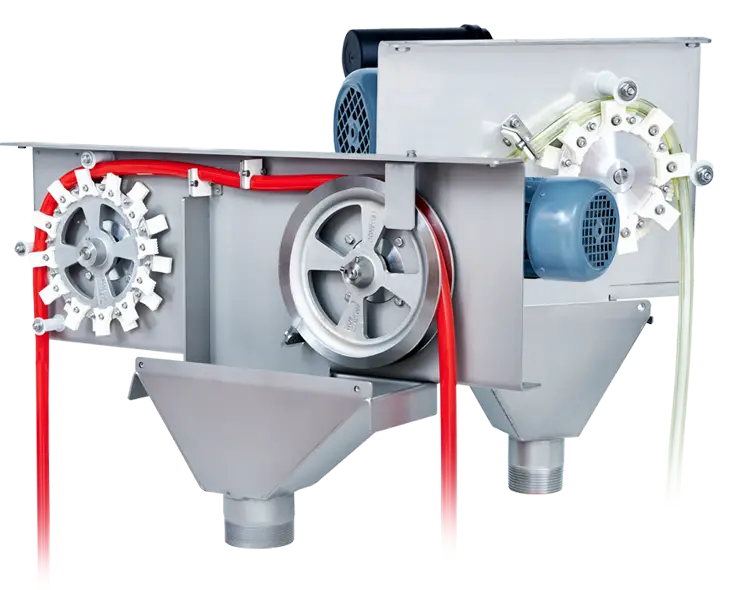
Video Demonstration: FRIESS Tube Skimmer Continuously Collecting Floating Oil
The video shows a FRIESS tube skimmer operating in an industrial tank. Its freely floating oleophilic tube continuously attracts floating oil and grease and transports them to the unit for separation.
FRIESS oil skimmers continuously and reliably remove floating oil and grease. They can be used with cutting fluids, cooling water, degreasing fluids, washing liquids and industrial wastewater.
Operating Principle
The core component is a freely floating oleophilic collection tube. It circulates across the liquid surface, continuously attracts floating oil and grease and carries them into the unit. A scraper then removes the oil from the tube and directs it into a waste-oil container. This continuous process can clean a large surface area.
Main Advantages
- Extends the service life of cutting fluids, washing liquids and other process fluids
- Stainless-steel construction and wear-resistant ceramic components for durability and low maintenance
- Preassembled system for fast installation and commissioning
- Automatically adapts to liquid-level fluctuations
- Freely floating collection tube covers a large liquid-surface area
Selection limits: skimmers remove free oil floating at the surface, not stable emulsions. Recovery rate and coverage depend on viscosity, oil-layer thickness, surface flow and installation. Inspect and clean the unit regularly.
Choose the Right Collection Design
Start with the accessible liquid surface and the space available for installation.
Tube oil skimmers
For small tanks through to large basins. Collection-tube routing is matched to the liquid surface and operating level range.
1U · 1S · W20 · W20-V · W40 · S100
Belt oil skimmers
For small machine sumps, narrow openings and limited mounting space with modest floating-oil loads.
BS · WBS
For large industrial basins with changing liquid levels and installations that require greater mounting height.
Type: Tube oil skimmer
Max. oil recovery rate: 500 L/h
- Mounting above liquid: up to 20 m
- Liquid-level variation: up to 2 m (standard)
- Custom solutions are available for basins with greater liquid-level variation.
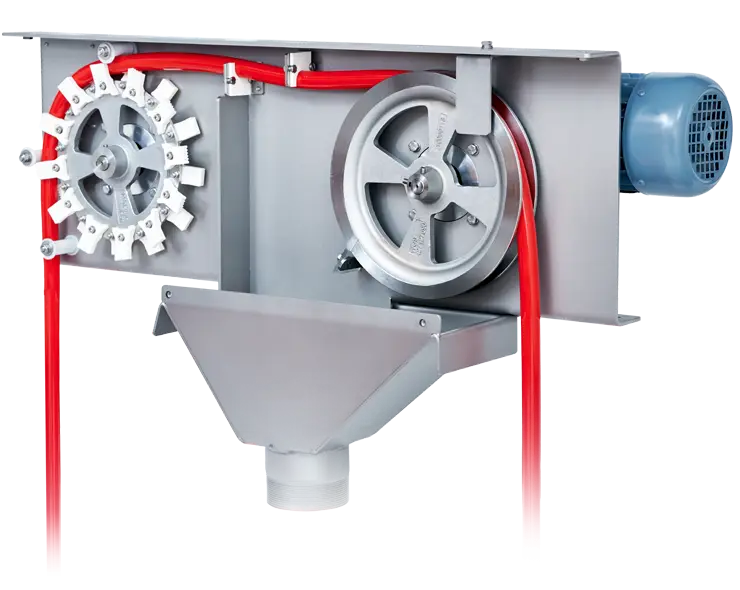
For larger open tanks and cooling-water basins where the skimmer can be mounted near the liquid surface.
Type: Tube oil skimmer
Max. oil recovery rate: 230 L/h
- Tank width from 800 mm
- Mounting above liquid: up to 600 mm
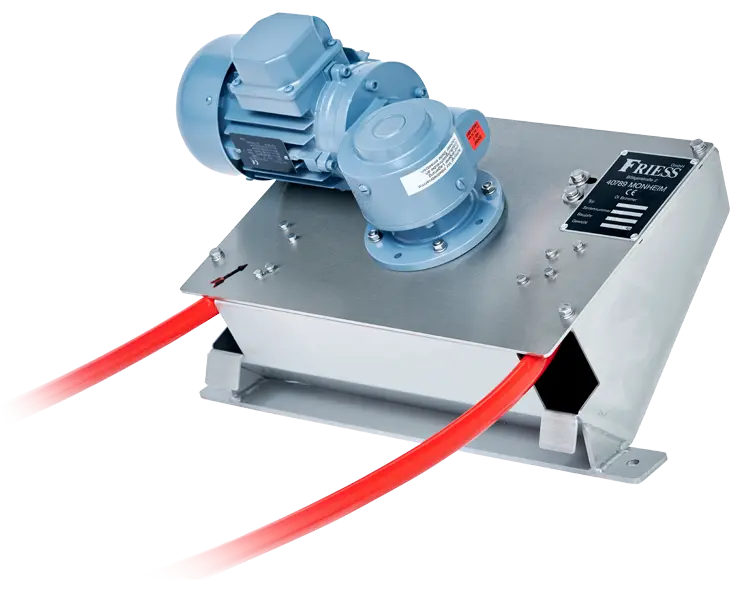
For enclosed or underground tanks where the collection tube must enter through a suitable small access opening.
Type: Tube oil skimmer
Max. oil recovery rate: 230 L/h
- Restricted tank access
- Site-specific tube routing

For small coolant or degreasing tanks where the skimmer can be mounted close to the liquid surface.
Type: Tube oil skimmer
Max. oil recovery rate: 30 L/h
- Mounting above liquid: up to 600 mm
- Min. surface: 400 × 400 mm

For small tanks and pump pits that require the skimmer to be mounted well above the liquid surface.
Type: Tube oil skimmer
Max. oil recovery rate: 30 L/h
- Mounting above liquid: up to 10 m
- Guided collection tube
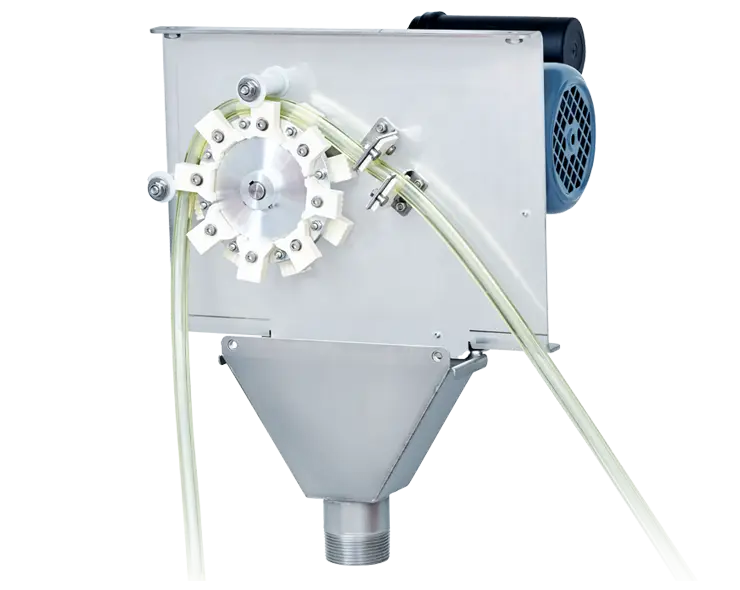
For long, narrow process tanks where floating oil needs to be collected along the tank length.
Type: Tube oil skimmer
Max. oil recovery rate: 230 L/h
- Tank width: 500–1,000 mm
- Mounting above liquid: up to 600 mm

For small machine-tool sumps and narrow process tanks with space for a compact, vertical-belt oil skimmer.
Type: Belt oil skimmer
Max. oil recovery rate: 15 L/h
- 160 mm unit width
- Min. surface: 100 × 100 mm

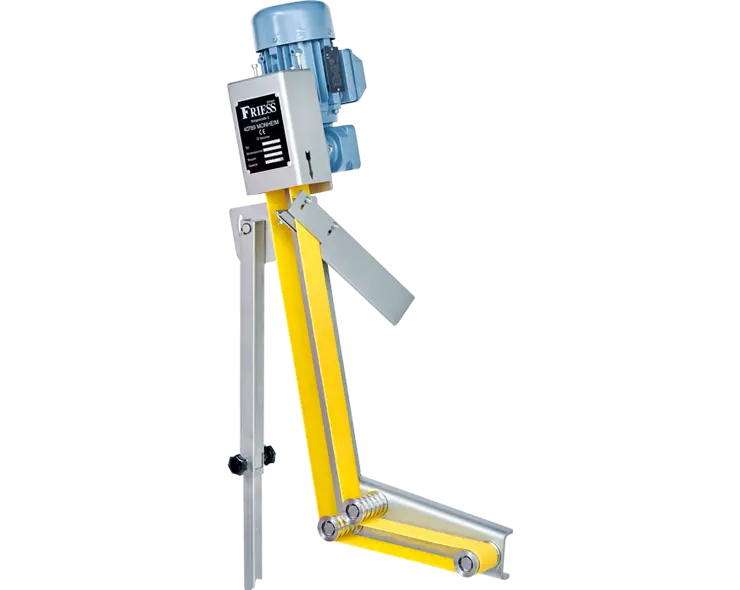
For small tanks where mounting width is restricted and an inclined belt offers a compact installation.
Type: Inclined belt oil skimmer
Max. oil recovery rate: 15 L/h
- 80 mm installation width
- Min. surface: 100 × 200 mm
Get a Recommendation for Your Tank
Share your tank dimensions, liquid-level range and mounting space. Our engineers can advise on the model and collection-tube layout.
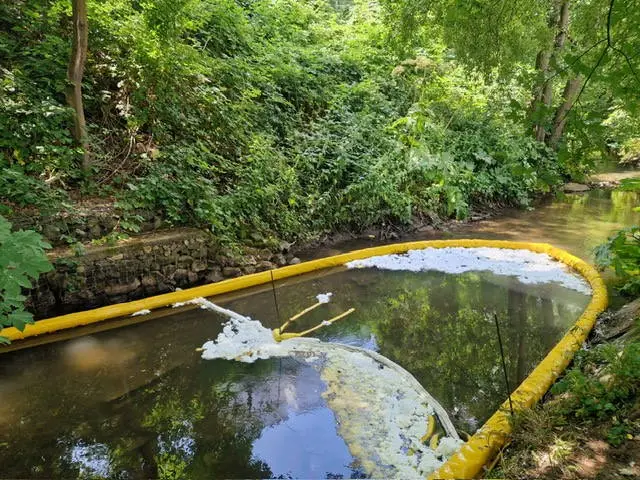
Oil Skimmer Application Examples


Article Navigation
Tube Oil Skimmers
How Does a Tube Oil Skimmer Work?
The oleophilic collection tube attracts oil from the liquid surface. When the tube enters the unit, the adhered oil is removed by the scraper and discharged. Because the tube is hollow, it floats and continuously works at the interface between the process liquid and the floating oil.
The tube forms a closed loop and circulates continuously across the surface, collecting floating oil over a wide area. Its length can be configured for the tank dimensions, so it can serve small tanks, large cooling-water basins, industrial pits and even outdoor basins.
Applications and Industries
Oil skimmers recover free oil and grease that have collected at the liquid surface. Tube designs serve many industrial tanks, but high-viscosity or solids-laden floating oil requires model selection against temperature, oil-layer thickness, solids loading and installation conditions. Confirm the recovery capacity for the actual process. Typical applications include:
- Steel production
- Metalworking and cutting-fluid maintenance
- Parts washing and industrial cleaning systems
- Wastewater treatment and pretreatment
- Food production
- Aluminium processing and production
- Industrial cooling water
- Other applications with floating surface oil
Product Functions
Advantages:
- High capacity
- Continuously collects accessible floating oil over a large surface; confirm coverage against tank shape, obstructions and surface flow
- Durable scraper components
- Very low maintenance requirements
Considerations:
- Higher purchase price than simpler oil-skimmer designs
Before Selecting a Tube Oil Skimmer
Oil Layer and Liquid Surface
- Confirm that free oil has formed a surface layer and can reach the collection tube.
- Record oil viscosity, layer thickness and surface flow to assess the required recovery capacity.
- Stable emulsified oil requires a separate treatment assessment and should not be sized as an ordinary surface-skimming application.
Installation and Maintenance
- Measure tank dimensions, the installation opening and mounting height at the lowest and highest liquid levels.
- Check collection-tube routing, tank obstructions, oil discharge and maintenance access.
- Plan inspection and cleaning of collection, scraper and drive components according to sludge and particle loading.
Oil Removal with Belt Oil Skimmers
A belt oil skimmer consists of a motor, drive roller, support and continuous flat skimming belt. The drive roller circulates the belt while a guide roller keeps it immersed in the floating oil layer. Oil adheres to the belt, is carried upward and is finally removed and discharged by scraper blades.
Applications and Industries
Belt oil skimmers are mainly used for cutting-fluid maintenance in metalworking, particularly in small coolant sumps on CNC lathes and other machine tools. Tramp-oil loads in these tanks are often modest, so the lower recovery capacity of a belt skimmer may be sufficient.
Belt skimmers are also used in some small oil-water separation units. Selection must match the separation-tank dimensions: their limited surface coverage makes them more suitable for small areas.
Product Functions
Advantages
- Compact construction with a small footprint
- Lower initial purchase cost
- Accommodates a range of liquid-level changes; larger models can accommodate greater variation
- Generally simple construction
Considerations
- Lower oil-recovery capacity
- Does not create a pronounced surface flow toward the collector
- Directly treats only the small surface area near the belt
- Particles may wear or damage scraper blades
- Sludge can block the oil outlet on some designs
Oil Skimmers and Oil-Water Separators
What Is the Difference Between an Oil-Water Separator and an Oil Skimmer?
Oil-water separators and oil skimmers both use the density difference between oil and water, but they serve different operating conditions. Oil skimmers remove oil that has already floated to the surface and are ideal for accessible tanks, pits and basins with a visible oil layer. Oil-water separators hold the contaminated liquid in a separation tank and use baffles or coalescing media, making them better suited to dispersed oil, fine droplets and more thoroughly mixed process liquids.
In simple terms: if the oil is already floating at the surface, choose an oil skimmer first. If droplets remain mixed into the liquid and do not rise naturally, an oil-water separator is generally more suitable.
In some applications the two technologies can be combined. The separator gives the oily liquid time to separate, while the skimmer continuously removes the oil collected at the surface. Skimmtelligent or SMT separators are preferred for fine droplets, turbulent liquids or unstable floating oil; skimmers are preferred where a clear surface oil layer forms.
Match the Installation to Your Tank
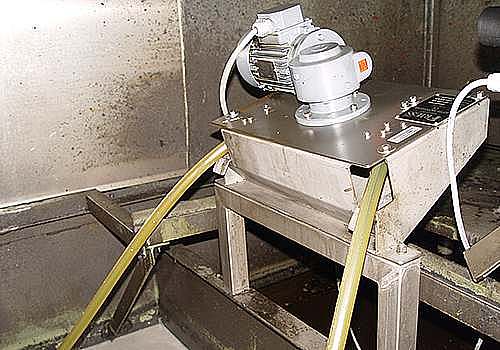
W40: mounting close to the liquid
A near-surface installation for a larger open tank. Check the mounting position, collection-tube route and space for the recovered-oil container.
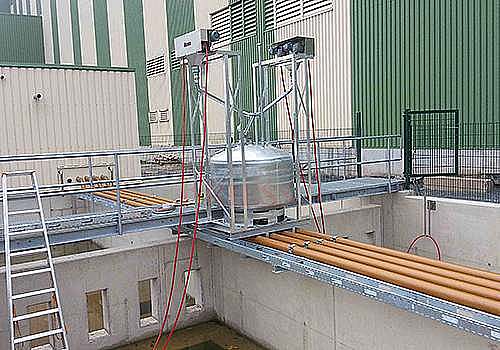
S100: elevated mounting
An elevated frame keeps the skimmer above the basin while the collection tube reaches the liquid. Check the full operating level range and access for maintenance.
These examples illustrate the arrangement; confirm the configuration for your site. For dispersed oil droplets, assess coalescing oil-water separation. Stable emulsions require a separate process assessment.
FRIESS GmbH — An Oil-Skimmer Manufacturer with More Than 50 Years of Experience
Since 1972, FRIESS has developed and manufactured oil skimmers in Germany for a wide range of industries and applications. We support customers from application analysis and selection through manufacturing, sales and, where required, on-site installation.
In addition to oil skimmers, FRIESS supplies oil-water separation, machine-tool coolant maintenance and industrial oil-cleaning solutions that help companies meet environmental objectives while reducing operating costs.
Selection and Quotation
Send your operating details through the consultation section below. Our engineers will help confirm the model and configuration and provide a quotation. An application questionnaire is available as a PDF on request.
Delivery is confirmed in the quotation and order. Before installation, check supports, power, the oil-discharge route and service access; site installation can be arranged separately.
Frequently Asked Questions: Selection, Operation and Maintenance
01
What Advantages Do Tube Skimmers Offer over Belt Skimmers?
A floating collection tube can cover a larger liquid surface and suit tanks with changing levels. Belt skimmers suit small sumps and narrow openings. Choose according to surface area, liquid-level variation and available mounting space.
02
Which Regulations Matter When Treating Wastewater?
Companies generating industrial wastewater must implement appropriate safety measures and establish collection, treatment or reuse systems in accordance with local requirements. Contaminants vary by industry. For oil and grease floating on water, FRIESS supplies German-made oil skimmers and oil-water separators that reliably remove surface oil, reduce the downstream treatment load and lower chemical demand.
Discharge limits are generally defined by the local authority or wastewater utility and may vary by location. Whatever standard applies, removing floating oil in advance helps stabilize compliance at a lower treatment load.
03
Why Is Using an Oil Skimmer Sustainable and Environmentally Friendly?
Oil skimmers can extend the service life of process fluids. Continuous removal of tramp oil helps cutting fluids and washing water remain within their required operating parameters for longer, reducing replacement frequency and extending bath life.
Fewer fluid changes reduce raw-material consumption and waste-fluid disposal. More complete use of each fluid charge improves resource efficiency and reduces the quantity of chemicals and oils purchased and discarded.
04
What Makes FRIESS Oil Skimmers Economical?
FRIESS oil skimmers are robust and require little maintenance, reducing labour input and life-cycle maintenance costs.
Continuous tramp-oil removal improves process-fluid cleanliness, stabilizes production and reduces quality problems and scrap caused by contamination.
Keeping process fluids in good condition extends service life and reduces fresh-fluid purchasing and waste disposal, lowering total operating costs across purchasing, maintenance, downtime and disposal.
05
How Is the Removed Oil or Grease Handled?
Waste oil and grease collected by the skimmer are normally handled by an authorized recycling or disposal company. If the water content is low and the recovered material has sufficient value, the recycler may pay for it.
Heavily contaminated oil or grease usually incurs a disposal charge. Regeneration and reuse may be technically possible but should be evaluated against oil value, contamination level and treatment cost.
06
What Materials Are FRIESS Oil Skimmers Made from, and Where Can They Be Used?
Stainless steel and ceramic components can provide corrosion and wear resistance in suitable operating conditions. For acidic, alkaline or other corrosive fluids, assess the full chemical composition, concentration, temperature and impurities such as chlorides, together with the material compatibility of all wetted parts.
V4A stainless steel or plastic options must be confirmed for the selected model and fluid conditions. A pH value alone does not establish compatibility or a universal operating range.
Get a Recommendation for Your Tank
Share what you know; estimates are fine. These details help our engineers assess your application:
- Tank dimensions, access opening and liquid-level range
- Liquid and oil types, with estimated oil accumulation per day, if known
- Available mounting height and space; a photo or sketch is useful
Our engineers can recommend a model and advise on the mounting position and collection-tube layout.