
CNC Coolant Tramp-Oil Removal and Oil Skimmer Selection Guide
CNC coolant tramp-oil removal is essential for maintaining coolant performance and extending fluid service life. Removing floating slideway oil, hydraulic oil and other tramp oils reduces contamination, avoids premature fluid replacement and helps maintain stable machining performance.
This requirement is not limited to CNC machine tools; it also applies to other metalworking systems that use coolant, emulsions or cutting fluids.
The effectiveness of an oil skimmer depends on the tank dimensions, exposed liquid-surface area, internal layout, available installation space and actual oil load. The correct model must therefore be selected for the conditions at each machine.
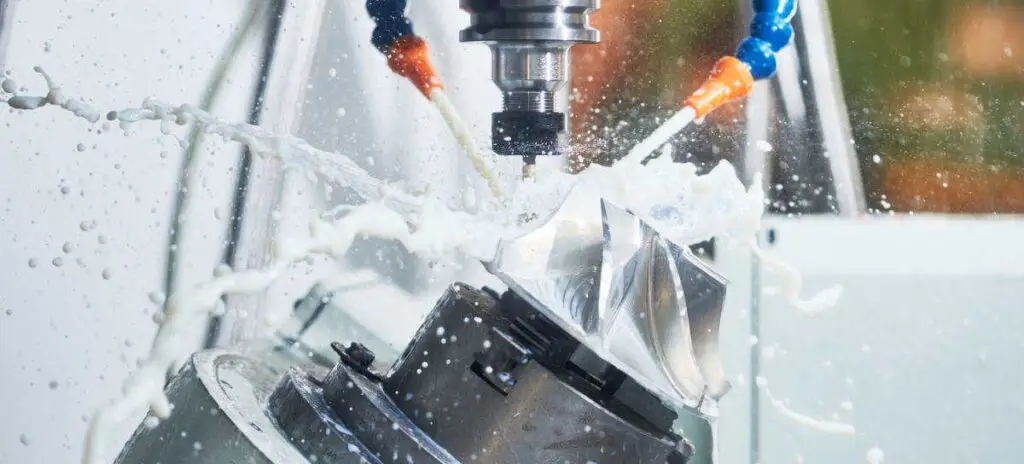
How Should an Oil Skimmer Be Selected for CNC Coolant?
CNC machines and coolant tanks vary widely, so there is no single oil-skimmer model that is ideal for every installation. Selection should begin with an accurate assessment of the tank and the available working space.
Tank dimensions: The exposed surface area and sump dimensions determine the required collection range.
Internal obstructions: Chip conveyors, pumps, level sensors and pipework may restrict installation and oil collection.
Surface coverage: The skimmer should cover as much of the usable liquid surface as possible and avoid dead zones where oil cannot be collected continuously.
When Are Belt Oil Skimmers Suitable for CNC Machines?
Belt oil skimmers are generally suitable for smaller coolant tanks or CNC machines with limited installation space and complicated internal layouts.
Where chip conveyors, pumps, level sensors or pipework obstruct the sump, a compact belt skimmer can operate within a small accessible surface area and continuously remove nearby floating oil.
On larger tanks, however, one belt covers only a limited area. If the oil film cannot move continuously towards the belt, untreated dead zones remain. Larger surfaces may therefore require several belt skimmers or a tube-type skimmer with a wider collection range.
A persistent oil film restricts oxygen exchange, encourages bacterial growth and accelerates coolant deterioration, leading to shorter fluid life and more frequent replacement.
FRIESS Belt Oil Skimmer Options
FRIESS offers durable belt-skimmer options for compact tanks and installations where obstacles prevent a collection tube from sweeping the full liquid surface.
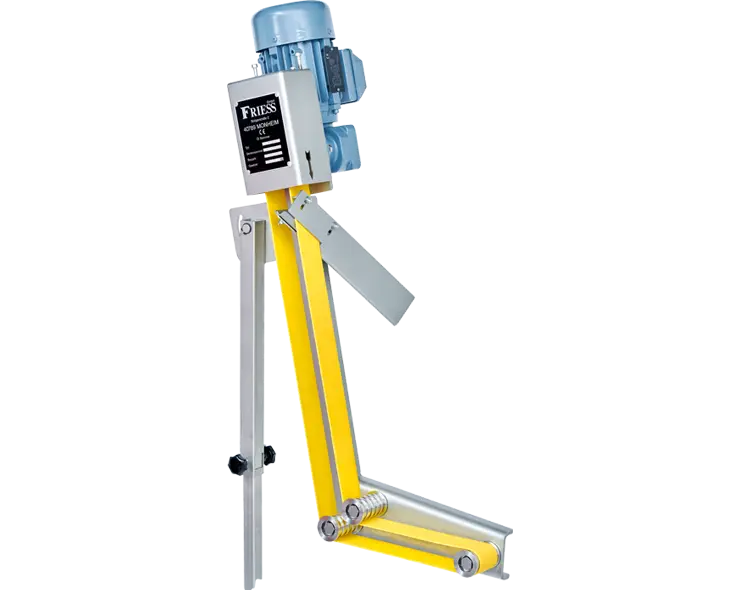
WBS Belt Oil Skimmer
Best suited to coolant tanks with restricted installation space or complicated internal layouts.
Its inclined-belt design works in limited access and contact areas where conventional skimmers are difficult to install, while continuously collecting floating oil near the belt.

BS Belt Oil Skimmer
Best suited to small tanks with a relatively simple layout.
The compact BS removes floating oil near the immersed belt. On larger tanks or surfaces with many obstructions, consider a WBS, several belt skimmers or a tube-type skimmer with wider surface coverage.
Tube Oil Skimmers for Larger CNC Coolant Tanks
Larger CNC coolant tanks require wider surface coverage. Unlike a belt that works at a fixed collection point, an oleophilic collection tube travels continuously across the liquid surface and gathers floating oil over a much larger area.
Once the tank reaches a certain size, or continuous wide-area coverage is required, a tube-type oil skimmer is usually the more suitable solution.
Advantages
The length of the oleophilic collection tube can be matched to the tank. It covers a wider surface, follows changes in liquid level and removes a high proportion of floating oil while carrying away very little coolant.
Installation Considerations
Chip conveyors, pumps, pipework and other internal components may restrict the free movement of the tube. Compact CNC sumps may therefore require a routing arrangement tailored to the available space.
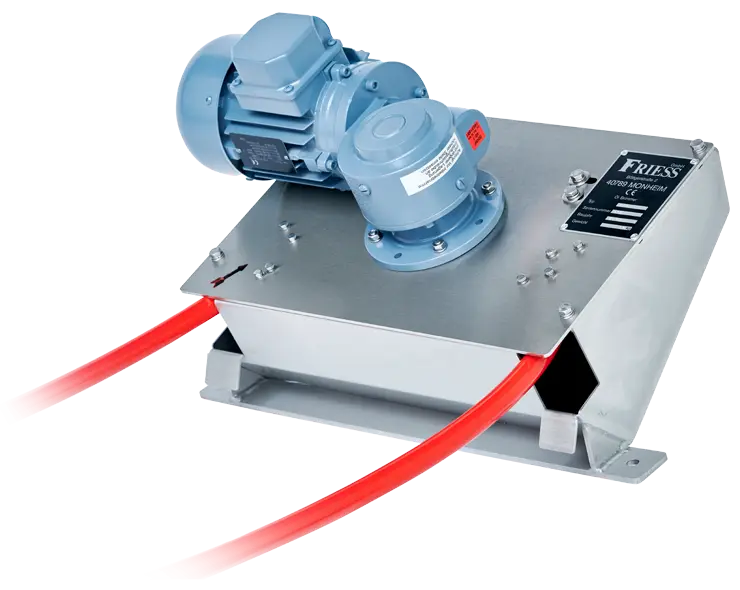
W40 model — for tanks of many sizes with widths of 800 mm or more.

W20 model — for narrow tanks approximately 500–1,000 mm wide.
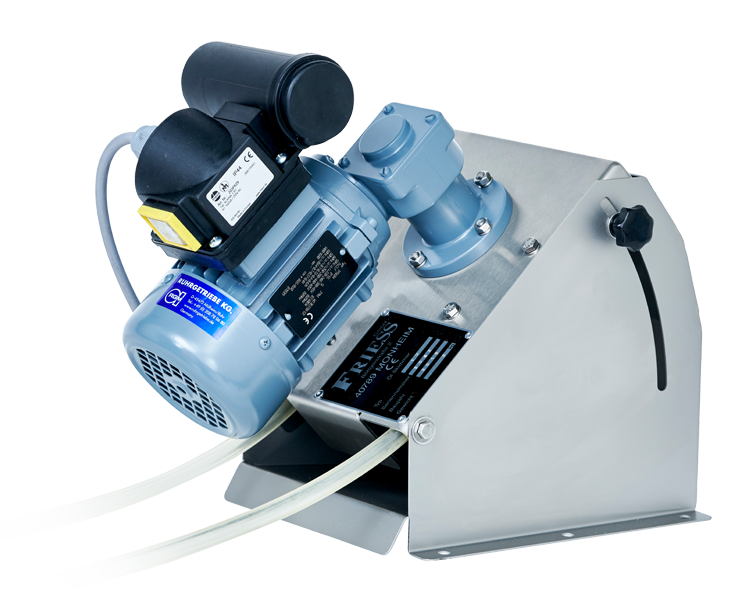
1U model — for small emulsion tanks and the standard choice for many individual machine tools.
Conclusion: Selecting an Oil Skimmer for CNC Machines
No single oil skimmer is suitable for every CNC installation. Belt skimmers are often the best option for small tanks or limited access, while tube-type skimmers usually provide better coverage on larger liquid surfaces.
Effective tramp-oil removal helps extend coolant service life, reduce fluid-change frequency and lower disposal costs. The final model should be selected according to tank dimensions, internal layout, installation space and the actual oil load.
Application Checklist
- What are the dimensions of your coolant tank or sump?
- Are structural obstructions limiting installation or operating space?
- Are there internal components that prevent wide-area collection of the oil film?
FRIESS Oil-Skimmer Case Studies and Coolant Articles
- Coolant Cleaning and Purification
- Bacterial Contamination in Coolant
- Skimmtelligent Oil Separation in a Central Coolant System
- Removing Tramp Oil from Coolant with a 1U Oil Skimmer