
80% less waste.
Payback in under four months.
Bayerische Milchindustrie eG used an S100 to remove floating fat from wastewater, reducing the water content of the recovered fat from about 80% to below 20%. Further system optimisation reduced waste volume by 80% and allowed the recovered fat to be sold for biogas production. The skimmer and its installation paid back in less than four months.
Case background
The dairy processor produces milk powder using a vacuum evaporator. Approximately 15% of the milk becomes powder and about 85% is water. Water is evaporated under vacuum to separate it from the solid components.
The challenge with the existing separation system
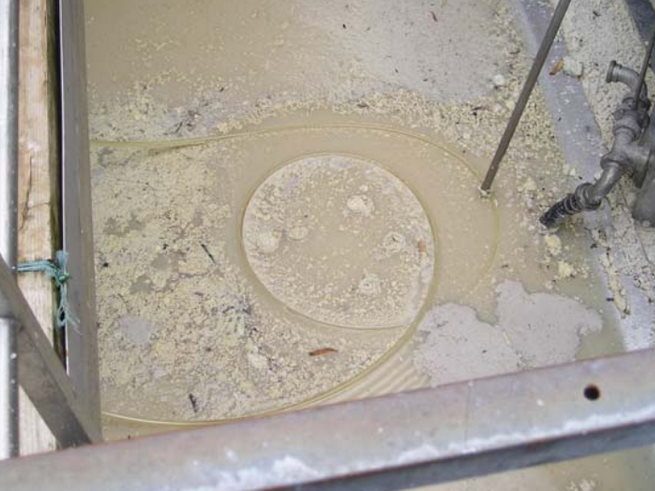
After condensation, the water is discharged as warm wastewater at about 30°C and contains a small amount of fat. Before entering the municipal sewer, this fat must be separated. At the company’s wastewater treatment plant, a settling tank collects fat at the water surface, where a layer approximately 2–3 cm thick forms each day. A floating open trough was used for separation, but the recovered mixture contained about 80% water and only 20% fat. Because the fat was very sticky and not liquid, the surface also required manual cleaning with a scraper, and the water-fat mixture had to be sent to a waste contractor.
To reduce disposal costs, the customer sought a food wastewater oil skimmer capable of separating the fat with as little water as possible.
The Solution: FRIESS S100 Oil Skimmer
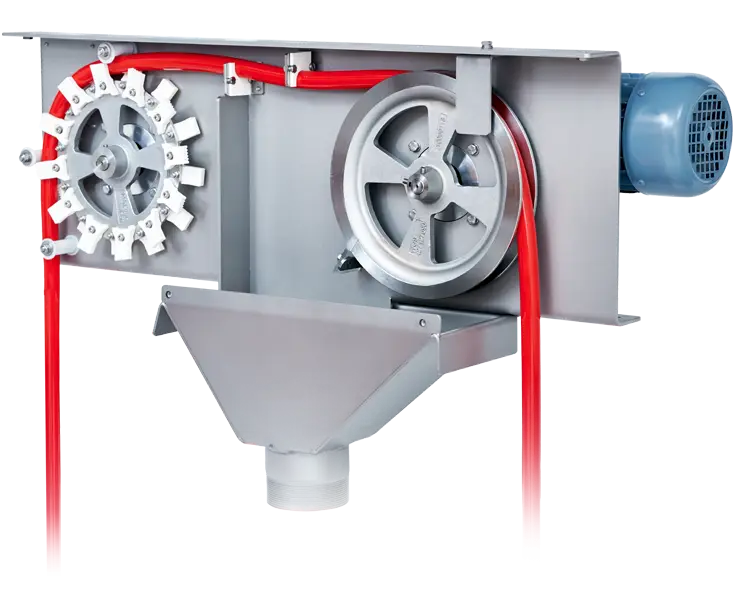
At a maintenance trade fair in Munich, the company’s maintenance manager saw a FRIESS S100 oil skimmer in operation. Its simple design and reliable removal of floating fat immediately impressed the Bayerische Milchindustrie eG team. The manager initially questioned whether the collection tube could remove the fat. During a site visit, the local FRIESS representative demonstrated the technology with a tube sample. Pulling it through the floating fat showed clearly that fat particles and globules adhered to the tube. The test also showed that the collection tube is unsuitable for very thick fat layers of 5 cm or more, because a hard layer forms and particles no longer adhere effectively.
The maintenance team and the FRIESS representative agreed to test an S100 oil skimmer under operating conditions. Before installing the rental unit, the hard fat layer was removed manually. Once the surface was clean, the skimmer was installed and started. The test showed that fat particles adhered to the collection tube and were removed as soon as they appeared at the surface. During operation, the water surface remained almost clean and no new fat layer formed.
Results
The oil skimmer reduced the water content of the recovered fat to below 20%. Even with the rental system, the company achieved a substantially better recovery value and lower waste-disposal costs.


Optimizations for Selling Dewatered Fat to a Bioenergy Company
- The oil skimmer was fitted with an additional heater to prevent fat from accumulating between the drive wheel and deflection wheel.
- The standard collection tray was replaced with an open channel that is easy to clean.
- The fat is collected in a specially designed container with additional chambers on both sides. Screens separate these chambers from the main container, allowing water to drain through and return to the wastewater system.

Benefits of the FRIESS S100 Oil Skimmer
- Waste volume was reduced by 80%.
- The company no longer pays for fat disposal; instead, it sells the recovered fat for biogas production.
- Maintenance and cleaning of the settling tank were greatly reduced.
- Lower disposal costs gave the oil skimmer and its installation a payback period of less than four months.
Recurring oil and fat layers in food wastewater increasing downstream treatment loads?
Please share your wastewater-basin dimensions, flow rate, oil and fat types and temperature, fat-layer thickness, liquid-level fluctuations, current pretreatment method and discharge targets. Our China engineering team can recommend an S100 oil skimmer configuration, collection-tube material, heated oil discharge and automatic control arrangement for your conditions.