
A year of emulsion life.
Payback under six months.
A transmission and engine component manufacturer used Skimmtelligent to clean a 30 m³ quenching-emulsion system. Tramp oil fell to 0.33 mL per 1,000 mL, substantially reducing scrap caused by inadequate quenching.
Case background and requirements
Even 50 litres of tramp oil in the 30 m³ system was enough to impair quenching performance and create soft spots in the workpieces. Strong turbulence in the central filtration system kept the incoming oil dispersed instead of allowing it to rise. The operator therefore needed to reduce the tramp-oil content far enough to eliminate this quality risk.
The solution: FRIESS Skimmtelligent oil separator

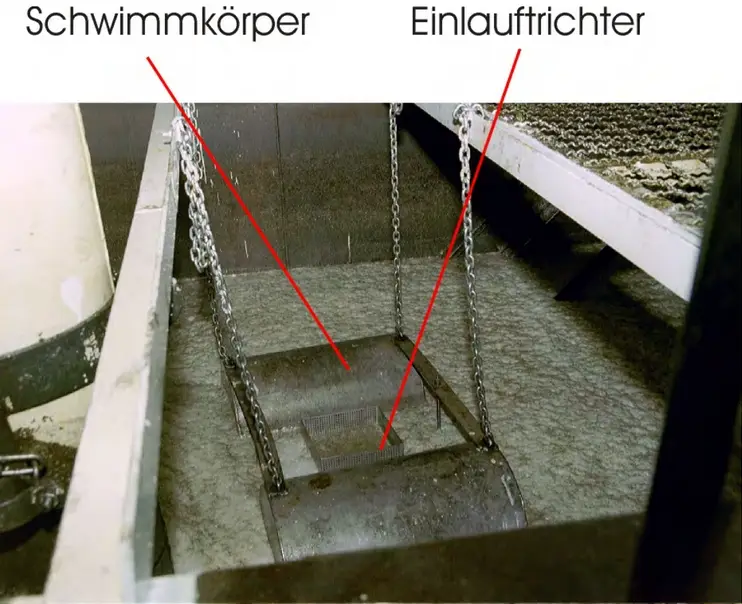
Contaminated emulsion is continuously drawn in through a large suction float. An air-operated diaphragm pump transfers it to the oil separator.
Unlike a centrifugal pump, the diaphragm pump does not break existing oil droplets into smaller ones. The gentle transfer preserves the droplet size, making the oil easier to separate.
Benefits at a glance
- Coalescer removes oil even from emulsified mixtures
- Coolant service life extended to one year
- Payback period under six months
Coalescence: helping fine oil droplets rise
When the volume of an oil droplet is halved, its buoyancy falls by 75%, so very small droplets separate much more slowly. Inside the oil separator, the flow velocity is reduced to give them time to rise.
The coalescer accelerates separation even for the smallest oil droplets. As contaminated emulsion passes through it, fine droplets adhere to its surface. Their small size gives them too little buoyancy to overcome the flow resistance in the emulsion, but the higher viscosity of the oil helps them adhere more readily than the water-based fluid.
The cleaned emulsion flows back to the central circuit by gravity. The retained droplets remain on the coalescer surface and gradually merge into larger drops with much greater buoyancy. These large drops then detach, rise to the surface and form an oil layer that can be removed.
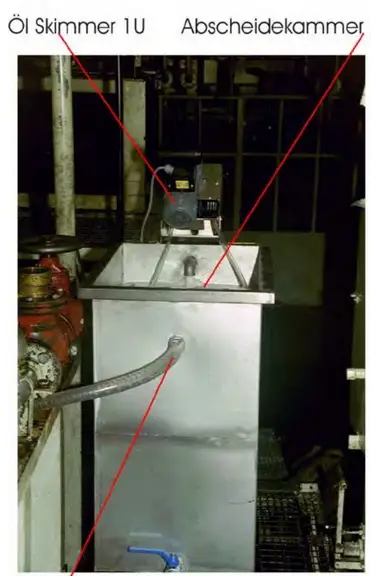
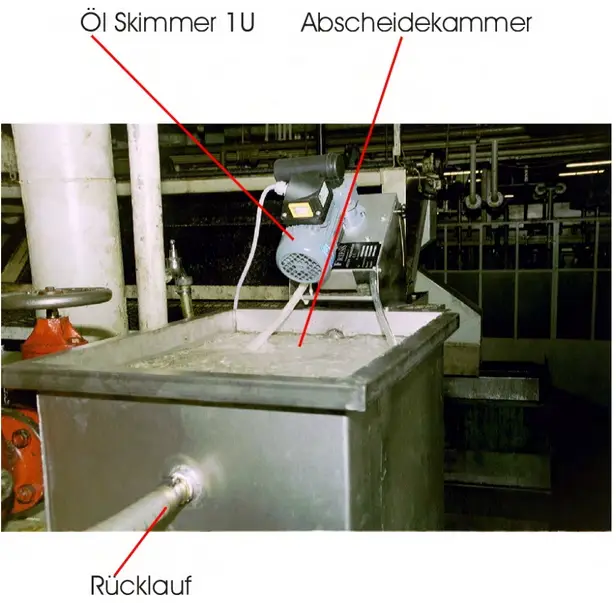
The Skimmtelligent separator therefore uses a FRIESS 1U oil skimmer instead of a fixed overflow edge. Floating oil adheres to the outside of the collection tube, is pulled into the skimmer and scraped off into a waste-oil tank.
The clean tube returns to the surface to collect more oil. Because the skimmer runtime can be matched to the actual oil volume, the separation between oil and emulsion can be controlled very precisely.
Conventional separators often remove the surface oil through an overflow edge. Its height must match the liquid level exactly. If set too low, large quantities of emulsion are lost with the oil, increasing fluid consumption and disposal costs. If set too high, a thick oil layer develops, blocks oxygen transfer and encourages anaerobic bacteria.
Results
After the FRIESS Skimmtelligent oil separator was installed, tramp oil throughout the circuit remained well below 50 litres. Scrap caused by inadequate heat dissipation during quenching fell substantially. The system paid for itself in less than six months, while emulsion service life increased to as much as one year.
Dispersed tramp oil failing to separate in your central coolant system?
Please share your system fluid volume, circulation flow rate, tramp-oil type and content, coolant temperature and viscosity, existing separation method and target residual oil level. Our China engineering team can recommend a Skimmtelligent model, fluid intake arrangement and return-flow layout suited to your conditions.