
Three times the wash-water life.
Oil marks eliminated.
A textile-machine component manufacturer washes small parts after oil-bath quenching, carrying large quantities of quenching oil into the wash water. With Skimmtelligent 20, the wash-water replacement interval increased from one week to three weeks, oil marks on the parts disappeared, and approximately 20 litres of oil are removed each day.
The challenge during continuous production
During the night shift, the plant used a FRIESS Type 3H oil skimmer to remove oil washed off the parts. It had operated reliably for more than 15 years, keeping the wash water in service and the parts clean. After the plant switched to three-shift operation, there was no longer enough time to remove the incoming oil. Because the wash water remained in constant motion, tramp oil could not collect at the surface, so the skimmer could no longer remove it effectively.
- Because the wash water was heavily contaminated with oil, it had to be replaced every week.
- In addition, the parts were not completely clean after washing; visible oil marks remained at the end of the cleaning process.
- Management therefore looked for a new system that could remove the oil continuously during the washing process.
The solution: Skimmtelligent 20
Following the recommendation of the FRIESS GmbH factory representative—and based on the plant’s positive experience with the Type 3H oil skimmer—the management selected a Skimmtelligent 20 oil separator. Contaminated wash water is continuously drawn from the degreasing bath through a floating suction device.
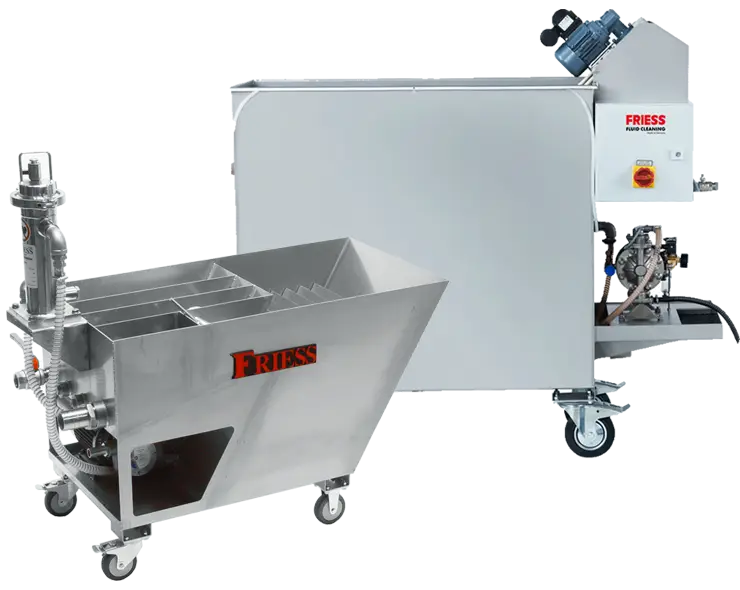
Compressed-Air Diaphragm Pump as Feed Pump
Settling Chamber for Coarse Dirt Particles
Inside the Skimmtelligent oil separator, the wash water first flows into a settling chamber.
Coarse dirt particles with a specific gravity greater than 1 settle at the bottom of the chamber.
The collected sludge can be drained from the vessel through a ball valve as required.
Separation Chamber with Coalescing Insert
The wash water then passes over a baffle into the main separation chamber containing a coalescing insert. As the wash water flows from top to bottom toward the outlet chamber, larger oil droplets remain directly on the surface. Small oil droplets dispersed throughout the wash water pass through the coalescing insert with the water. The droplets strike the coalescing media and adhere to it. As several small droplets combine into a larger droplet, buoyancy increases and the enlarged droplet rises to the surface.
To support separation in the coalescing chamber, exhaust air from the compressed-air diaphragm pump is introduced into the separator from below. A needle valve regulates the air volume, creating additional lift in the wash water so that individual droplets are carried upward by the air bubbles.
Oil-Free Return for Reuse
The de-oiled wash water flows beneath a baffle into the next chamber and then returns by gravity through a large drain hose to the degreasing system, free of oil.
Oil floating in the Skimmtelligent separator is removed automatically at intervals by a FRIESS Type 1U oil skimmer.
Flexible Operation Through Runtime Control
The built-in controller adjusts the oil skimmer’s operating and pause times, allowing the oil layer to be removed regularly while minimising the amount of wash water entering the waste-oil collection tank.
The pump’s operating and pause times can also be set independently. With oils of higher specific gravity in particular, allowing the wash water to rest can further improve separation performance.
Adjustable Pump Delivery Rate
The pump delivery rate is continuously adjustable. At higher flow rates, large quantities of oil can be removed quickly. At lower pump output, the longer residence time of the liquid inside the oil separator optimises separation performance.

Results: three times the wash-water life
- Using the Skimmtelligent oil separator extended the wash-water service life from one week to three weeks—three times the original service life.
- Cleaning performance also improved significantly, and the oil marks on the parts disappeared completely.
- The oil content of the wash water was reduced substantially.
- The Skimmtelligent oil separator now removes approximately 20 litres of oil from the wash water every day.
Continuous production causing oily wash water and frequent bath changes?
Please share your wash-bath volume, circulation flow rate, incoming oil type and daily quantity, bath temperature, particle load, current replacement interval and target cleanliness. Our China engineering team can recommend a suitable Skimmtelligent model, pump flow rate and operating cycle for your application.