
Continuous Surface Oil Removal,
Less Downstream Load
Floating oil, grease and solids in steel-mill cooling water increase the load on downstream gravel filters. An S100 with a collector hose and pump receiver tank can continuously remove the surface oil phase and separate entrained water from the recovered oil. With a correctly sized longitudinal clarifier and continuous skimming, cooling-water oil content can be reduced to below 5 mg/L.
A typical treatment line combines a scale pit, longitudinal clarifier and downstream gravel filter.
Scale pits in steel mills

Because mill scale is denser than water, it settles to the bottom of the scale pit and the longitudinal clarifier. An excavator removes the scale collected in the pit. In the clarifier, a scraper pushes settled scale to the deepest point, where it is dredged periodically.
Longitudinal clarifiers with scrapers
Oil and grease phases that are lighter than water collect on the surface of the longitudinal clarifier.
The flow through the clarifier carries floating oil towards the pump chamber.
A baffle holds back the floating oil-and-grease mixture.
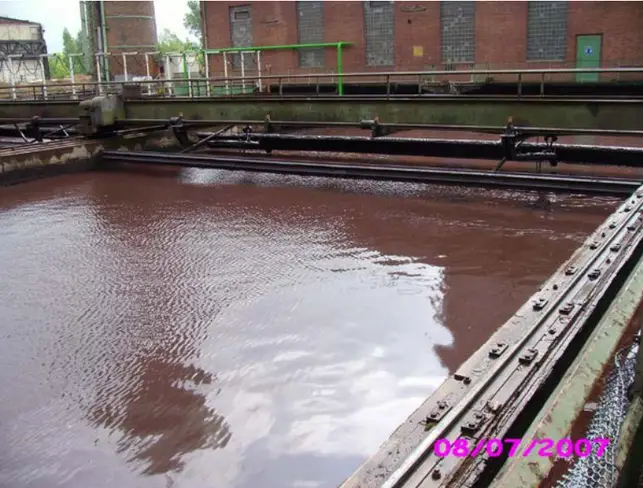
Water passes beneath the baffle into the pump chamber and is then pumped back into the circuit through a gravel filter. Bearing grease, lubricating oil, hydraulic oil and other hydrocarbons—mixed with mill scale and solid particles—float on the cooling water. This floating oil layer must be removed continuously so that as little hydrocarbon contamination as possible reaches the gravel filter. One simple and reliable method is a height-adjustable skimming channel.
Skimming channel in a longitudinal clarifier
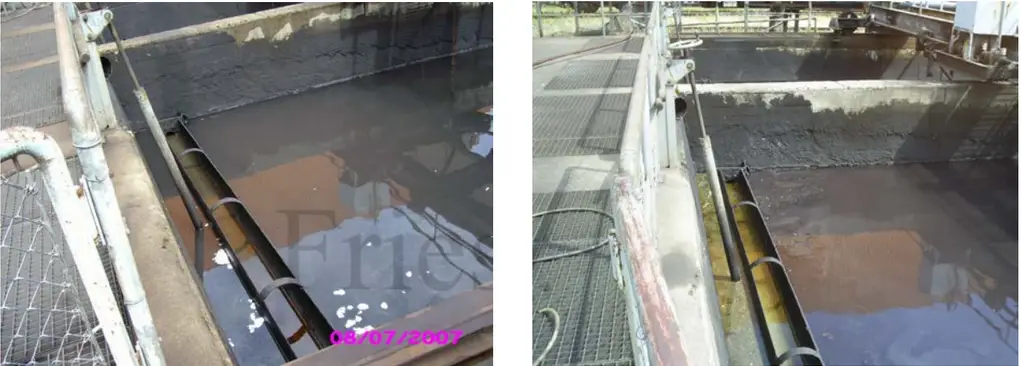
The inlet edge of the skimming channel is adjusted precisely to the liquid surface. Water and oil therefore flow continuously from the surface into the channel and leave the cooling-water circuit. The disadvantage of this simple, reliable method is the large amount of water removed with the oil and grease. A typical channel discharge contains only 1–2% oil and 98–99% water, so the discharged mixture still requires a separate and comparatively laborious separation step.
Solution: FRIESS S100 Oil Skimmer
For simpler and more efficient separation of the floating oil phase, a FRIESS S100 oil skimmer can be combined with an oil-attracting hose and a pump receiver tank.
A coarse-particle basket inside the tank retains debris such as cigarette ends, polystyrene chips and leaves. Oil passes through the basket’s large openings into the collection tank. A water separator beneath the basket allows any water carried over with the skimmed oil to settle at the bottom, while the lighter oil floats and spills over a weir into the next compartment.
Water Return from the Separation Tank
At the same time, the separated water rises through a dip pipe that reaches into the lower part of the separator and returns to the longitudinal clarifier through a separate outlet. This ensures that the oil pumped to the storage tank is virtually water-free.
To prevent frost damage in winter, the pump receiver tank can be fitted with an electric immersion heater. An eccentric screw pump is used for transfer; this robust pump can reliably handle highly viscous mixtures of oil, grease and solids.
Result
Continuous removal of the floating oil phase prevents individual oil droplets from being carried by the water flow along the baffle and into the pump chamber. With a correctly sized longitudinal clarifier and continuous removal by a hose-type oil skimmer, the oil content of the cooling water can be reduced to below 5 mg/L.
Floating oil from your steel mill clarifier reaching the gravel filters?
Please share your clarifier dimensions, water-level fluctuations, cooling-water flow rate, floating oil and solids composition, current skimming method and water return requirements. Our China engineering team can recommend an S100 oil skimmer, a suitable collector hose and a collection tank with transfer pump to match your operating conditions.