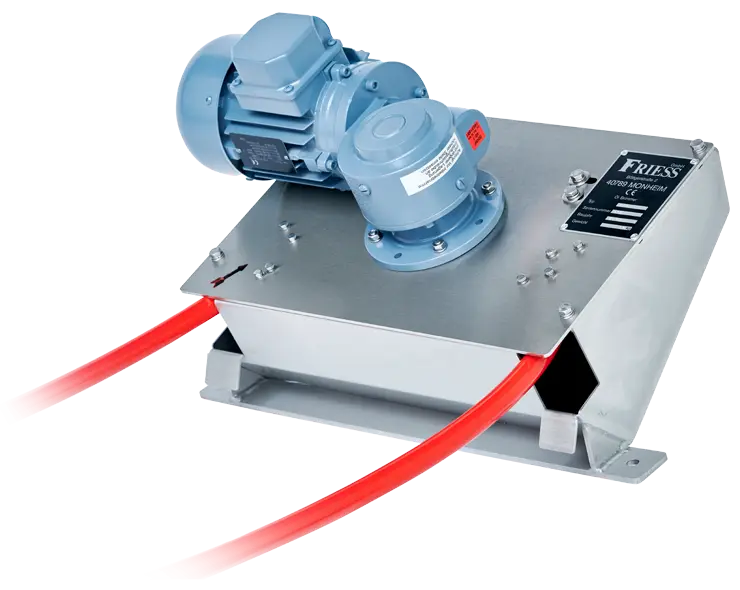
Removing floating oil from steel mill cooling water with a FRIESS W40 oil skimmer
Optimising the process and reducing disposal costs in steel production
In a steel mill, cooling water was heavily contaminated by several sources of leakage oil. Rolling bearings released small quantities of lubricating oil and especially persistent grease. Leaks in hydraulic systems continuously introduced small amounts of hydraulic oil into the cooling-water circuit. During a failure, a burst or torn hose could suddenly release up to 1,000 litres of hydraulic oil into the system.
Oil and grease combined with scale, dust and other solids in the water. In the lamella clarifier, heavy solids settled to the bottom while oil and grease mixed with solids floated as a viscous layer. The mixture spread across the clarifier surface, approximately 6 × 4 m.
A baffle retained the oil and grease while the water flowed back into the circuit underneath it.
Because the water passed through a gravel filter downstream of the lamella clarifier, oil and grease had to be removed reliably. Otherwise, the gravel filter would gradually clog and bind together. Disposing of oil-contaminated filter gravel is extremely expensive, so the oil concentration after the clarifier had to remain as low as possible. If the separated oil and grease were not removed frequently, part of the layer could be carried beneath the baffle and eventually enter the gravel filter.
The Solution: FRIESS W40 Oil Skimmer
To remove oil from the largest possible surface area, the FRIESS W40 oil skimmer was equipped with a 14 m collecting hose. Its length allowed it to reach the entire basin surface. The hose was arranged opposite the skimmer so that it swept the full water surface. Ceramic scrapers removed the mixture from the hose and directed it into a funnel-shaped collection tray.
Because of the high solids content, the scrapers required ceramic protection to prevent wear and ensure a long service life. The recovered oil-and-grease mixture was not free-flowing, so a funnel-shaped tray was used. The sludge dropped through the funnel into a vertical R 3-inch drain pipe and then into a collection container.
The Result
Using the oil skimmer optimised the steel-production process and reduced costs. Removing floating oil significantly lowered the oil content in the cooling water. The downstream gravel filter has now operated for more than three years without problems.