FRIESS VOD 16 and EFR D2 Hydraulic Oil Cleaning for a Cement Plant
A cement-industry mill generates large quantities of process dust. Severe contamination from the production environment repeatedly caused failures in its hydraulic control system.
Cement production requires a variety of additives, many of which must be ground before further processing. Depending on the cement grade, ground blast-furnace slag is used as an additive. A major cement producer therefore built a slag-processing plant close to a large steel mill in Germany, receiving blast-furnace slag directly from the mill.
The slag is ground to the required particle size in a mill supplied by a well-known German manufacturer. Large hydraulic cylinders continuously adjust the grinding rollers during operation to maintain an accurate particle-size distribution. Despite the high forces involved and an adjustment range of only a few millimetres, the cylinder movement must remain extremely precise.
Dust Contamination and Servo-Valve Failures
Even with highly effective extraction equipment, the process creates heavy dust contamination inside the building. Although the hydraulic power unit for the adjustment cylinders was separately enclosed, dust entered the hydraulic oil through both the air filter and the cylinder seals. The high contamination level caused servo valves in the hydraulic control system to malfunction, so the particle-size distribution no longer met specification.
The new plant manager was the first to recognise the connection between contaminated hydraulic oil and the recurring production interruptions. After an online search, the company contacted FRIESS GmbH. A FRIESS field engineer examined the oil and confirmed that it was far too contaminated for reliable servo-valve operation. The sample also showed that condensate had already separated in the hydraulic oil.
During commissioning, the hydraulic system experienced several prolonged shutdowns. Because the building was unheated, the hydraulic-oil tank was exposed to large temperature fluctuations, causing condensation to enter the system.
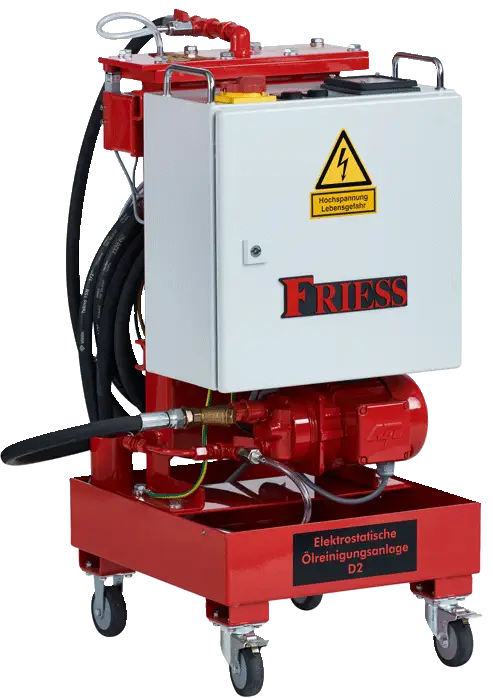
Based on the oil-analysis results, the operator selected a FRIESS EFR D2 electrostatic oil cleaning system together with a VOD 16 vacuum oil dewatering system to improve oil cleanliness and remove water.
Results
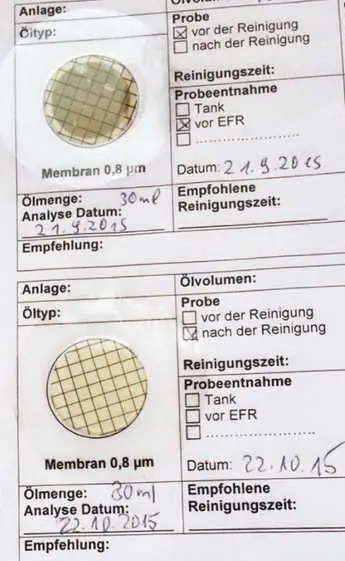
The VOD 16 oil dewatering system removed more than one litre of condensate from approximately 1,500 litres of hydraulic oil within a very short time. The EFR D2 electrostatic oil cleaning system was then put into operation. After only four weeks of continuous treatment, the hydraulic oil showed a substantial improvement in cleanliness.
No further condensate was detected.
The hydraulic oil became visibly cleaner.
The mill now operates continuously without interruptions.