
About 90% Fewer Particles Above 4 µm in a 23-Hour Trial
In a 23-hour trial using 40 litres of used hydraulic oil from gearbox production, an EFR D8 reduced the number of particles larger than 4 µm by about 90%. The MPC value fell from 31.3 to 10.3. Both particle counting and membrane patch analysis showed a substantial reduction in contamination.
Case Background
A European automotive manufacturer operates three gearbox-production plants. At one Central European site, the hydraulic oil used across various machines totals approximately 10,000 litres.
Hydraulic Oil Contamination
After three years of continuous operation, hydraulic failures had increased noticeably. The maintenance team investigated the cause and the in-house laboratory found substantially higher contamination levels in the hydraulic oil from the machines. Although several offline filtration systems were available and used regularly, the results were unsatisfactory.
The Solution: FRIESS EFR D8 Electrostatic Oil Cleaning

During an online search, the maintenance team contacted the local FRIESS GmbH representative. To determine whether an electrostatic hydraulic oil cleaner could improve the situation, a trial was agreed. For the test, 40 litres of used hydraulic oil were cleaned with an EFR D8 system.
Results
The test ran for 23 hours. Oil samples were taken at defined intervals and analysed in the plant laboratory. The particle counts produced the following results:
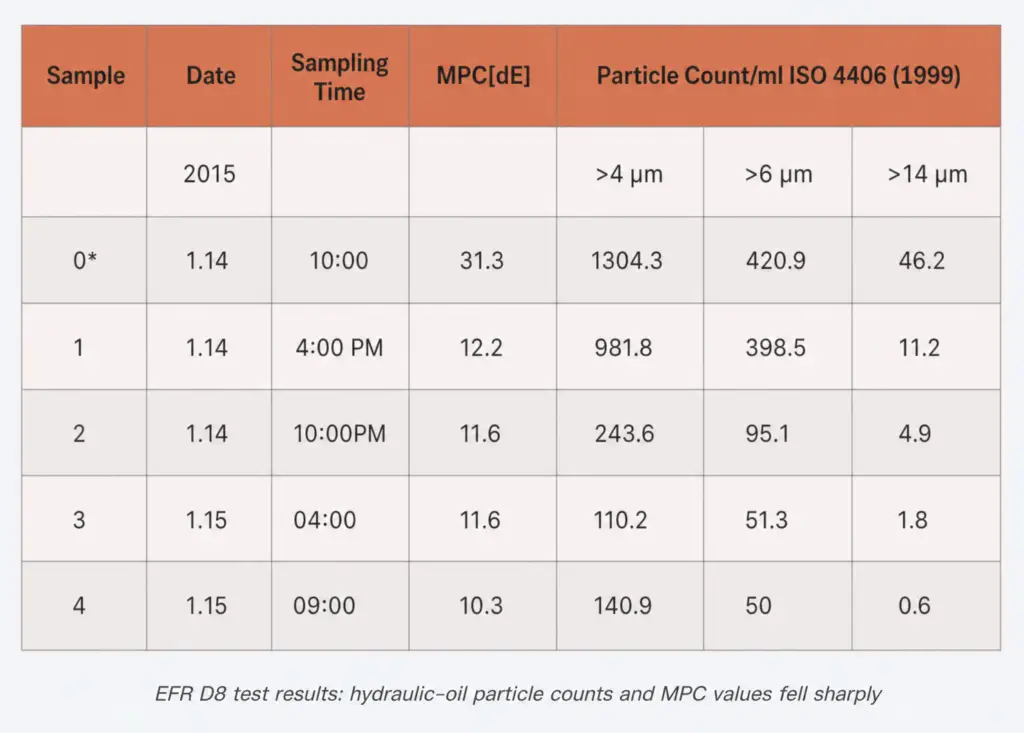
*The first oil sample was taken 10 minutes after commissioning the electrostatic oil cleaner.
- Particle counting showed about 90% fewer particles larger than 4 µm. Since dirt particles account for approximately 70% of hydraulic failures, the cleaning result indicates that electrostatic oil cleaning can prevent roughly 60–70% of hydraulic failures. This is an estimate, not a measured reduction in failure rate during the 23-hour trial.
- An MPC test (Membrane Patch Colorimetry) was also performed. For this test, 50 mL of oil was mixed with 50 mL of petroleum spirit and drawn through a 0.45 µm membrane, making oxidation products, ageing residues and sticky reaction products visible. The analyses showed a significant reduction in oxidation products, supporting reliable hydraulic-system operation.
For hydraulic-system operators:
FRIESS also provides on-site hydraulic-oil analysis and purification services. Equipment repairs and spare-parts supply are not included.
Hydraulic oil particles causing valve wear and downtime on your gearbox production line?
Please share your hydraulic oil grade, reservoir volume, system pressure, ISO 4406 cleanliness, particle and oxidation-product conditions, failure records and target performance. Our China engineering team can recommend an EFR D8 electrostatic oil cleaner configuration, bypass flow rate and operating schedule for your conditions.