
Five Minutes a Week After Initial Oil Removal
Daily operation of a 2H skimmer first removed most of the floating waste oil from the refinery’s groundwater. Once the oil film had been reduced to a minimum, about five minutes of operation per week was sufficient to remove newly accumulated traces of oil.
Case Background
Hydrocarbon contamination was suspected near a refinery. Test drilling confirmed that waste oil had seeped through the soil and formed a layer on the groundwater surface.
The Challenge
The local authority commissioned a consulting company to recommend a safe method for removing the oil layer. A series of 300 mm-diameter test wells showed that the groundwater level was approximately 4 m below ground. Continuous pumping from one well lowered the groundwater level, drawing surface oil towards that well and mixing it with the groundwater.
To minimize remediation costs, the project required a fully automatic system that could separate the oil layer from the groundwater without continuous maintenance or supervision.
Two Systems Were Evaluated
Suction System
This concept used a suction hose to remove the oil layer from the groundwater. Because the oil had to be lifted approximately 4 m to ground level, the project faced difficult questions about pump location and how to collect the recovered oil.
Increasing suction to accelerate cleanup also removed large volumes of water, creating another separation problem. For effective oil recovery, the floating layer needed to be at least 50 mm thick so that the hose would collect mainly oil and only a small amount of water. However, allowing such a thick oil layer increased mixing between the oil and groundwater and required additional separation equipment, monitoring and cost.
Belt Skimmer
A special belt skimmer designed for a 300 mm-diameter well and a 4.5 m lifting height would have been very expensive to manufacture. Because the recovered oil contained sand and other particles, the process would also have required continuous monitoring.
The belt skimmer’s steel scraper would wear rapidly and need frequent replacement. In addition, sticky hydrocarbons could block the oil discharge channel.
The Solution
FRIESS Model 2H Oil Skimmer
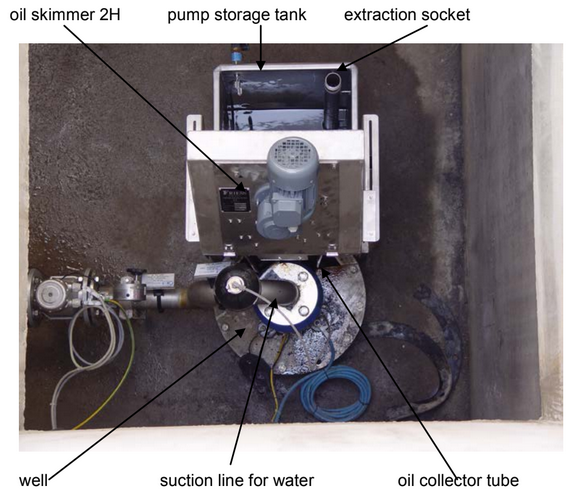
A FRIESS Model 2H oil skimmer with an oil-collecting tube was selected to remove as much floating oil as possible from the groundwater surface. The system consists of a drive unit and an endless oil-collecting tube. The tube descends through the borehole to the groundwater, passes around a pulley in an adjustable suspension and travels through the oil layer before returning to the surface.
Floating oil adheres to the tube and is drawn into the skimmer, where ceramic scrapers remove it and direct it into a waste-oil tank for disposal.
The clean tube then returns to the well to collect more waste oil. The FRIESS skimmer can recover oil layers from 50 mm down to 5 mm without introducing water into the collected oil. As the layer becomes thinner, a small amount of water is removed with the oil; at approximately 0.1 mm, the water content of the recovered liquid increases.
Except for the lower deflection pulley, all skimmer components that contact the oil-collecting tube are ceramic, providing excellent wear resistance.
Results
Daily operation of the FRIESS Model 2H rapidly removed most of the waste oil from the refinery groundwater. As the floating oil film was reduced to a minimum, the skimmer could be switched to intermittent operation. Scheduling is adjustable through the control panel, and about five minutes of operation per week is sufficient to remove newly accumulated traces of floating waste oil.
Recurring floating oil in groundwater and high manual recovery costs?
Please share your well diameter and depth, groundwater-level fluctuations, oil-layer thickness, oil viscosity, sand content, pumping method and target residual oil level. Our China engineering team can recommend an oil skimmer model, collection-tube length, downhole guide and automatic control arrangement for your conditions.