
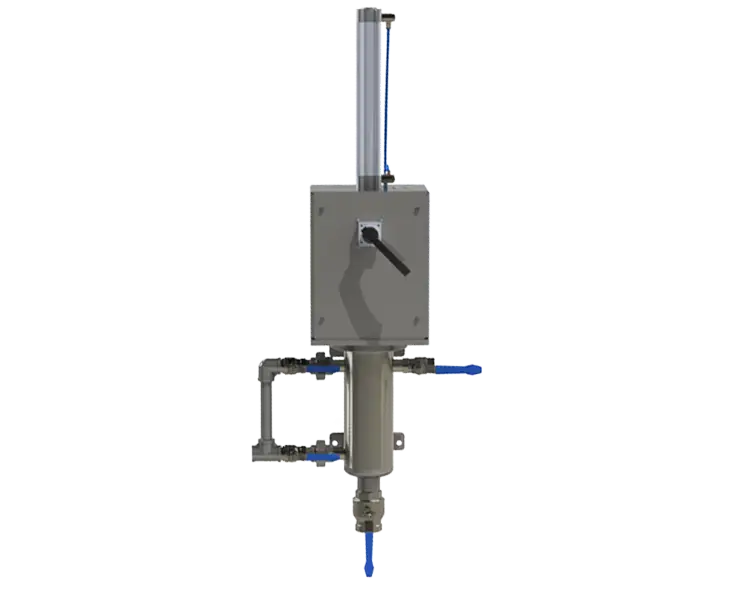
FRIESS SMF
Semi-Automatic Magnetic Filter
Semi-automatic cleaning without opening the housing. External levers simplify routine removal of ferromagnetic particles from coolants, grinding fluids and wash liquids.
No disposable filter media required. Suited to frequent cleaning when fully automatic sludge discharge is not needed, helping maintain fluid life and process cleanliness.
SMF Product & Application Gallery


What Does the SMF Magnetic Filter Do?
The cleaning process is particularly practical. Unlike the fully automatic ASMF, the SMF is cleaned manually using only a few external levers. The filter does not need to be opened, keeping the operator’s hands clean while minimising maintenance effort.
Filtration and Operating Requirements
SMF uses three or five rods containing neodymium magnets to capture ferromagnetic fines. Particles around 1 µm may be captured under suitable conditions; actual performance depends on magnetic response, flow, viscosity and cleaning intervals. No disposable filter paper or cartridges are needed, reducing filter-media purchasing and waste. Operating costs still include circulation, cleaning, maintenance and contaminant disposal.
Permanent-magnet capture needs no separate electrical supply, but semi-automatic cleaning actuation and fluid circulation require appropriate utilities. Confirm site services and maintenance intervals during selection.
Technical Data
SMF 3
Maximum flow rate: 150 L/min (water-based fluids)
Maximum flow rate: 75 L/min (oil)
Temperature range: 5 °C to 60 °C
Particle holding capacity: approx. 2 kg
Maximum working pressure: 10 bar
Connection: 1-inch
SMF 5
Maximum flow rate: 300 L/min (water-based fluids)
Maximum flow rate: 150 L/min (oil)
Temperature range: 5 °C to 60 °C
Particle holding capacity: approx. 5 kg
Maximum working pressure: 10 bar
Connection: 1½-inch
Advantages
- Can capture ferromagnetic fines around 1 µm under suitable conditions; confirm performance for the actual fluid, particles and flow.
- No disposable filter media or electrical power for the magnetic field; cleaning actuation and fluid circulation still require utilities.
- Cleaning does not require opening the filter; external levers discharge the collected metal particles.
- Extends the service life of coolant, wash water, grinding oil and other process fluids.
- Improves surface quality in grinding processes.
Typical Applications
- Coolant and cutting-fluid filtration
- Grinding
- Honing
- Electrical discharge machining (EDM)
- Waterjet cutting
- Wash-water filtration
SMF Selection and Cleaning FAQ
Q1: What is the difference between the SMF and ASMF magnetic filters?
A: The SMF is cleaned semi-automatically by operating a few external levers. The filter does not need to be opened, keeping the operator’s hands clean. The ASMF cleans fully automatically and is suited to applications requiring a higher level of automation. Neither system requires filter consumables.
Q2: How is the SMF cleaned?
A: Operate the external levers without opening the filter housing. When the magnetic rods retract, the collected ferromagnetic particles are released and discharged. Plan the cleaning steps, sludge discharge and production coordination using the equipment instructions and site arrangement.
Q3: Which processes are suitable for the SMF?
A: Grinding, honing, EDM, waterjet cutting and wash-water filtration, as well as other metalworking processes that generate ferromagnetic particles. The SMF extends the service life of coolant, grinding oil and cleaning liquids.
Q4: Which SMF sizes are available?
Compare the maximum flow rates for water-based fluids:
- SMF 3: up to 150 L/min.
- SMF 5: up to 300 L/min.
Both versions have a maximum working pressure of 10 bar. Confirm the configuration for your fluid and particle loading.
Q5: Does the SMF require consumables or additional energy?
A: No disposable filter paper or cartridges are needed, and permanent-magnet capture needs no separate electrical supply. Cleaning actuation and fluid circulation still require utilities, routine maintenance and sludge-disposal arrangements.
Opening the filter too often to remove magnetic particles?
Share fluid type, flow rate, temperature, pressure, magnetic particle load, cleaning frequency and service space. We will recommend an SMF model and cleaning arrangement suited to your process.