
Continuous Oil Recovery,
Fewer Discharge Exceedances
A biodiesel producer tested a 1S oil skimmer on its wastewater oil separator, continuously collecting floating oil into an IBC. The rapidly rising level showed substantial oil and fat recovery, while limit exceedances at the downstream monitoring point declined. The company purchased the unit after the successful trial and began further tests in upstream drains.
Background
When biodiesel is produced from rapeseed oil, both the feedstock and the finished product can enter the wastewater system. The producer needed to meet the receiving treatment plant’s discharge limits and reduce reliance on vacuum tankers to empty the separator.
Problem
A solution was therefore needed that could continuously remove the accumulated oil.
This would prevent the separator from being overloaded while allowing the company to collect the oil itself for disposal or recycling—a far more cost-effective alternative to repeatedly calling a vacuum tanker.

Solution: FRIESS Type 1S Oil Skimmer
An oil skimmer was well suited to the task: it could operate without constant supervision and remove the oil accumulating inside the oil separator. The recovered oil would then be directed into a designated IBC.
To verify that a hose-type oil skimmer could remove the floating phase and deliver the required result, a frame-mounted FRIESS Type 1S oil skimmer was tested on the separator.
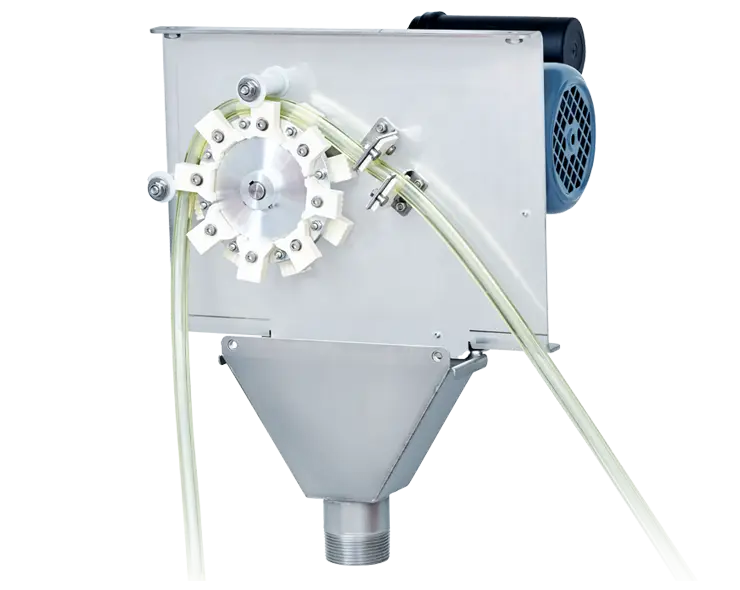
The oil skimmer operated continuously and removed the oils and fats entering the wastewater stream.
After only a short period, it was clear that the skimmer was removing substantial quantities of oil and fat, as shown by the steadily rising level inside the IBC.
Limit exceedances at the downstream monitoring station also declined.
There was initially concern that the collector hose would have a short service life because organic oils and fats can attack plastics and cause them to swell. In practice, this concern proved only partly justified. Although the collector hose lost some rigidity, this did not affect its conveying capacity or otherwise impair the oil skimmer. Its average service life was approximately six months.
Result
After the successful proof of concept, the oil skimmer was purchased. Further trials are now being carried out at other points in production to reduce the wastewater load upstream of the separator and remove oils and fats as close to the source as possible.
The oil skimmer is currently being tested at two additional locations:
- Above a drain channel in the production hall. Wastewater containing a floating phase is pumped from there to the separator. Skimming at this point reduces the load on the separator.
- In the tank-storage area, a drain channel collects escaped oils and fats. Removing them here reduces the separator load and may eliminate the need for a skimmer at the separator—the final opportunity before the contaminants enter the public sewer system.
Too much oil in your wastewater separator and rising vacuum-truck costs?
Please share your wastewater flow rate, oil and grease types and peak load, separator dimensions, liquid-level fluctuations, discharge limits and current collection frequency. Our China engineering team can recommend a 1S oil skimmer, collection tube and recovery-container configuration for your operating conditions.