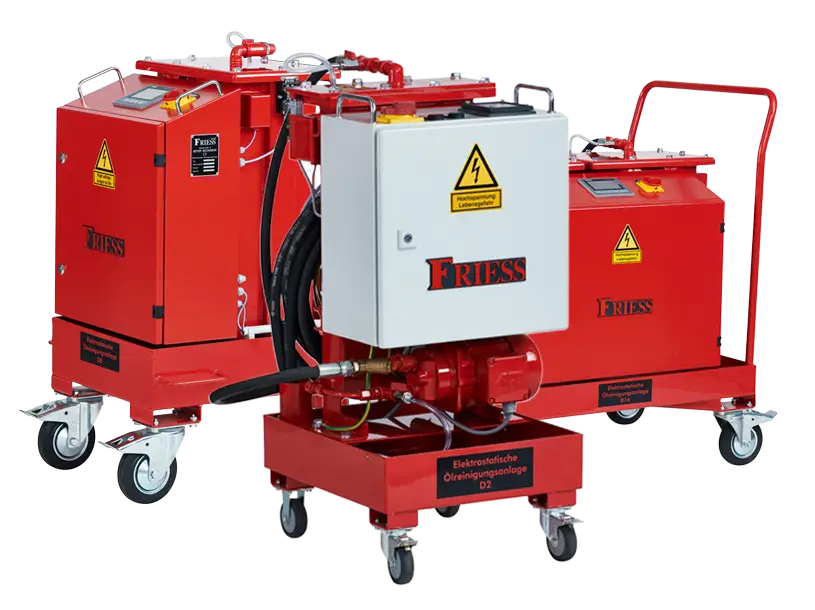
FRIESS EFR D16 with Particle Monitoring for an Automotive Press Line
Reducing Hydraulic-Oil Contamination with an EFR D16
A globally active automotive supplier operates state-of-the-art press lines at a plant in southern Germany to manufacture high-strength sheet-metal components. Using high-strength steel makes the parts significantly lighter at the same strength, helping reduce body-in-white weight.
Tight customer tolerances and the demands of forming high-strength steels require every press parameter to remain extremely precise. The four presses therefore use high-quality servo-valve technology and premium hydraulic oil. Even so, the specified tolerances were repeatedly exceeded.
A detailed fault analysis showed that the level of contamination in the hydraulic oil was substantially higher than the precision servo technology could tolerate.
After extensive research, the maintenance team decided to use a FRIESS EFR D16 electrostatic oil cleaning system to reduce contamination and break down oxidation products, resin and varnish in the hydraulic oil.
To verify the expected results before purchase, the system was initially rented. During the trial, oil samples were taken repeatedly and analysed carefully. The results showed a substantial reduction in contamination as well as the removal of oxidation products and varnish.
At the same time, hydraulic-system faults on the presses fell sharply. Machine precision improved and scrap was reduced to a minimum. The clear improvement in process reliability led the team to purchase the electrostatic oil cleaning system.
Automatic Particle Monitoring
Previously, monitoring oil cleanliness and quality required substantial manual work, including taking and shipping samples. The EFR D16 was therefore equipped with FRIESS’s fully automatic particle monitor.
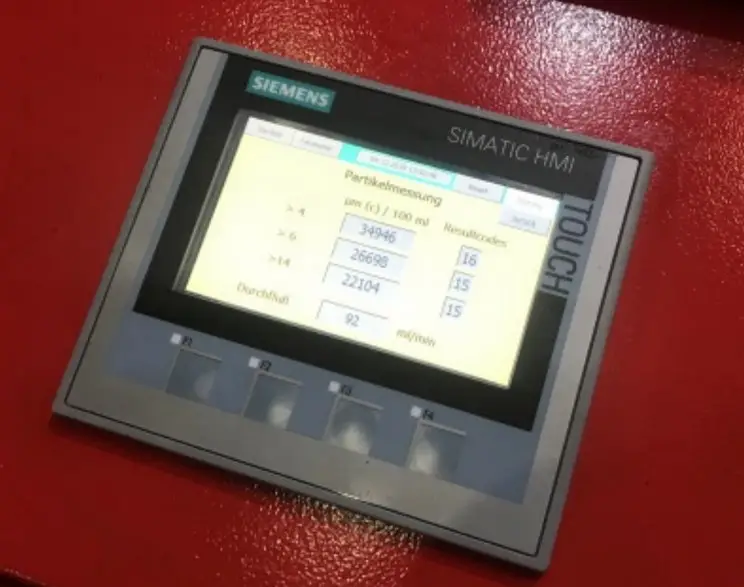
The monitor continuously tracks hydraulic-oil cleanliness during electrostatic filtration and displays the measured cleanliness values on the D16 screen.
Particle counts and ISO 4406 cleanliness classes displayed by the automatic particle monitor
A small oil flow passes continuously through the particle monitor while the EFR system is operating. Contamination is measured every 10 minutes and can be shown on the oil-cleaning system’s display.
The latest 2,000 measurements are stored, and recent results can be displayed graphically. Oil cleanliness is therefore documented and visible without manual intervention, allowing deviations to be addressed before they affect production.
Combining electrostatic oil cleaning with integrated particle-count monitoring gives the operator continuous evidence of oil condition and process stability.
Results at a Glance
Very clean hydraulic oil by removing particles and microparticles down to 0.1 µm.
Reduced oxidation products, resin and varnish in the oil.
Higher machine precision and process reliability by preventing contamination-related hydraulic faults.
Less maintenance work because routine oil samples no longer need to be taken, commissioned and shipped.
Faster troubleshooting using the stored particle-count history.
Hydraulic faults on the presses were reduced by more than 80%. Lower repair costs for servo valves and pumps delivered a payback period of less than six months.
Oil changes were no longer required because oil cleanliness and quality remained consistently high.
FRIESS EFR D16 with integrated particle monitoring