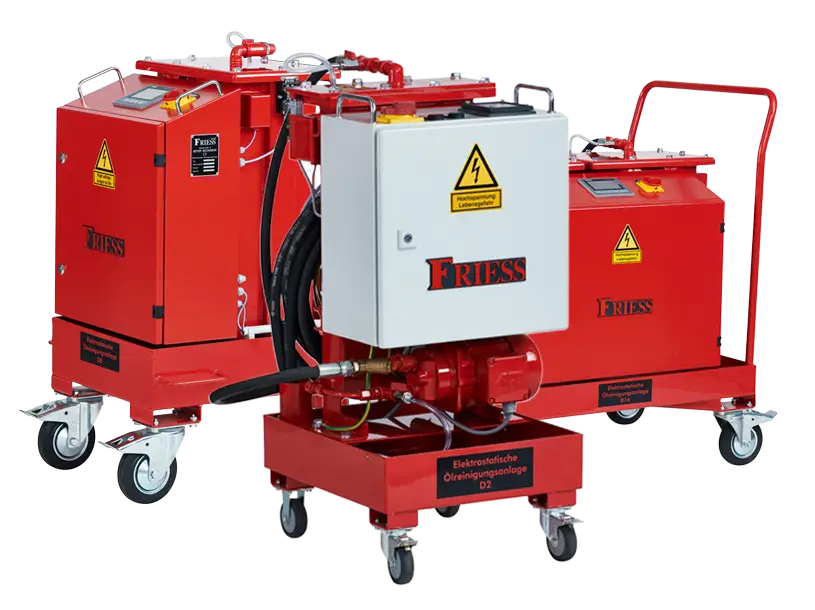
FRIESS EFR D16 Electrostatic Oil Cleaning for an Aluminum Extrusion Press
Today, aluminum profiles are produced predominantly by extrusion. Round aluminum billets are heated and pressed through a die by a large hydraulic press. The required high force is generated by a single hydraulic cylinder.
The cylinder is powered by a hydraulic system with several pump groups, servo-valve control and an oil volume of approximately 10,000 to 40,000 litres. To maintain consistent profile quality, both the pressing force and cylinder feed must be controlled as precisely as possible. This level of control requires exceptionally clean hydraulic oil.
At an aluminum plant in Westphalia, Germany, two hydraulic extrusion presses each contained approximately 12,000 litres of HLP 46 hydraulic oil. Contamination in the oil repeatedly caused servo-valve malfunctions and failures.
An offline filtration system was installed first to improve oil cleanliness. It removed coarse particles but could not eliminate the underlying causes of the faults: microparticles, oxidation products and varnish.
During the plant shutdown, the entire oil volume was pumped out and the reservoir was cleaned internally. Large quantities of deposits, varnish and sticky oil residues were removed from the tank walls and floor. The used oil was then pumped back through the existing fine-filtration system. Even this extensive measure produced no significant improvement.
Varnish and oxidation products captured on the EFR cleaning elements
Even with effective offline filtration, oxidation products and varnish continue to form while a hydraulic system operates. Heat, oxygen and catalytic influences cause oil molecules to react with oxygen from the air. Long-chain molecules form first. As they continue to grow, some combine and polymerise into resinous or gel-like solids.
These sticky, soft contaminants deposit on valves, pistons, pumps and other components, creating a brown, lacquer-like film. Because the material is soft, it can pass through conventional filter pores and remain in the oil.
More varnish particles, often containing embedded dirt, then accumulate on hydraulic components. In the worst case, the deposits prevent a servo valve’s control spool from moving correctly in its cylinder. The hydraulic system malfunctions and the valve must be replaced.
After consulting the oil manufacturer, the operator decided to trial a FRIESS EFR D16 electrostatic oil cleaning system.
After approximately 2,500 operating hours, an oil sample was taken and analysed. Despite all previous cleaning measures, the oil remained heavily contaminated with oxidation products. Inspection of the D16 showed that its cleaning elements had captured extreme levels of contamination.
Results
The electrostatic oil cleaning system removed oxidation products and varnish from the hydraulic oil. Once cleaned, the oil was able to dissolve oxidation products that had already deposited inside the hydraulic system.
As a result, the surfaces of valves, pumps and other components became clean again. Moving parts were no longer obstructed, and the hydraulic system operated more precisely and reliably. After installation of the FRIESS EFR D16, the aluminum extrusion press returned to fault-free operation.
Results at a Glance
Oxidation products and varnish were removed from the oil.
Existing deposits inside the hydraulic system were dissolved.
Valve, pump and component surfaces became clean again.
Moving hydraulic components were no longer obstructed.
The system operated more precisely and without faults.