
Less oil and sludge.
Payback in about 13 months.
An automotive supplier fitted a W40 oil skimmer with a magnetic collector hose to remove floating oil, graphite and metal sludge from a central coolant system of approximately 30 m³. After several months, contamination and tramp-oil levels had fallen substantially. Maintenance savings alone produced a payback period of about 13 months.
Case background
Machining grey cast-iron components produces fine graphite and iron particles as well as coarse chips. Combined with lubricating and hydraulic oils entering through minor leaks, these particles form a sticky black sludge layer that is difficult to remove from the coolant surface.
The challenge with the existing system
An automotive supplier installed a new central coolant system with a capacity of approximately 30 m³. A floating-phase extractor was intended to remove tramp oil and sludge.
A feed pump transferred the mixture of emulsion, oil and dirt particles into a separator. The cleaned emulsion was expected to return to the clean tank, while the oil phase flowed to a waste-oil container.
Because the floating layer contained a very high concentration of fine particles, a sticky deposit quickly formed on the extractor. It eventually became so heavy that it sank into the emulsion.
With the plant running continuously in three shifts, the required regular cleaning could not be carried out. The operator therefore needed trouble-free continuous operation without routine maintenance.
The requirement
The customer needed a system that could reliably and fully automatically remove the floating layer of lubricating oil, hydraulic oil, graphite and metal wear at regular intervals—without routine cleaning.
The solution: FRIESS W40 for a large tank surface
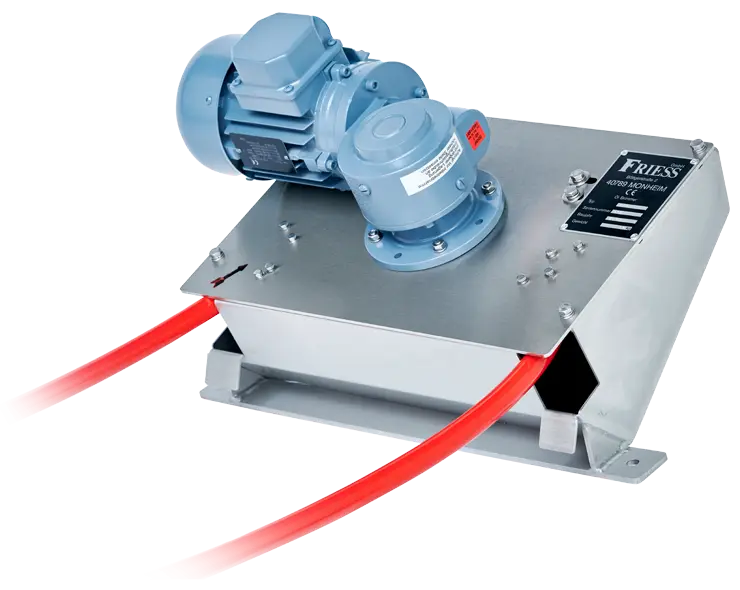
A FRIESS W40 oil skimmer with a freely floating collection tube was installed to remove the floating phase across a large surface area. The tube follows the liquid level automatically and attracts the oil phase from the coolant surface.
Because solid and graphite particles were also floating on the emulsion, magnets were fitted to the collection tube. They retain the particles even when the oil content is very low, while ceramic scrapers remove the adhered material from the tube inside the skimmer.
The skimmed material was no longer fluid and consisted mainly of solids, so a funnel was installed beneath the skimmer in place of the standard collection tray. The solids fall through the funnel into an open container. A level sensor stops the skimmer when the container is full, while variable-speed and timer controls match skimmer output to the rate of contamination.
Results
After several months of operation, the contamination and tramp-oil content of the coolant had fallen substantially. Apart from emptying the collected oil-and-solids mixture, the skimmer required no additional maintenance. The maintenance savings produced a payback period of approximately 13 months.
Floating oil, graphite and metal sludge accumulating on your coolant tank surface?
Please share your coolant volume, tank surface dimensions, floating layer composition and thickness, water-level fluctuations, operating shifts, current oil-removal method and maintenance frequency. Our China engineering team can recommend a W40 oil skimmer and collector hose configuration, and assess whether magnetic elements are suitable for the ferrous particles present.