
Over 90% less oil.
No more nozzle-related stoppages.
Two S100 skimmers mounted on a pump receiver tank between the basins reduced cooling-water oil content by more than 90%. After an initial thorough cleaning, the filtration system operated without faults and production stoppages caused by blocked nozzles were eliminated.
Case background
A metalworking plant operated two parallel longitudinal settling basins separated by one wall. Production introduced about 10–20 litres of oil per hour into the cooling-water circuit. Oil accumulated on the surface and was removed only intermittently. The circulation pumps repeatedly drew it back into the circuit, even though their intakes were about 2 m below the surface.
Oil ingress and cooling-system failures
Oil circulating through the cooling-water system caused frequent failures and contamination of critical components:
- Oil-contaminated cooling water caused filter failures and high maintenance costs.
- Oil mixed with grease and dirt coated the inside of pipes, reducing cooling-water flow. Small nozzles in particular clogged frequently and had to be cleaned or replaced.
- High oil content reduced cooling capacity, while oil and grease contaminated product surfaces.
Requirements: continuous oil removal and stable production
To optimize the cooling-water system and avoid costly cleaning, the maintenance team looked for a system that would continuously remove oil from the surface of the settling tanks. The requirements were:
- No interruption to production
- Rapid removal of oil from the cooling water
- Low investment and operating costs
The Solution: FRIESS S100 Oil Skimmers
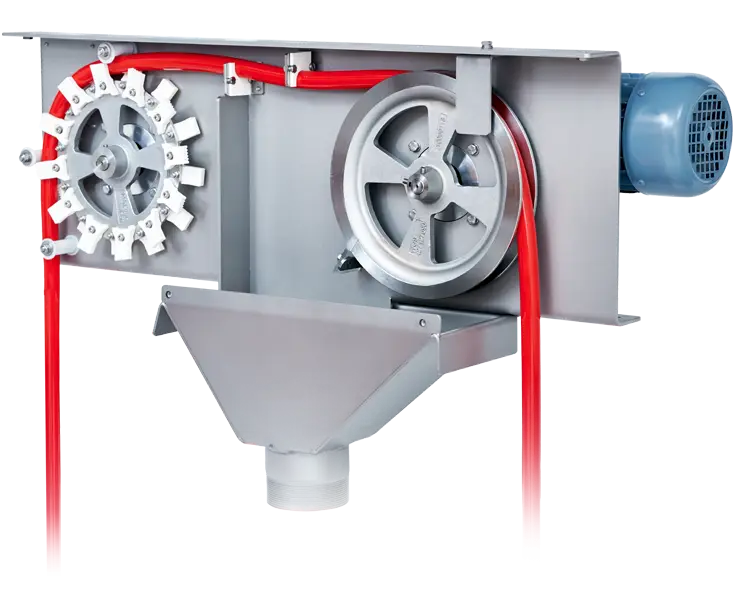
After evaluating several options, the maintenance team selected two FRIESS S100 oil skimmers for the following reasons:
- The collection tube removes floating oil across the entire basin width.
- The FRIESS oil skimmers operate continuously.
- Robust stainless-steel construction and ceramic scrapers provide long service life with minimal maintenance.
- Positive feedback from other users of FRIESS oil-skimmer systems
- FRIESS could meet the plant’s additional requirements: a tank with pump and a customized installation design.
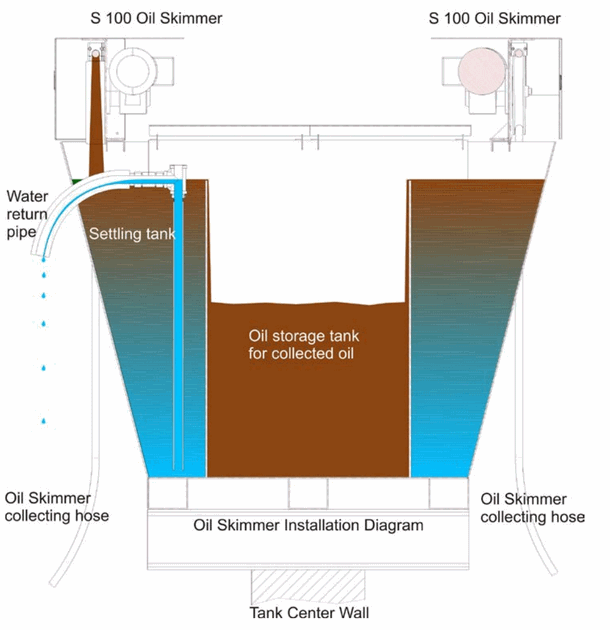
Space around the basins was extremely limited: there was neither room to install the skimmers beside the basins nor space for a separate waste-oil container. FRIESS therefore designed a pump receiver tank mounted on the partition wall between the two basins. One S100 oil skimmer for each basin was installed directly above this tank.
How it works: continuous skimming and tank separation
To minimize the water content of the waste oil and reduce disposal costs, the first chamber of the pump receiver tank serves as an oil–water separator. The collected mixture settles there: water sinks to the bottom while oil rises to the surface.
When the separation chamber reaches its maximum level, the floating oil passes over a partition into the storage chamber. At the same time, the settled water returns to the cooling-water basin through a dip pipe.
Results: more than 90% less oil
- The oil level in the main collection tank is monitored. At the maximum level, the recovered oil is pumped into a large disposal container.
- Using FRIESS S100 oil skimmers reduced the oil content in the cooling water by more than 90%.
- After an initial cleaning, the cooling-water filtration system operated without faults.
- Production stoppages caused by blocked nozzles were eliminated.
Continuous oil ingress into your cooling-water basin and frequent filter or nozzle blockages?
Please share your settling-basin dimensions, cooling-water circulation flow rate, hourly oil ingress, oil type, liquid-level fluctuations, available installation space beside the basin and target oil concentration. Our China engineering team can recommend the number of S100 oil skimmers, collection-tube layout, and oil transfer and storage arrangements for your operating conditions.