
Remove Ferrous Particles,
Extend Flowmeter Operating Life
A major automotive manufacturer installed two FMF 240/1 HT magnetic filters in a die-casting machine’s cooling circuit. Continuous removal of ferrous particles from mould cooling channels kept the water cleaner. Flowmeter turbines operated significantly beyond the previous replacement interval of about 2,000 hours, and annual repair and replacement costs fell substantially.
Case Background
The plant produces engine and transmission components on die-casting machines. Each machine uses up to three temperature-control units, with small turbine flowmeters monitoring cooling-water flow.
False Flow Alarms Despite Normal Water Flow
During operation, repeated low-cooling-water alarms interrupted production even though closer inspection showed that the actual flow was normal.
Fine dirt particles had accumulated around the flowmeter turbine, preventing it from rotating freely and producing incorrect readings. As a result, flowmeters had to be replaced after only about 2,000 operating hours.
Turbines of this type normally last more than ten years. Repairs and replacements were costing approximately €40,000 per year.
Maintenance staff and the temperature-control equipment supplier therefore looked for a way to reduce these costs. The deposits clearly showed that more effective cooling-water filtration was required.
The Solution: FMF 240/1 HT Magnetic Filtration
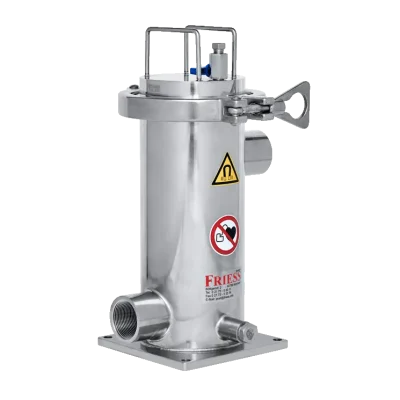
The temperature-control equipment manufacturer found FRIESS GmbH through an online search. After an initial analysis, two FMF 240/1 HT magnetic filters were installed in the die-casting machine’s internal cooling circuit. When the filters were opened after about two weeks, the cooling water looked relatively clean, yet the magnetic rods were visibly loaded with ferrous particles. The same finding was repeated two weeks later.
Even in the closed circuit, new particles were clearly being generated continuously. Corrosion in the mould cooling channels was identified as the source.
Continuous removal of ferrous particles made the cooling water visibly cleaner, and the flowmeter turbines have operated significantly beyond the previous replacement interval of about 2,000 hours.
Because the existing filters in the temperature-control units had not captured these particles, the individual circuits are now scheduled for retrofit with temperature-resistant magnetic filters.
Results at a Glance
- Continuous removal of ferrous particles keeps the cooling water cleaner
- Flowmeter turbines now operate for more than 2,000 hours
- Annual flowmeter repair and replacement costs fell significantly
Ferrous particles causing flowmeter faults in your die-casting cooling-water circuit?
Please share your cooling-water flow rate and temperature, ferrous particle load and size, existing filtration method, flowmeter fault symptoms and target cleanliness. Our China engineering team can recommend an FMF 240/1 HT magnetic filter configuration, installation position and cleaning interval suited to your conditions.