
Remove grease continuously.
Reduce carryover and manual maintenance.
A producer of salad dressings and fat-rich marinades installed a mobile S100 system to continuously transfer grease from its separator into an IBC container. This prevented grease carryover into the sewer and reliably met the municipal wastewater treatment plant’s receiving requirements. Heated discharge, timer control and level monitoring reduced manual intervention, while the complete unit could be moved by pallet truck or forklift.
Case background
Food processing generates wastewater containing oils and fats, particularly during the production of salad dressings and fat-rich marinades. These materials must be reliably removed before discharge to the sewer or further wastewater treatment.
Site challenge: grease carryover
A manufacturer of salad dressings and fat-rich marinades needed an effective solution for removing oil and grease from its process wastewater. However, the existing grease separators could not meet these requirements reliably.
A key problem was that the thickness of the grease layer forming in the separator could not be monitored reliably. As a result, oil and grease regularly passed beyond the separator into the wastewater system. This led to repeated objections from the downstream municipal wastewater treatment plant, including a warning that the company’s discharge permit could be withdrawn.
The site therefore required the separated grease to be transferred automatically, without manual intervention, from the separator into a suitable collection container in order to reduce maintenance and improve operational safety.
Solution: Mobile FRIESS S100 Oil Skimmer System
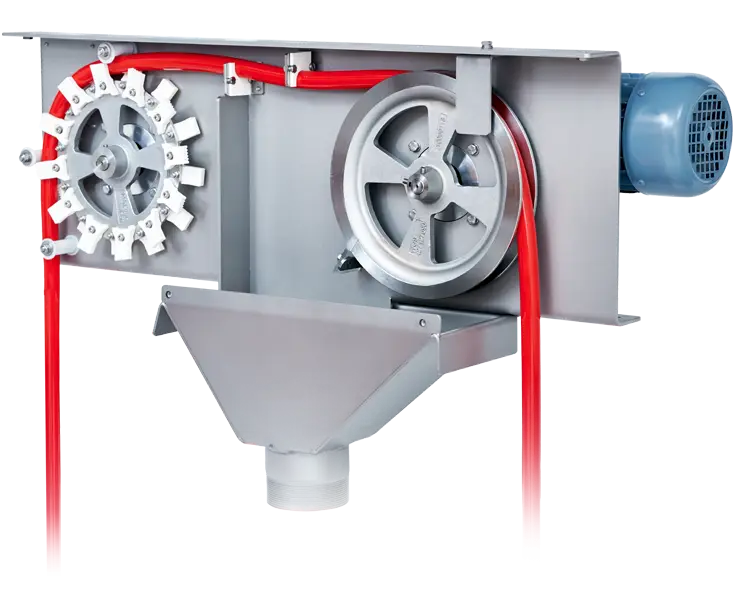
To keep the grease separator continuously emptied, a FRIESS S100 oil skimmer was installed and specially configured for the application.
A key feature of the solution is the heated discharge trough. It prevents grease from solidifying and ensures continuous, trouble-free discharge of the separated material even at lower temperatures.
The oil-skimmer system was designed as a mobile unit. The entire assembly can be moved together with its IBC collection container by pallet truck or forklift, so the yard containing the grease separator remains accessible to trucks.
A dedicated mounting frame secures the skimmer directly and safely to the IBC container, creating a compact, space-saving installation. Timer-based control combined with IBC level monitoring enables largely automatic operation and prevents the collection container from overflowing.
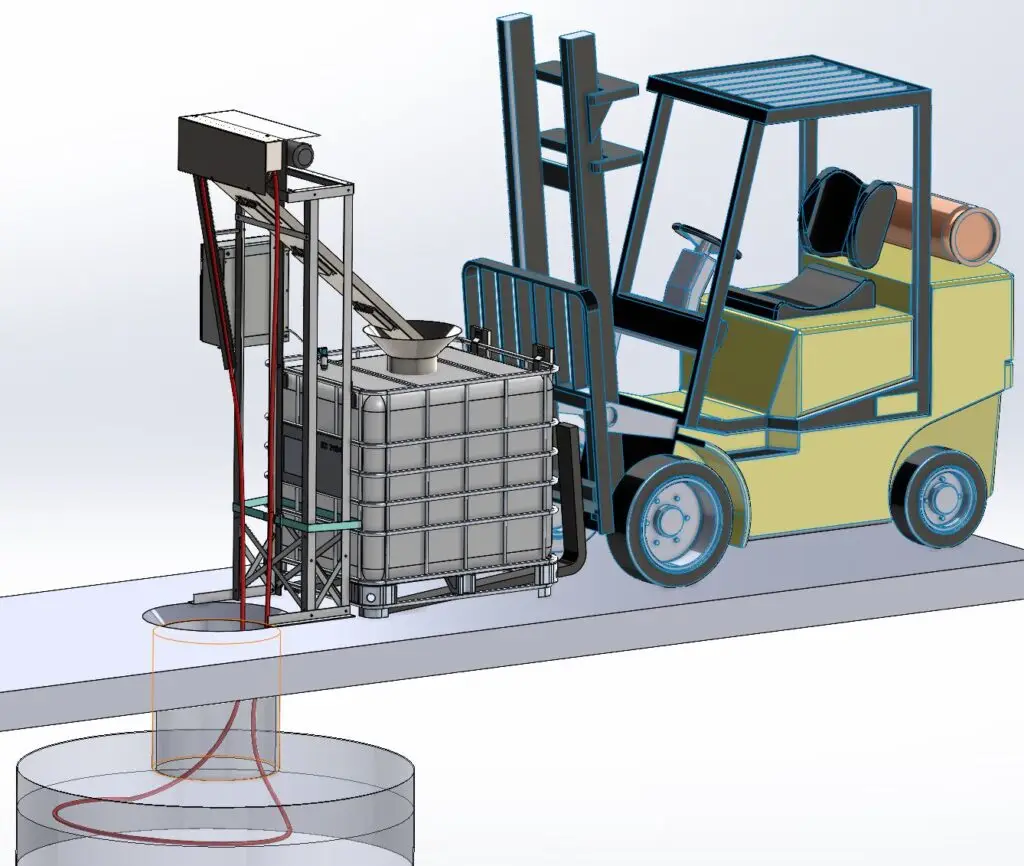
Heated Discharge
Prevents grease from solidifying and ensures continuous, smooth discharge.
Flexible Mobility
Can be easily moved by pallet truck or forklift.
Compact Installation
The S100 is mounted directly above the IBC container to save space.
Automatic Overflow Prevention
Timer control combined with level monitoring prevents the collection container from overflowing.
Results
Prevents oil and grease from entering the sewer system and helps meet wastewater treatment requirements.
Automatic discharge reduces manual intervention and improves operational safety.
The mobile design allows the system to be used flexibly at different locations.
Provides a practical and effective pretreatment solution for oily wastewater in the food industry.
Especially suitable for large basins, cooling-water tanks and industrial tanks with substantial liquid-level fluctuations.
Oil and grease overflowing from your food-industry grease separator?
Please share your wastewater flow rate, oil and grease types and temperature, separator dimensions, liquid-level fluctuations, discharge requirements and current collection frequency. Our China engineering team can recommend an S100 oil skimmer, heated discharge trough and IBC collection arrangement for your operating conditions.