
One Week of Collection Matched the Old Filter’s Year
A steel-profile manufacturer replaced a magnetic filter delivering only about 1,500 gauss with FMF 420/3 rods delivering approximately 10,800 gauss. Emulsion cleanliness improved substantially: in just one week, the new filter removed as much contamination as the previous unit had collected in twelve months.
Case Background
The plant uses around 4,000 litres of emulsion to cool and lubricate its rolls. Cold rolling produces fine metal particles, typically below 10 µm, that conventional belt filters usually cannot capture. The company initially purchased a magnetic filter for a smaller emulsion system, but its performance was unsatisfactory.
The Problem
A maintenance employee learned about FRIESS magnetic filtration through a press report. During an on-site meeting, the operator was very sceptical because the existing filter had performed poorly. As these results did not match the previous experience of FRIESS customers, the installed filter was inspected. Its cleaning procedure proved extremely difficult and unnecessarily complicated.
Complex Cleaning
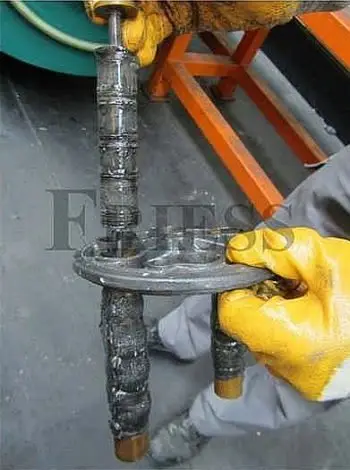
Dirt accumulated not only on the outer tubes but also on the magnets inside them, making disassembly, cleaning and reassembly very time-consuming.
A Weak Magnetic Field of Only 1,500 Gauss
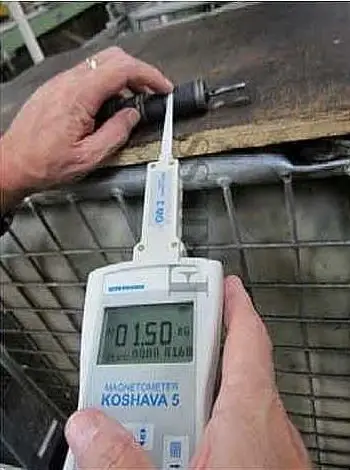
Because the poor separation result was unusual, the magnets were measured. Their flux density was extremely low at only 1,500 gauss.
Low-cost hard ferrite magnets had been used instead of more powerful neodymium magnets. This made the filter inexpensive, but its separation performance was inadequate.
The Solution: FRIESS FMF 420/3
After a FRIESS FMF 420/3 fitted with magnetic rods delivering approximately 10,800 gauss was installed, emulsion cleanliness improved visibly.
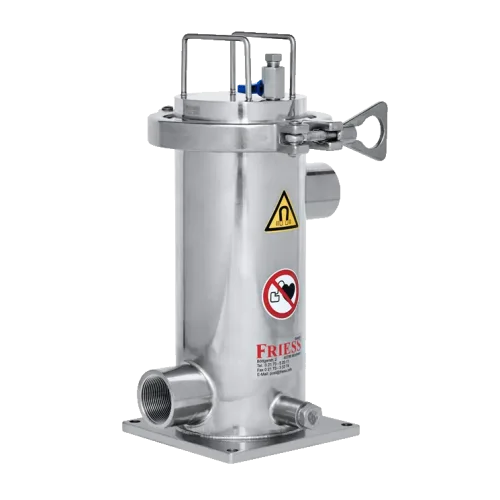
High Magnetic Flux Density
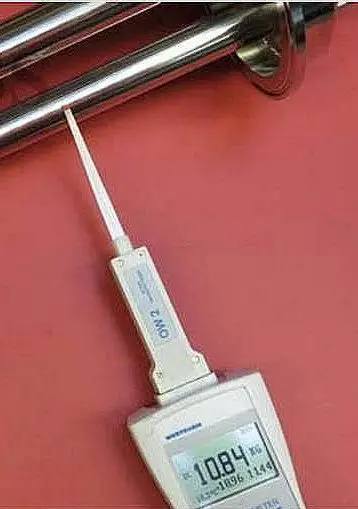
High flux density of approximately 10,800 gauss.
Dirt Simply Wipes Off
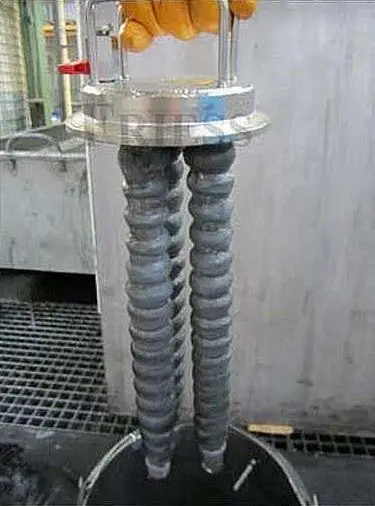
The supplied cleaning tool removes contamination from the magnetic rods quickly and easily.
Results
In just one week, the FRIESS FMF 420/3 removed as much contamination as the previous filter had collected in twelve months. The comparison demonstrates that actual flux density at the outside of the magnetic rods is decisive for filtration performance. High-performance neodymium magnets cost more than conventional hard ferrite magnets, but their far greater separation efficiency makes them the better choice.
When comparing magnetic filtration systems from different manufacturers, always compare the actual flux density as well as the purchase price.
- In one week, the FRIESS magnetic filter removed as much dirt as the previous filter did in one year!
Fine metal particles remaining in your emulsion and inadequate magnetic filtration?
Please share your emulsion volume, circulation flow rate, particle material and size, existing filtration rating, magnetic flux density at the rod surface and target cleanliness. Our China engineering team can recommend an FMF 420/3 magnetic filter, installation arrangement and cleaning interval for your conditions.