
Viscous Surface Layers Removed,
No Additional Cleaning
Wash water from a die-casting plant’s air scrubber contained viscous release agents, oil, grease and dust. A roughly 5 m oleophilic collector hose covered most of the settling tank surface and removed the floating layer. An open-bottom support frame allowed the recovered sludge to fall directly into a container, preventing discharge blockages and eliminating additional cleaning work.
Background
Die-casting moulds are sprayed with heat-resistant release agents to allow the castings to be demoulded properly. To avoid odour nuisance and health impacts, the resulting vapours are extracted and sent to an air scrubber. Water continuously sprays through the contaminated air in a chamber, capturing dust particles, release-agent vapours and oil droplets before flowing to a settling tank.
Problem
The contaminated air scrubber wash water flows into a settling tank. Lighter contaminants such as dust particles, oil, grease and release agent float to the surface, while heavier metal particles settle to the bottom. The clarified water is then pumped back to the air scrubber for reuse.
Due to the high contaminant load, the wash water had to be replaced at very short intervals. Each time the wash water was changed, the settling tank also had to be cleaned manually, which required considerable time and labour.
Task
A suitable treatment system was required to significantly extend the service life of the air scrubber wash water.
Several different treatment systems were evaluated, some of which were also tested under actual operating conditions:
01
The first attempt used a floating oil suction unit to remove oil, grease, release agent, dust and other contaminants floating on the water surface.
The system used a height-adjustable collection funnel mounted on floats. The height was adjusted so that the inlet edge of the funnel was positioned just below the water surface, and a pump was then used to draw in the floating oil and other surface contaminants.
However, because the release agent used in the die-casting process was highly viscous, the system could only remove floating contaminants within a small area around the funnel. Release agent floating farther away could not flow toward the funnel and therefore could not be effectively collected.
In addition, the highly adhesive contaminants accumulated on the floats and the funnel, requiring frequent cleaning. As the deposits continued to build up, the funnel became increasingly heavy and eventually sank. At this point, the pump drew in only water and could no longer effectively remove the floating oil and contaminants.
Main Problem: Only contaminants close to the funnel could be collected, and accumulated deposits caused the funnel to sink.
02
A subsequent trial with a belt skimmer was also unsuccessful. During operation, only an area of approximately 10 cm around the collector belt remained relatively clean.
Because there was virtually no circulation in the settling tank, floating contaminants farther away from the collector belt could not move toward it and therefore could not be effectively collected.
During the trial, the floating contaminants were manually pushed toward the belt skimmer. This significantly increased the skimmer’s removal capacity.
However, because the contaminants were highly viscous and had poor flowability, the discharge chute became clogged within a very short time.
Main Problem: Limited collection range, and highly viscous contaminants easily caused the discharge chute to clog.
Solution: FRIESS Hose-Type Oil Skimmer
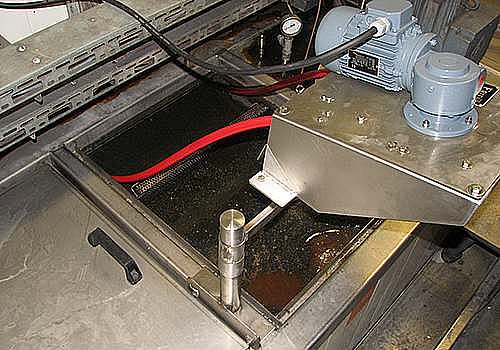
How the Oleophilic Collector Hose Works
Most of the oleophilic collector hose floats freely on the water surface, while only a small section passes through the oil skimmer, where it is driven continuously and stripped by the scraper mechanism.
The floating oil-and-grease mixture first adheres to the surface of the oleophilic collector hose. The contaminated hose is then drawn into the oil skimmer, where the adhering oil and grease are removed by the scraper mechanism and collected.
Compared with the other skimming systems tested, a key advantage of the FRIESS hose-type oil skimmer is its approximately 5 m long collector hose, which allows it to cover most of the surface of the settling tank.
As the collector hose continuously circulates across the water surface, it creates a gentle rotating flow. Even highly viscous oil-and-grease mixtures are gradually moved toward the collector hose, where they can be picked up and removed.
Anti-Clogging Installation Design
Once the oil-and-grease mixture adheres to the oleophilic collector hose, it is carried into the oil skimmer as the hose circulates.
Because the recovered contaminants are highly viscous and sticky, the oil skimmer was specially positioned so that the oil and grease removed by the scrapers can fall vertically into a collection container.
For this purpose, the oil skimmer was installed outside the settling tank and mounted on a support frame with an open bottom.
The removed sludge falls directly through the support frame into an open collection container positioned beneath the oil skimmer. This arrangement reliably prevents clogging caused by highly viscous contaminants.
At the same time, no additional cleaning work is required.