
FRIESS W40 Automotive Forging-Wastewater Case Study
Virtually Oil-Free Wastewater,
Reliable Treatment in Forging
Case Background
The Task
The operator reported a lubricating-oil consumption of approximately 1,000 litres every 20 days. The skimming system in each wastewater collection tank had to remove this volume of oil and transfer it to a mobile waste-oil collection container.
For environmental protection, the tanks had to be double-walled and equipped with leak and level monitoring. The limited available space also placed very high demands on the construction and design of every component.
Because the operator had already achieved positive results with FRIESS oil-skimmer systems at other locations, it recommended that the system manufacturer contact FRIESS.
Engineering and Solution
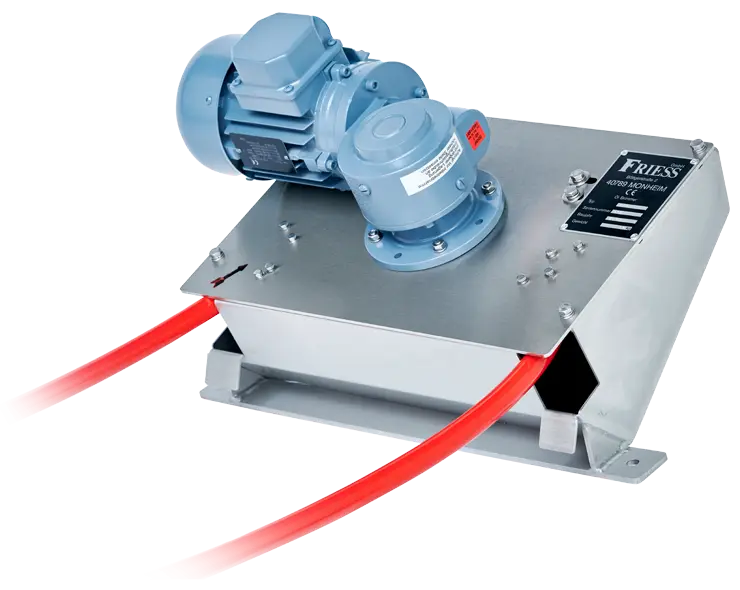
Because the wastewater collection tanks had to fit within the existing production building, space was severely limited. To accommodate the initially required wastewater volume of approximately 40 m³, two differently sized tanks were designed. The final capacity was reduced from 40 m³ to 30 m³ per tank. Each tank was equipped with a FRIESS W40 oil skimmer and a guided floating oil-collection hose to remove the floating phase over a large surface area.
The floating collection hose continuously picks up the oil phase from the wastewater surface. Ceramic scraper blades inside the W40 remove the oil from the hose, and the separated oil flows through a funnel into a sealed, double-walled waste-oil container with a capacity of 1 m³.
When the waste-oil container reaches its maximum level, a level sensor stops the skimmer and issues a notification. The collected oil is then pumped from the container for disposal.
The water level in each wastewater tank is monitored by sensors. When the maximum level is reached, the basement feed pumps are shut down. The interstitial space between the double walls is also monitored for leaks. The de-oiled wastewater is periodically removed by a vacuum tanker through a suction connection on each tank; any leak triggers an alarm.
A standalone PLC controller operates the complete skimmer system and is linked to the higher-level control room, allowing operation either from the system PLC or from the central control system.
Two Wastewater Collection Tanks with W40 Oil Skimmers and Waste-Oil Containers
