
Coolant Purification and KSS Filtration Guide: Magnetic Filters, Oil Skimmers and Coolant Maintenance

Article Navigation
01 · Contamination Sources and Operating Risks
Why must metalworking coolant be continuously cleaned and regenerated?
Coolant purification and filtration are essential because metalworking coolant—known in German as Kühlschmierstoff (KSS), and often referred to as grinding or drilling fluid—performs cooling, lubrication, chip flushing and corrosion-protection functions. Its cleanliness directly affects machining quality, equipment life and process stability.
Many industrial manufacturing processes depend on coolant. It removes heat generated between the tool and workpiece while lubricating the cutting zone. At the same time, metal chips and fines, grinding-wheel debris, way oil and hydraulic oil continuously enter the coolant tank.
If these contaminants remain in the system, workpieces, tools, pumps, valves and nozzles suffer additional wear, while process stability and finished-part quality decline. Continuous contaminant removal is therefore essential for reliable machining.
Chips and Abrasive Fines
Large chips settle in the tank, while fine abrasive particles recirculate with the fluid and wear machining surfaces and system components.
Way Oil and Hydraulic Oil
Tramp oil floats on or disperses in the coolant, destabilising the emulsion and creating favourable conditions for microbial growth.
Bacteria and Fungi
Poorly maintained coolant is vulnerable to microbial contamination, causing odour, loss of performance and potential health risks for operators.
Continuous Purification
Filtering particles, removing tramp oil and monitoring coolant condition stabilise machining quality and extend coolant service life.
02 · Staged Purification by Particle Size
Remove large chips first, then filter fine and magnetisable particles
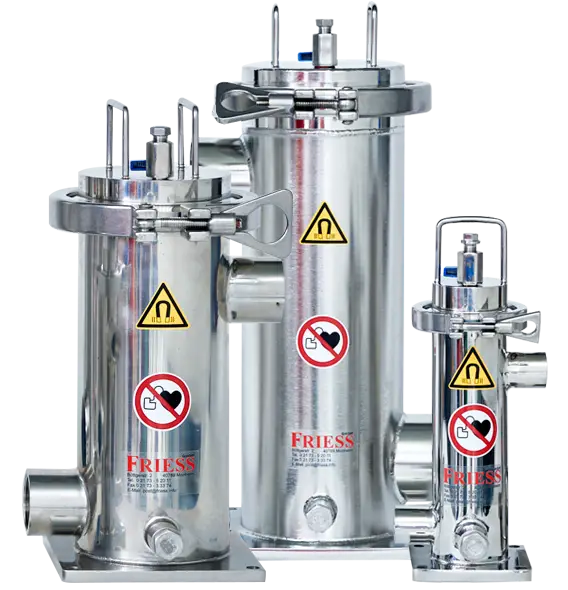
Different contaminants require different treatment stages. Large chips can be removed by a chip conveyor, while smaller particles require mechanical filtration. Fine steel and magnetisable stainless-steel particles can be captured by magnetic filtration without filter media.
Operating limits of magnetic filtration
Magnetic filtration is effective only for magnetisable particles. In suitable applications, however, it can achieve very high separation efficiency and may eliminate the need for belt or secondary filtration. Whether it can replace belt or bag filtration depends on particle material, flow rate and the target cleanliness level.
Chip Removal
Large chips settle at the bottom of the tank and can be continuously discharged by a belt-type or other chip-conveying system.
Belt Filtration
Roll-fed filter media advances as the contamination load increases. Used filter media is collected and disposed of at regular intervals.
Bag Filtration
Often used as a polishing stage to remove particles that remain after belt filtration, but filter bags must be replaced and disposed of manually.
Magnetic Filtration
Efficiently captures steel and magnetisable stainless-steel particles without disposable filter media.
System Selection
Configure the filtration stages according to particle material, size distribution, flow rate and target cleanliness.
03 · Removing Tramp Oil and Light Contaminants
Continuously remove grinding oil, way oil and hydraulic oil with an oil skimmer
Grinding oil, way oil, hydraulic oil and other light oil contaminants generally float on the coolant surface and can be removed continuously with an oil skimmer. Reducing the surface oil layer also improves oxygen exchange and lowers the risk of emulsion instability and microbial growth.
- Belt oil skimmers: Suitable for smaller tanks; a continuously moving belt carries surface oil out of the fluid.
- Tube oil skimmers: Suitable for larger tanks or pits, covering a wider surface area and tolerating moderate liquid-level fluctuations.

04 · Operation, Maintenance and Occupational Safety
A stable system reduces maintenance work but does not replace condition monitoring
Every continuously operating coolant system requires operation, inspection and maintenance, and the associated labour is part of its operating cost. A well-designed, stable system can significantly reduce routine maintenance and inspection, but it still requires disciplined coolant management and safety procedures.
- Monitor coolant condition continuously: Check concentration, pH, appearance, odour and contamination load at defined intervals so changes are detected early.
- Keep the purification system effective: Remove deposits on schedule and inspect conveying, filtration and skimming components to prevent a loss of treatment capacity.
- Apply workplace safety rules: Improper coolant use can pose health risks. Protective measures should be based on the site risk assessment and occupational-safety requirements.
05 · Purification Costs and Potential Savings
Evaluate equipment, consumables, energy, maintenance and disposal costs together
Main Operating Costs
Coolant purification commonly combines chip removal, filtration and tramp-oil removal. In addition to equipment investment, consider:
- Filter media used by belt or bag filters
- Replacement and maintenance of belt or tube skimmer components
- Centrifuges avoid filter consumables but generally require more operating energy
- Energy and maintenance costs for pumps and conveying systems
- Disposal costs for used filter media, separated oil and spent coolant
Main Areas of Saving
- Reduce wear on pumps, valves, nozzles, tools and other components
- Reduce full tank changes and the associated production downtime
- Extend coolant service life and reduce concentrate purchases
- Reduce transport, treatment and wastewater-disposal costs
Energy use in magnetic filtration
The separation process uses permanent magnets and requires neither filter media nor additional excitation energy. The magnets themselves are virtually wear-free. Motor-driven sludge discharge, conveying systems or circulation pumps still consume energy and require maintenance.
06 · Top-Up, Regeneration and Final Coolant Replacement
Purification extends service life significantly, but coolant does not last forever
Leakage, carry-out and concentration correction
Even with good maintenance, machine leakage, workpiece carry-out and concentration adjustment consume coolant. Water or concentrate must therefore be added according to test results.
Coolant still requires replacement at the end of its service life
Purification can extend the operating cycle significantly, but it cannot stop chemical ageing indefinitely. When the coolant no longer meets production requirements, it must be replaced correctly.
The value of continuous cleaning and regeneration
Continuous cleaning and regeneration significantly reduce coolant consumption, extend change intervals and lower the volume of spent fluid requiring costly disposal or wastewater treatment.
07 · Conclusions and System Selection
Treat coolant maintenance as part of the production system
Coolant cleaning and regeneration require equipment investment, but they usually deliver long-term economic benefits by reducing fluid consumption, component wear, downtime and disposal. Lower coolant consumption also means less purchasing, transport and disposal, helping reduce the environmental load and carbon footprint of production.
Filtration and regeneration systems should be selected according to contamination type, treatment flow rate, tank volume and target cleanliness rather than relying on a single device for every contaminant.
Main benefits of continuous maintenance
- Reduce coolant purchasing costs and consumption
- Some FRIESS purification solutions require no filter media
- Lower spent-fluid disposal costs
- Reduce fluid changes, wear and unplanned downtime
- Reduce the environmental impact of production
Need a purification solution matched to your operating conditions? Request Expert Advice → Learn how to test coolant →