
Hydraulic Oil Particle Contamination: How It Causes Machine Failures
What Functions Does Hydraulic Oil Perform in a Hydraulic Drive System?
Hydraulic oil performs several essential functions in a hydraulic drive system:
- It transfers the energy generated by the pump to a hydraulic cylinder or motor.
- It minimises friction between surfaces that slide against one another.
- It protects internal system components against corrosion.
If the oil can no longer perform any one of these functions reliably, wear accelerates and the machine may ultimately suffer component failure or unplanned downtime.
How Contaminant Particles in Hydraulic Oil Cause Machine Failures
One of the principal causes of premature wear and failure is damage to the lubricating film between moving components. Many contaminant particles are similar in size to the clearances between sliding surfaces, allowing them to enter the most sensitive friction zones.
When two surfaces move relative to one another and a particle contacts both surfaces at the same time, local material fatigue and microscopic breakaway can occur. The detached material becomes a new wear particle, which accelerates further wear of the hydraulic component.
Because each particle can generate additional particles through this process, solid contamination can multiply throughout the hydraulic oil and eventually cause valves, pumps and other hydraulic components to fail. Regular oil analysis provides an early indication of oil contamination and ageing.

Smaller particles may pass through lubricating clearances but strike the edges of nozzles, valve spools and similar components at high velocity. Like continuous sandblasting, this gradually erodes the component surface.
The result is reduced positioning repeatability and, ultimately, component failure.
To reduce hydraulic-system failures, as many contaminant particles as possible should therefore be removed continuously. Lubricating clearances within a hydraulic system can range from approximately 1 µm to well above 100 µm. Particles of different sizes can enter the corresponding clearances and cause damage, while even smaller particles contribute to abrasive wear.
Solution: FRIESS Electrostatic Hydraulic-Oil Purification
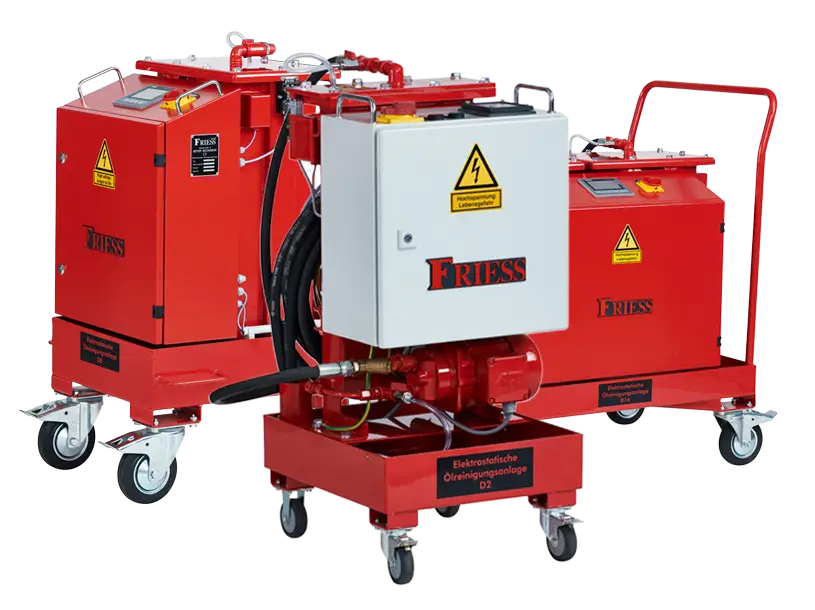
FRIESS electrostatic oil-cleaning systems can reduce this type of hydraulic failure by up to approximately 90%. Their operating principle allows them to remove both extremely fine particles down to about 0.05 µm and larger particles exceeding 100 µm.
Conventional filtration primarily relies on filter-media pore size. Electrostatic purification instead uses an electric field to deflect solid contaminants and capture them in collector media, so performance is not limited to one fixed particle size.
The hydraulic oil itself and additives dissolved in the oil are not captured in the same way as solid contamination. Foreign solid particles are continuously removed from the circulating oil.
By directly controlling an important cause of hydraulic failure—particle contamination—electrostatic purification helps reduce component wear, improve operating reliability and extend the service life of both the oil and hydraulic components.
Note: FRIESS also provides oil analysis and purification services for hydraulic-system operators; these services do not include equipment repairs or spare parts.
Particles and oxidation products building up in your hydraulic oil?
Please share your oil grade, reservoir volume, ISO 4406 cleanliness level, particle and varnish condition, equipment fault symptoms, existing filtration method and target values. Our China engineering team can recommend an EFR electrostatic oil-cleaning configuration and bypass purification cycle based on the contamination source.