
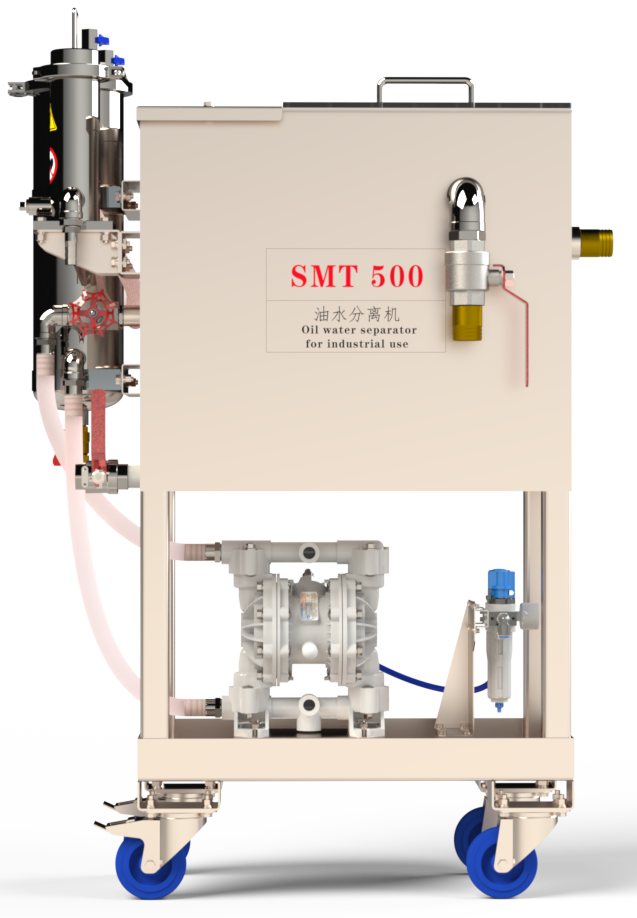
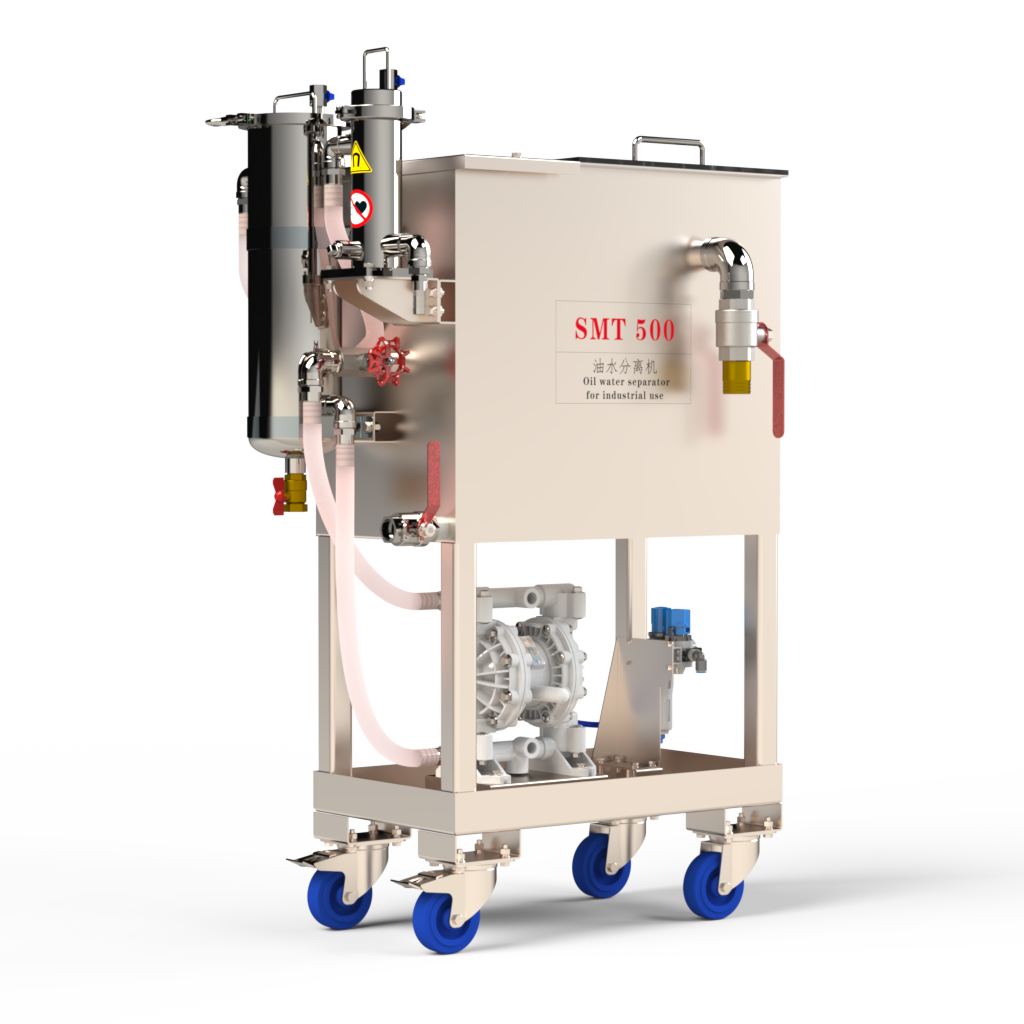
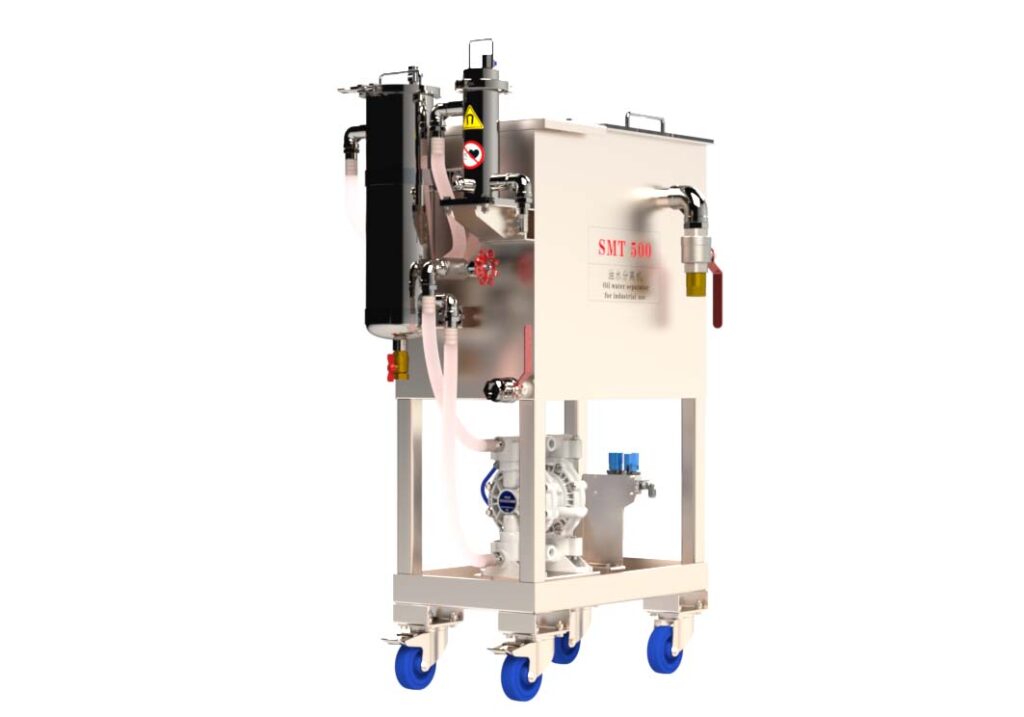
One mobile unit.
Clean multiple tanks.
Continuous bypass treatment removes floating oil and coalescible oil droplets from cutting, grinding and washing fluids. Move the unit between tanks without modifying the existing fluid-supply system.
Standard flow rate: 600 L/h, with 350 μm basket pre-filtration. Add an optional FMF 240 magnetic filter to remove fine ferromagnetic particles.
600 L/h
Standard Flow Rate
350 μm
Stainless-Steel Basket Filtration
Multiple-Tank Service
Mobile on Castors · Bypass Operation
Down to 1 μm
Optional FMF 240
Understand the SMT500V Process in One Minute
One Unit for Multiple Tanks
SMT500V operates as an independent bypass system and can purify different tanks in rotation without modifying the machine tool’s existing fluid-supply system. It is ideal for plants seeking higher equipment utilization and fewer permanently installed purification units.
- Coolant tanks on CNC machining centres, lathes and milling machines
- Grinding machines and grinding-fluid circulation systems
- Industrial washers and washing-liquid tanks
- Individual machine tanks and small central fluid systems
- Sites requiring one purification unit to rotate between multiple tanks
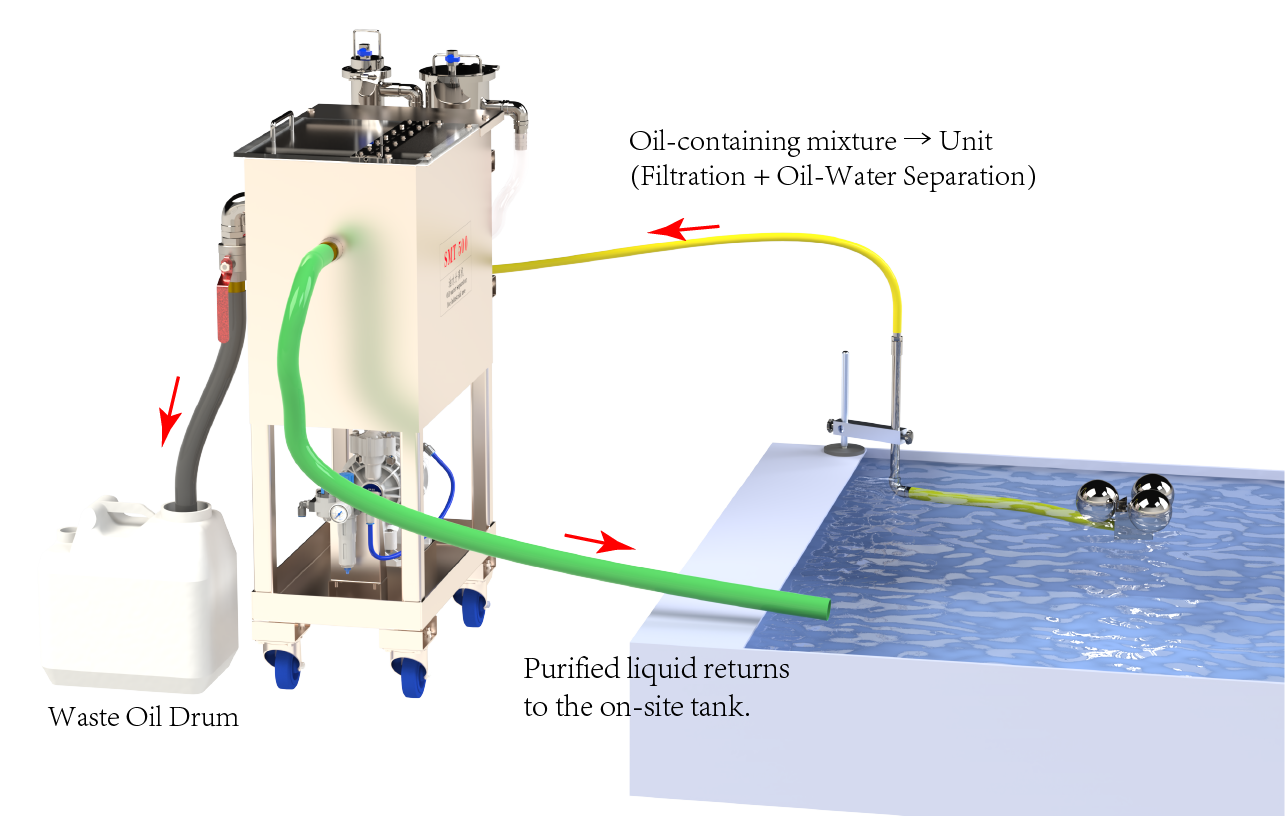
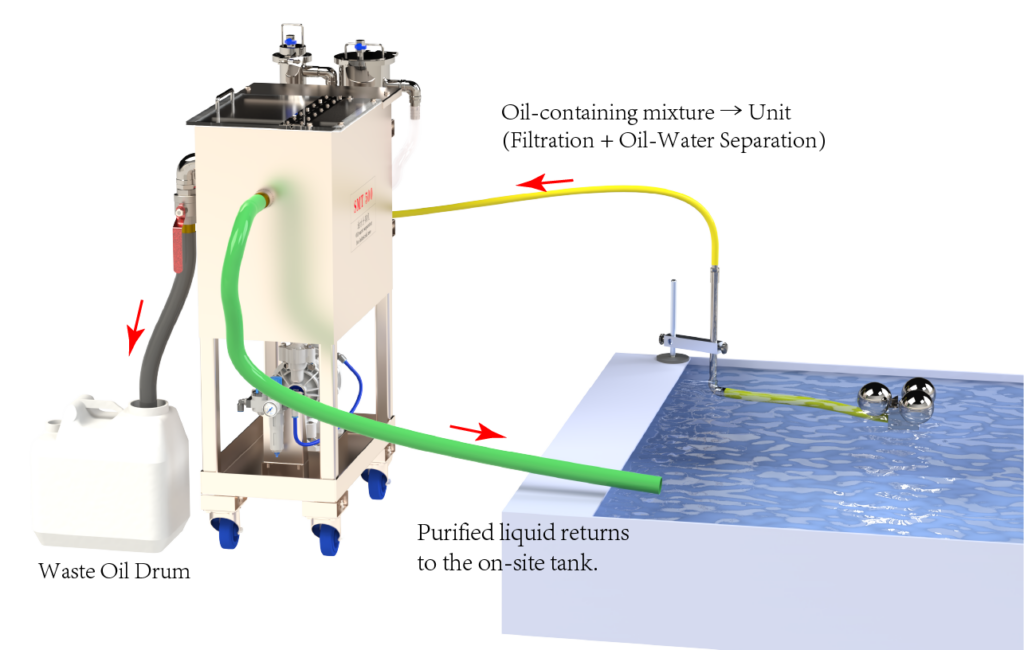
Four Steps of Continuous Bypass Purification
From floating surface intake to the return of purified fluid, SMT500V provides continuous circulation without altering the machine tool’s existing fluid-supply system.
01 Floating Surface Intake
The floating intake follows changes in liquid level and preferentially draws oil-contaminated fluid from near the surface.
02 Basket Pre-Filtration
A 350 μm stainless-steel basket retains larger chips and solid particles, reducing the risk of blockage in downstream components.
03 Coalescing Separation
Fine dispersed oil droplets adhere to the oleophilic coalescing media, collide and combine into larger droplets.
04 Oil Discharge and Clean-Fluid Return
The coalesced oil droplets rise and are discharged, while the treated fluid returns to the original tank by gravity.
Standard Configuration and Optional Upgrades
Select the configuration according to the contaminants in the fluid. The standard unit focuses on oil-water separation and retention of larger solids; an additional magnetic filtration stage can be added where fine ferromagnetic metal particles are present.
Standard Configuration
Oil Separation and Solid-Particle Pre-Filtration
- Standard flow rate: 600 L/h
- Continuous removal of floating oil and coalescible dispersed oil droplets
- 350 μm stainless-steel basket filter
- Retention of larger chips and solid particles
- Mobile bypass operation for multiple tanks
Physical coalescing separation requires no chemical additives.
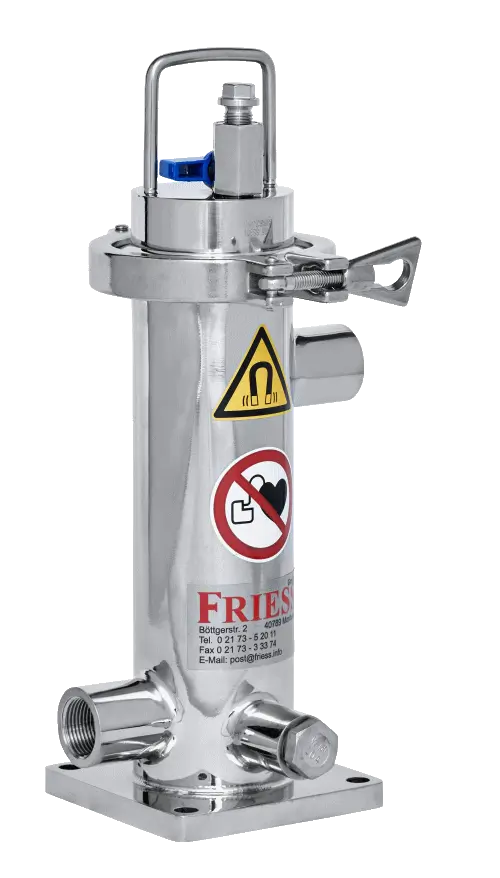
Optional Configuration
FRIESS FMF 240 Magnetic Filter
- Removes fine ferromagnetic metal particles
- Filtration down to 1 μm for ferromagnetic particles
- Suitable for grinding, cast-iron machining and similar fine magnetic-particle applications
- Combines with SMT500V for coordinated removal of oil and solid particles
Note: The 1 μm rating refers only to the optional FMF 240 filtration of ferromagnetic particles. The standard SMT500V basket filter is rated at 350 μm.
SMT500V Technical Specifications
The following are the main technical specifications for the standard SMT500V configuration. The actual configuration can be adapted to tank conditions, contaminant type and operating requirements.
Model
SMT500V
Standard Flow Rate
600 L/h
Oil-Water Separation Method
Physical separation with oleophilic coalescing media
Treatable Oils
Floating oil and coalescible dispersed oil droplets
Standard Pre-Filter
350 μm stainless-steel basket filter
Operating Method
Independent bypass circulation
Mobility
Castor-mounted for rotation between multiple tanks
Purified-Fluid Return
Gravity return to the original tank
Optional Configuration
FRIESS FMF 240 magnetic filter
Optional Filtration Rating
Down to 1 μm for ferromagnetic particles
Technical note: SMT500V uses physical filtration and coalescing separation and does not include ultraviolet, ozone or other disinfection equipment. It primarily treats floating oil and coalescible dispersed oil droplets and is not designed to remove stable emulsified oil. Other filtration equipment may be required for fine non-magnetic particles.
Get SMT500V Selection Advice
Tank volume, liquid-level variation, oil type and solid-particle conditions all affect equipment configuration. Provide the following operating information and we will confirm whether SMT500V is suitable and recommend the appropriate configuration.
- Number of tanks and effective volume
- Liquid-level range and surface area
- Type of cutting, grinding or washing fluid
- Type and approximate load of floating oil
- Type of solid particles and whether they are magnetic
- Target treatment time and operating schedule
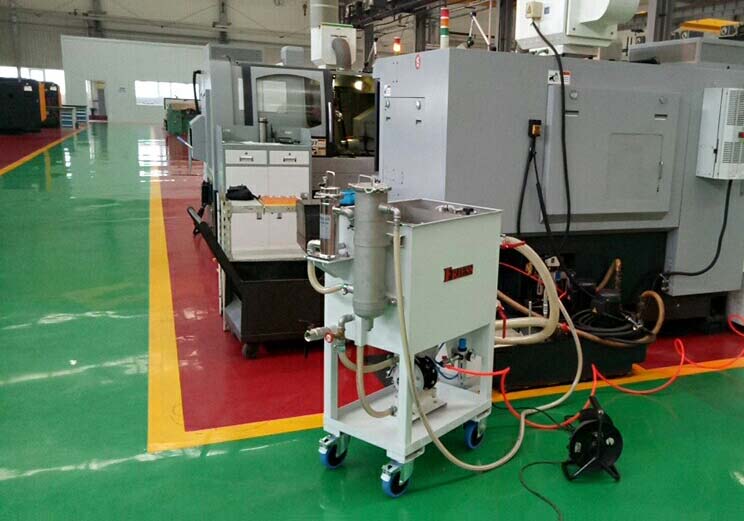
SMT500V in the Field
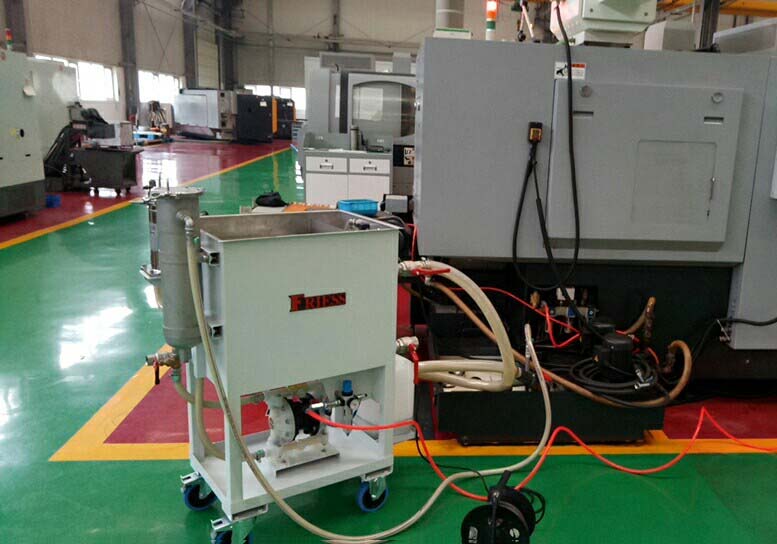
Why Continuously Remove Tramp Oil from Coolant?
When machine-way oil, hydraulic oil and other tramp oils enter the coolant, they usually form a floating oil layer on the surface. Long-term accumulation can affect tank condition and routine maintenance and may increase the risk of odour and fluctuations in fluid performance.
Continuous bypass removal of floating oil and coalescible dispersed droplets helps keep tanks clean, reduces the return of tramp oil to the machining circuit, and lowers the need for tank cleaning, fluid replacement and waste-fluid disposal. Actual results depend on fluid condition, contaminant load and operating time.
Reduce Floating-Oil Accumulation
Continuously remove surface tramp oil before the oil layer thickens.
Reduce Tramp-Oil Recirculation
Lower the chance of floating oil re-entering the machine-fluid circuit.
Reduce Maintenance Demand
Reduce tank cleaning, fluid replacement and waste-fluid disposal requirements.
How Does the SMT500V Remove Dispersed Oil Droplets by Coalescence?
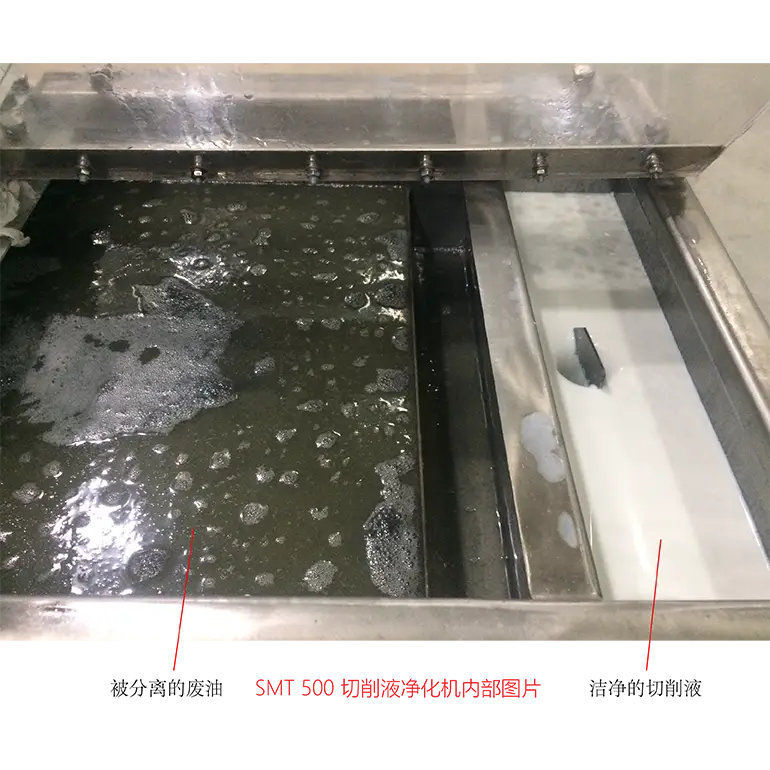
After pre-filtration, the oil-bearing fluid enters the separation unit and passes through an oleophilic coalescing medium. Fine dispersed oil droplets are captured, collide and merge on the medium, gradually forming larger droplets. As their diameter increases, the droplets rise faster, collect at the surface and are discharged, while the treated fluid returns to the original tank by gravity. The entire process is physical and requires no chemicals.
Coalescing Medium
The oleophilic coalescing medium provides a large contact area for fine dispersed oil droplets. As the fluid flows through it, droplets attach, collide and merge, shortening the time required for subsequent rising and separation.
Why Must Fine Oil Droplets Coalesce into Larger Droplets?
Under ideal conditions such as low Reynolds numbers and approximately spherical droplets, smaller oil droplets require much longer to rise naturally. Coalescence combines fine droplets into larger droplets, accelerating their rise and separation.
Theoretical Rise Time for Oil Droplets of Different Sizes
Time Required for an Oil Droplet to Rise 75 mm (3 in)
| Oil-Droplet Diameter (μm) | Rise Time |
|---|---|
| 300 | 12 seconds |
| 150 | 42 seconds |
| 60 | 4 min 12 sec |
| 30 | 17 min 24 sec |
| 15 | 1 h 8 min 54 sec |
| 5 | 10 h 2 min 9 sec |
Note: The values in the table are theoretical results under specific assumptions. They illustrate how droplet size affects rise time and are not guaranteed equipment performance values. Actual separation time depends on fluid viscosity, temperature, density difference, droplet shape and flow conditions.
Stokes' Law and Theoretical Rise Velocity
According to Stokes’ law, under ideal conditions such as a low Reynolds number and approximately spherical droplets, the theoretical terminal rise velocity of an oil droplet is proportional to the square of its radius:
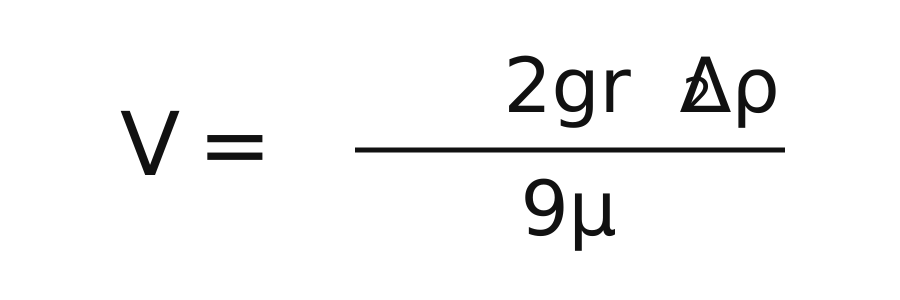
Symbols: V = terminal rise velocity of the oil droplet; g = gravitational acceleration; r = oil-droplet radius (half its diameter); Δρ = density difference between the continuous phase and the oil droplet; μ = dynamic viscosity of the continuous phase. The formula shows that terminal rise velocity is proportional to the square of the droplet radius.
When all other conditions remain equal and the formula applies, doubling the droplet radius increases its theoretical terminal rise velocity by approximately four times. Fine droplets must therefore first coalesce into larger droplets to substantially shorten rising and separation time.
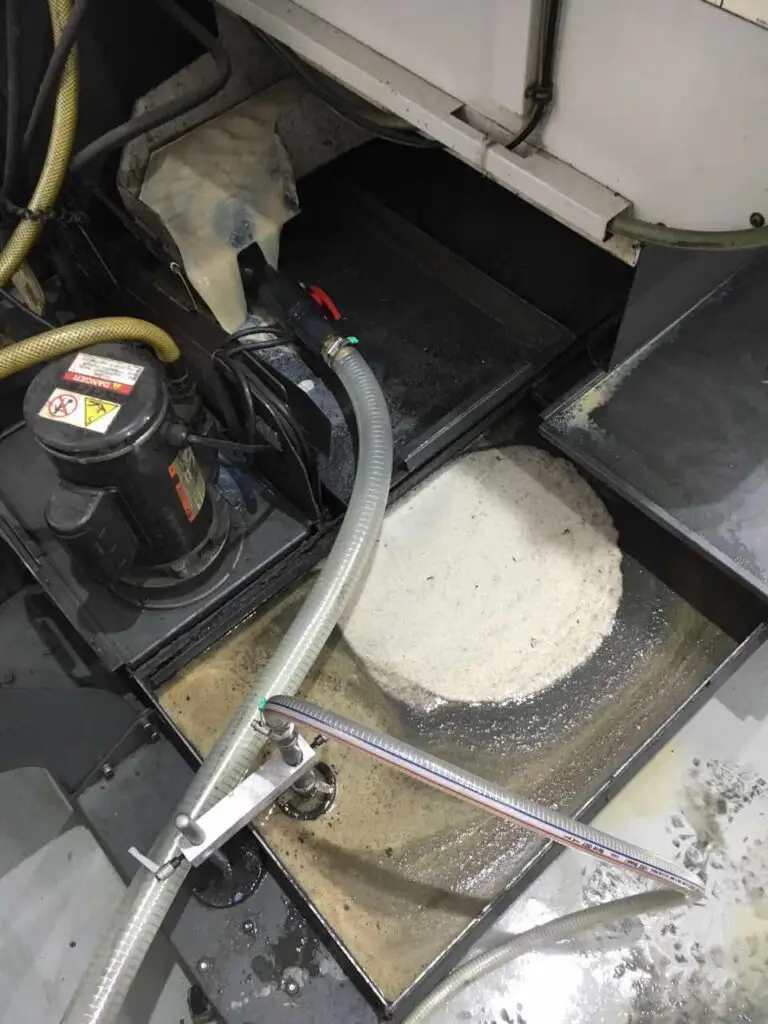
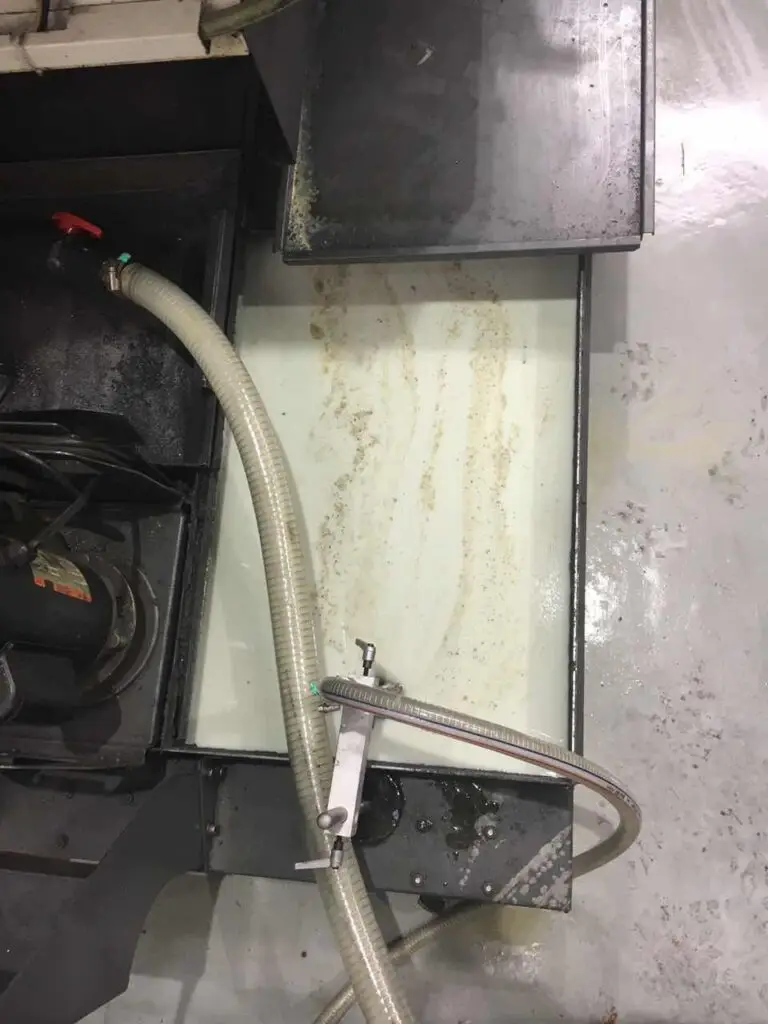
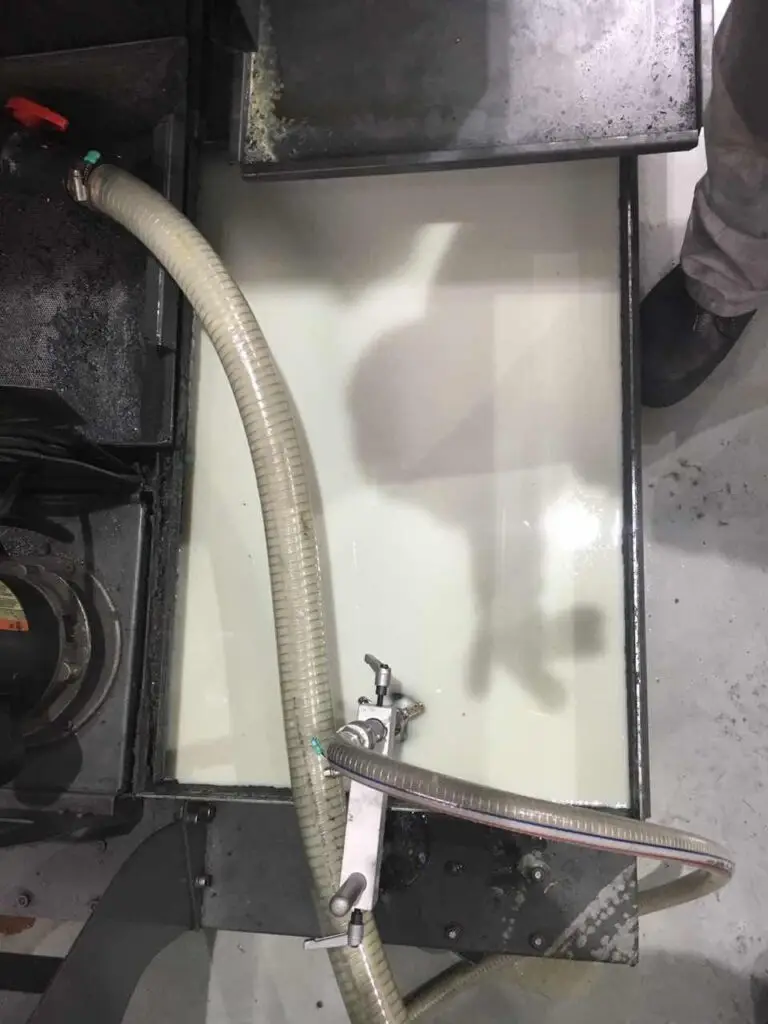
Field Results: Continuous Removal of Floating Oil from Coolant
The following field photographs show the liquid surface before, during and after SMT500V bypass treatment. Actual results and treatment time depend on tank volume, oil load, fluid condition and operating time.
Advantages of the SMT500V Coolant Purification System
- Castor-mounted design for flexible movement between machines or tanks
- Standard flow rate of 600 L/h; bypass connection does not interrupt the existing machine-fluid system
- Floating intake follows the liquid level and preferentially draws oil-rich surface fluid
- 350 μm stainless-steel basket pre-filter retains larger chips and solids
- Physical coalescing removes floating and coalescible dispersed oil without chemicals
- Pneumatic diaphragm pump; treated liquid returns to the tank by gravity
- 304 stainless-steel construction for industrial environments
- Optional FRIESS FMF 240 magnetic filter for ferromagnetic particles down to 1 μm
Typical Applications
- Water-based coolant tanks on CNC machining centres, lathes and milling machines
- Water-based grinding-fluid circulation systems
- Industrial washing machines and cleaning-fluid tanks
- Individual machine tanks and small central systems after application review
- Production sites requiring one purifier to rotate between multiple tanks
- Suitable for floating oil and coalescible dispersed droplets. Stable emulsions or special fluids require an application review; the optional FRIESS FMF 240 magnetic filter can be combined when fine ferromagnetic particles are also present.
Technical Data
- Model: SMT500V
- Standard treatment rate: 600 L/h
- Standard pre-filtration: 350 μm stainless-steel basket
- Treatable oil: floating oil and coalescible dispersed droplets
- Separation method: physical separation through an oleophilic coalescing medium
- Transfer method: pneumatic diaphragm pump
- Return method: gravity return
- Operating mode: bypass circulation
- Fluids: water-based cutting fluids, water-based grinding fluids and industrial cleaning liquids
- Housing material: 304 stainless steel
- Mobility: castor-mounted
- Option: FRIESS FMF 240 magnetic filter, down to 1 μm for ferromagnetic particles
➦ SMT500V Frequently Asked Questions
What Tank Size Is the SMT500V Suitable For?
Tank volume alone is not sufficient for selection. Oil load, target circulation rate and daily operating time must also be considered. The SMT500V has a standard treatment rate of 600 L/h; treatment time and rotation intervals for each tank are determined from the actual operating conditions.
Can the SMT500V Remove Metal Chips?
The standard 350 μm stainless-steel basket retains larger metal chips and solid particles. For fine ferromagnetic metal particles, the optional FRIESS FMF 240 magnetic filter can achieve filtration down to 1 μm.
Will the SMT500V Affect the Machine-Tool Fluid Supply?
Normally no, provided the unit is connected and the flow is set correctly. The SMT500V draws fluid independently from the tank through a bypass loop, and treated fluid returns by gravity, allowing operation separately from the machine tool’s original supply system.
Can the SMT500V Treat Emulsified Oil?
The SMT500V is designed for floating oil and coalescible dispersed oil droplets, not oil that has formed a stable emulsion. If the oil condition is uncertain, please provide a fluid sample or field photographs for assessment.
Can One SMT500V Serve Multiple Tanks?
Yes. The unit is mounted on castors and can be moved between tanks for rotational purification. The appropriate interval depends on tank volume, oil load and target treatment time.
Does the SMT500V Include UV or Sterilisation Equipment?
No. The SMT500V uses physical pre-filtration and coalescing separation and does not include UV, ozone or other sterilisation equipment. Its main purpose is to remove floating oil and coalescible dispersed droplets, while the 350 μm stainless-steel basket retains larger solids.
Other Product Options
Depending on your required flow rate, mobility, and oil removal needs, you may also consider the following products.
Separates floating oil, removes particles and circulates coolant for purification. Its compact, mobile design is ideal for servicing multiple machine tools while helping extend coolant life and reduce fluid-change frequency.
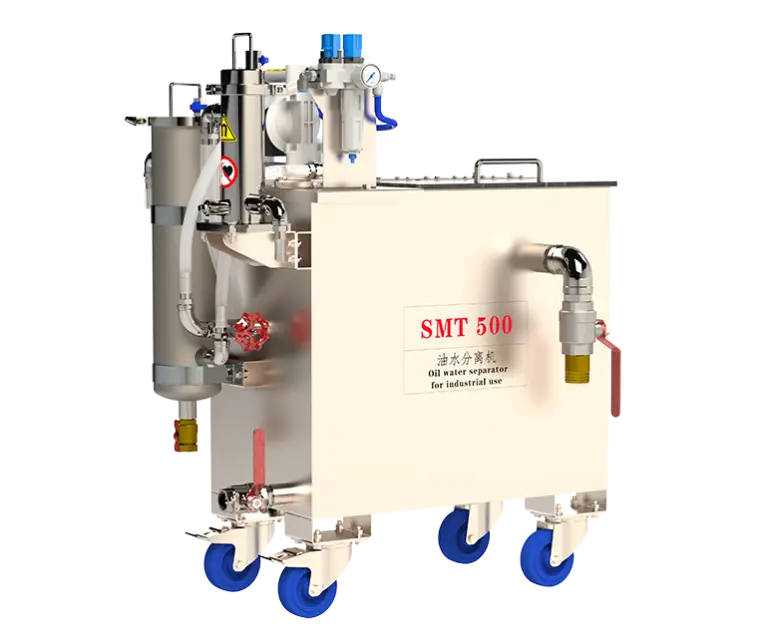
Combines proven FRIESS 1U oil-skimming technology with continuous oil-water separation. It reliably discharges separated floating oil, helping keep coolant cleaner and reduce manual tank maintenance.

Beyond cost savings, FRIESS oil skimmers, electrostatic oil cleaners, magnetic filters, coolant purification systems, oil-water separators and vacuum oil purifiers provide many additional benefits.
We would be pleased to explain how they can help your process.