
Compact and mobile.
Clean multiple tanks.
Compact coolant purification at 600 L/h. Continuous bypass treatment removes floating oil and coalescible oil droplets from cutting, grinding and washing fluids, returning clean fluid to the tank.
Manufacturer: Wuhan Ouyi Environmental Protection Equipment Co., Ltd. · Origin: China
For CNC machining centres, grinders and industrial washers, with one mobile unit serving multiple tanks. Add an optional FMF 240 magnetic filter for fine ferromagnetic particles.
SMT500C Product Photos
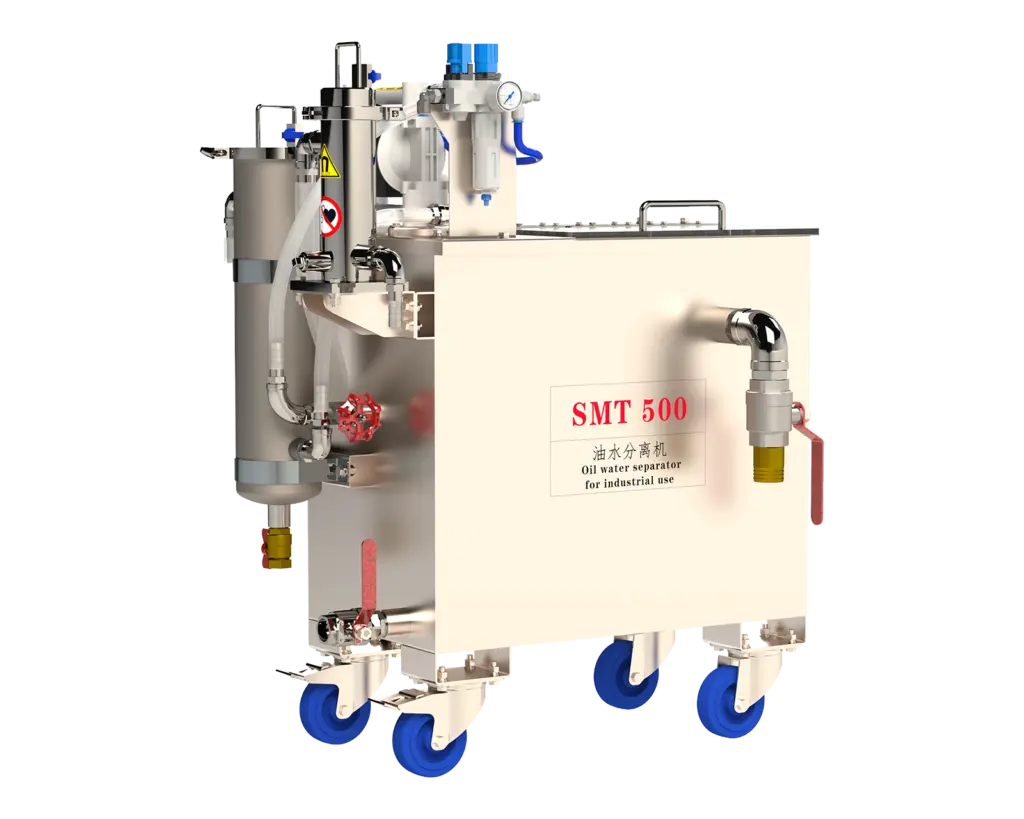
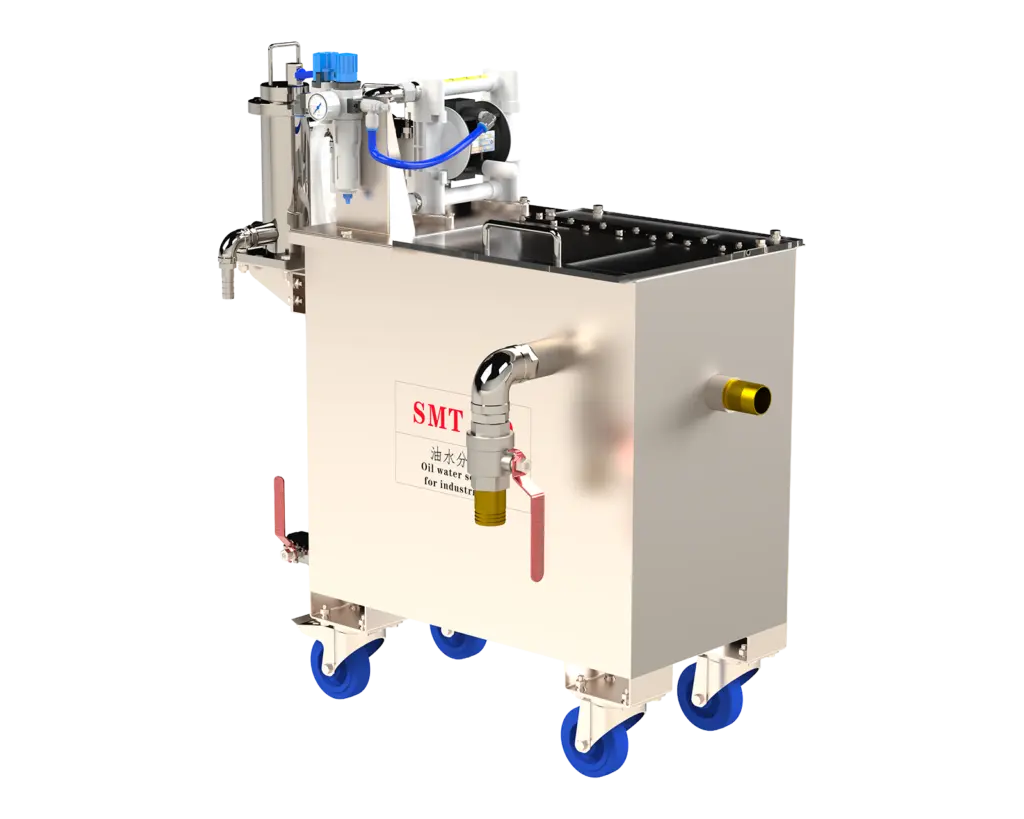
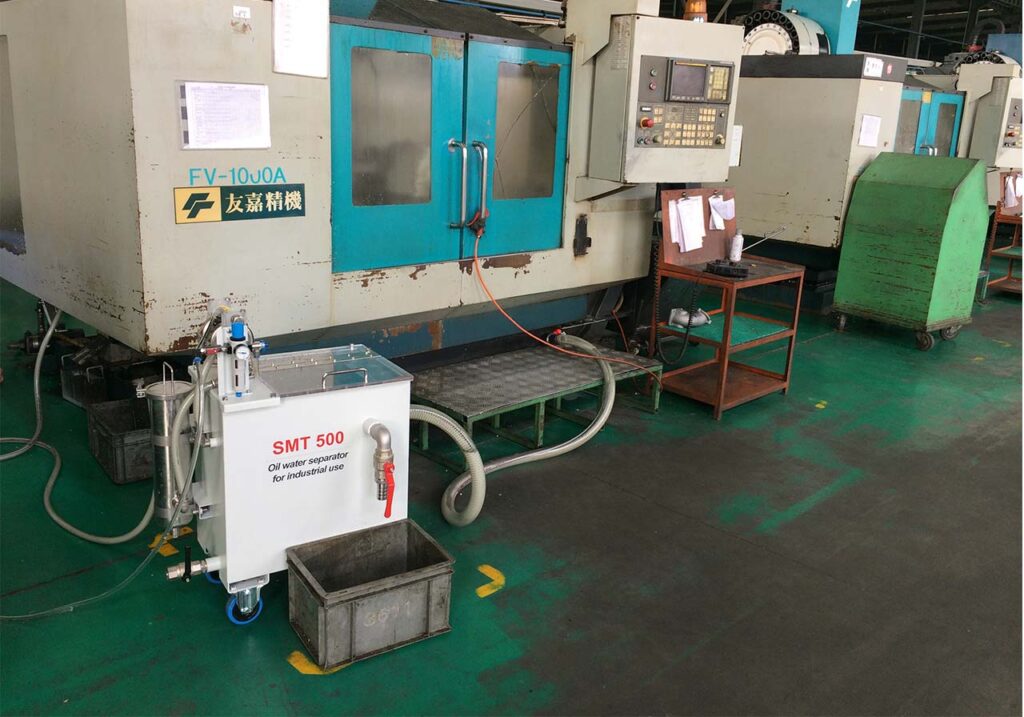
A compact and mobile bypass purification solution
Installing a fixed purification unit for every machine or tank increases both floor-space requirements and investment. The compact mobile SMT500C can be moved to the required tank and operated independently. It draws fluid, separates oil and returns the treated fluid without modifying the machine’s existing fluid supply system.
Compact and mobile
Independent bypass
Continuous oil removal
Optional upgrade
SMT500C process flow and bypass circulation
Pipe colour key — Yellow: oil-contaminated liquid transfer; Green: treated-fluid return; Dark grey: separated-oil discharge
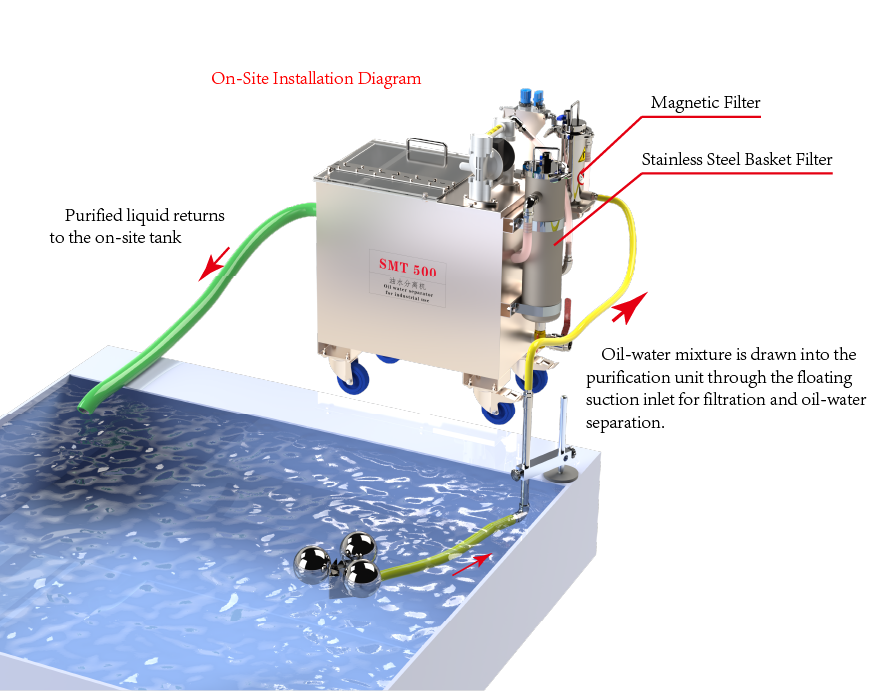
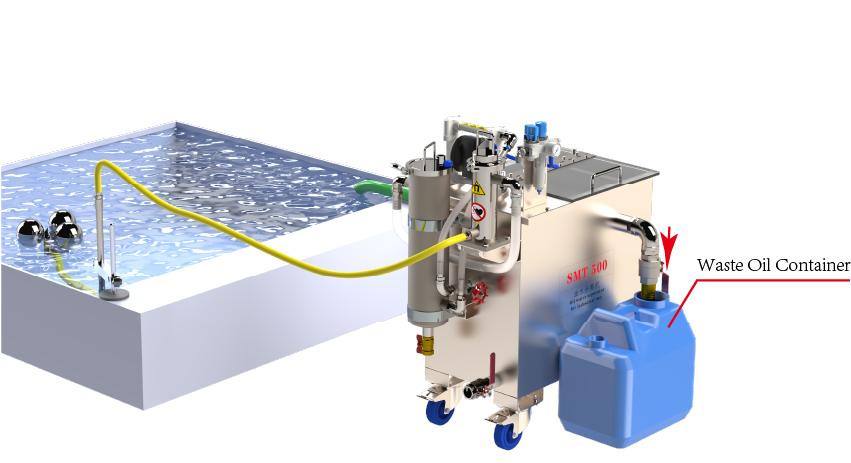
01 Surface pickup
The floating suction device follows changes in liquid level and preferentially draws the oil-rich layer near the surface.
02 Bypass transfer
Oil-contaminated fluid is transferred through an independent bypass without altering the machine’s existing supply system.
03 Coalescing separation
Small oil droplets attach to the oleophilic coalescing medium, collide and merge into larger droplets.
04 Separated-oil discharge and treated-fluid return
Coalesced droplets rise and are discharged, while treated fluid returns to the original tank by gravity.
Standard configuration and optional upgrade
Select the configuration according to the contaminants present. The standard system focuses on oil-water separation and interception of larger solids; a magnetic filtration unit can be added for fine ferromagnetic particles.
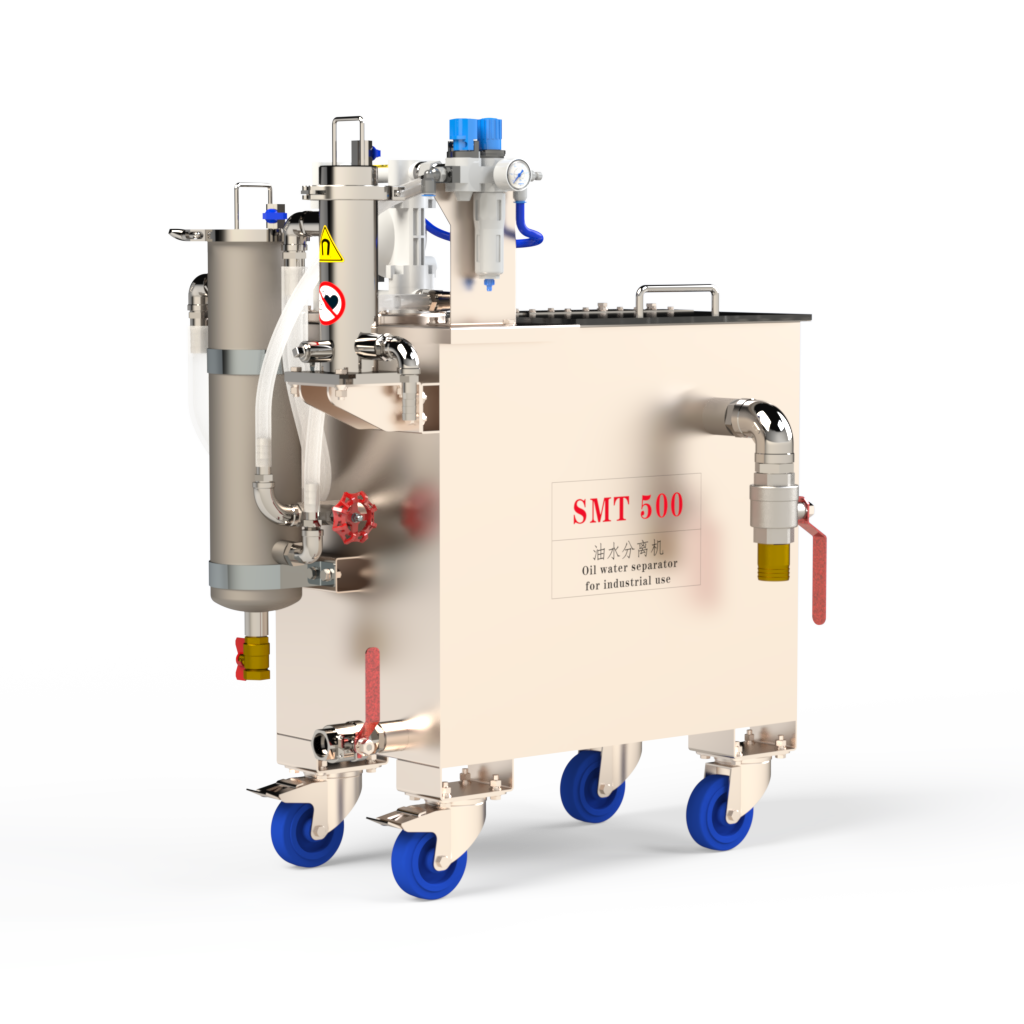
Standard configuration
Oil-water separation and solids pre-filtration
- Nominal flow rate: 600 L/h
- Continuous removal of floating oil and coalescible dispersed droplets
- 350 μm stainless-steel basket filter
- Interception of larger chips and solid particles
- Mobile bypass operation across multiple tanks
Uses physical coalescing separation without chemical additives.
Optional configuration
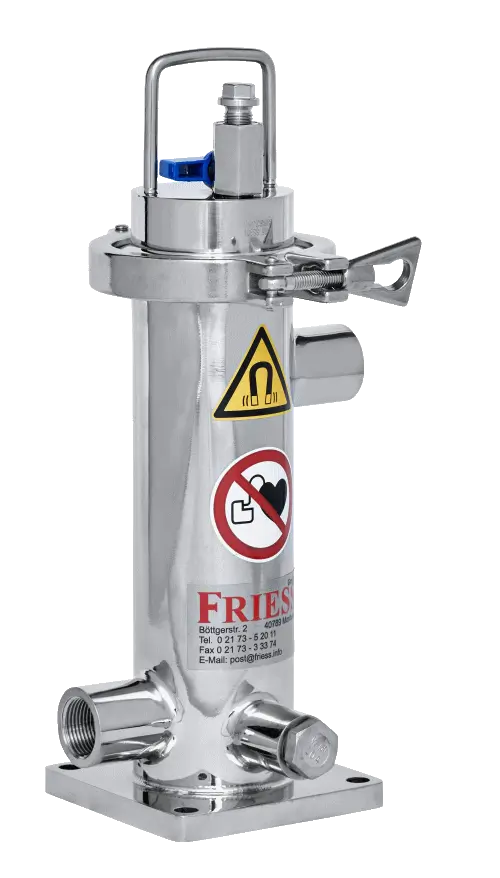
FRIESS FMF 240 magnetic filter
- Removes fine ferromagnetic metal particles
- Filtration capability down to 1 μm for ferromagnetic particles
- Suitable for grinding, cast-iron machining and processes with fine magnetic particles
- Can be combined with the SMT500C for coordinated oil and solids removal
Note: The 1 μm figure applies only to the optional FMF 240 and ferromagnetic particles. The standard SMT500C basket filter is rated at 350 μm.
SMT500C technical data
The following data applies to the standard SMT500C configuration. The final configuration can be adapted to tank conditions, contaminant type and operating requirements.
The SMT500C is designed primarily for bypass removal of floating oil and coalescible dispersed oil droplets from coolant, grinding fluid and industrial washing liquids. If fine ferromagnetic particles are also present, an optional FRIESS FMF 240 can be added. Stable emulsified oil, fine non-ferromagnetic solids or applications requiring disinfection call for additional treatment technologies.
SMT500C applications and selection limits
The SMT500C is designed primarily for bypass removal of floating oil and coalescible dispersed oil droplets from coolant, grinding fluid and industrial washing liquids. If fine ferromagnetic particles are also present, an optional FRIESS FMF 240 can be added. Stable emulsified oil, fine non-ferromagnetic solids or applications requiring disinfection call for additional treatment technologies.
Suitable applications
- Applications where the main contaminants are floating oil and coalescible dispersed droplets
- Grinding machines and grinding-fluid circulation systems
- Industrial washing machines and washing-fluid tanks
- Individual machine tanks and small central fluid systems
- Production sites requiring purification across multiple tanks
- Applications where the main contaminants are floating oil and coalescible dispersed droplets
Applications requiring further assessment
- Fluid composition, temperature or viscosity is outside the normal range
- Fine non-ferromagnetic solid particles must be removed
- UV, ozone or another disinfection function is required
- Solid-particle loading is very high or large amounts of grinding debris are present
- Large central fluid systems or required flow rates substantially above 600 L/h
- Fluid composition, temperature or viscosity is outside the normal range
The oil-contaminated liquid first passes through a 350 μm stainless-steel basket filter, then enters the separation chamber and flows through oleophilic coalescing media. Fine oil droplets are captured on the media, collide and merge into larger droplets. As they grow, their rising velocity increases, allowing them to collect at the surface for discharge. The treated liquid returns to the original tank by gravity.
Need greater system capacity and expandability? Explore the SMT500V mobile coolant purification system.
How does the SMT500C remove dispersed oil droplets by coalescence?
The oil-contaminated liquid first passes through a 350 μm stainless-steel basket filter, then enters the separation chamber and flows through oleophilic coalescing media. Fine oil droplets are captured on the media, collide and merge into larger droplets. As they grow, their rising velocity increases, allowing them to collect at the surface for discharge. The treated liquid returns to the original tank by gravity.
Three stages of coalescing separation
- Droplet capture
Oleophilic coalescing media provides a large contact area that captures fine dispersed oil droplets on its surface.
- Collision and coalescence
As the liquid flows, captured droplets collide and merge on the media, gradually forming larger droplets.
- Rising and discharge
Once enlarged, the droplets rise more quickly, form an oil layer at the surface and are discharged from the unit.
Why must small oil droplets coalesce and grow?
Under the applicable Stokes-law conditions—low Reynolds number and approximately spherical droplets—the theoretical terminal rising velocity is proportional to the square of the droplet radius. Doubling the radius therefore increases the theoretical rising velocity by approximately four times.
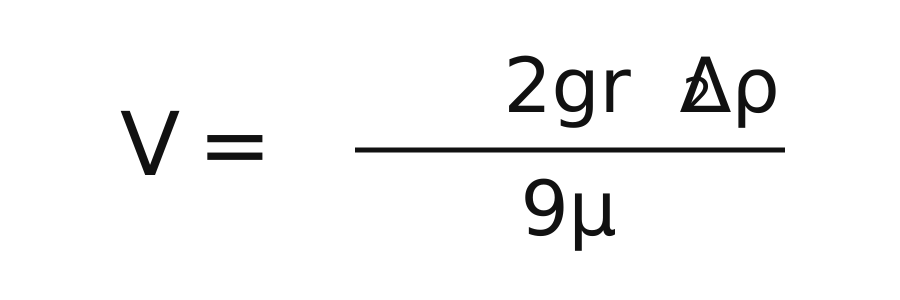
V: terminal rising velocity of the oil droplet; g: gravitational acceleration; r: droplet radius; Δρ: density difference between the continuous phase (water phase) and the oil droplet; μ: dynamic viscosity of the continuous phase.
Note: This relationship applies under ideal conditions such as low Reynolds number and approximately spherical droplets. Actual separation performance is also affected by viscosity, temperature, density difference, droplet shape, flow conditions and operating time.
Field video | SMT500C bypass purification across multiple tanks
Independent bypass operation: one unit for multiple tanks
This field video shows the SMT500C operating at a CNC machining site. The unit draws liquid independently from the target tank, passes it through basket pre-filtration and coalescing separation, and returns the treated liquid by gravity. No modification to the machine’s existing fluid supply is required, and one unit can be rotated among multiple tanks.
- Independent bypass operation without changing the machine’s existing fluid supply
- Castor-mounted mobility: one unit can serve multiple tanks
- Continuous removal of floating oil and coalescible dispersed droplets
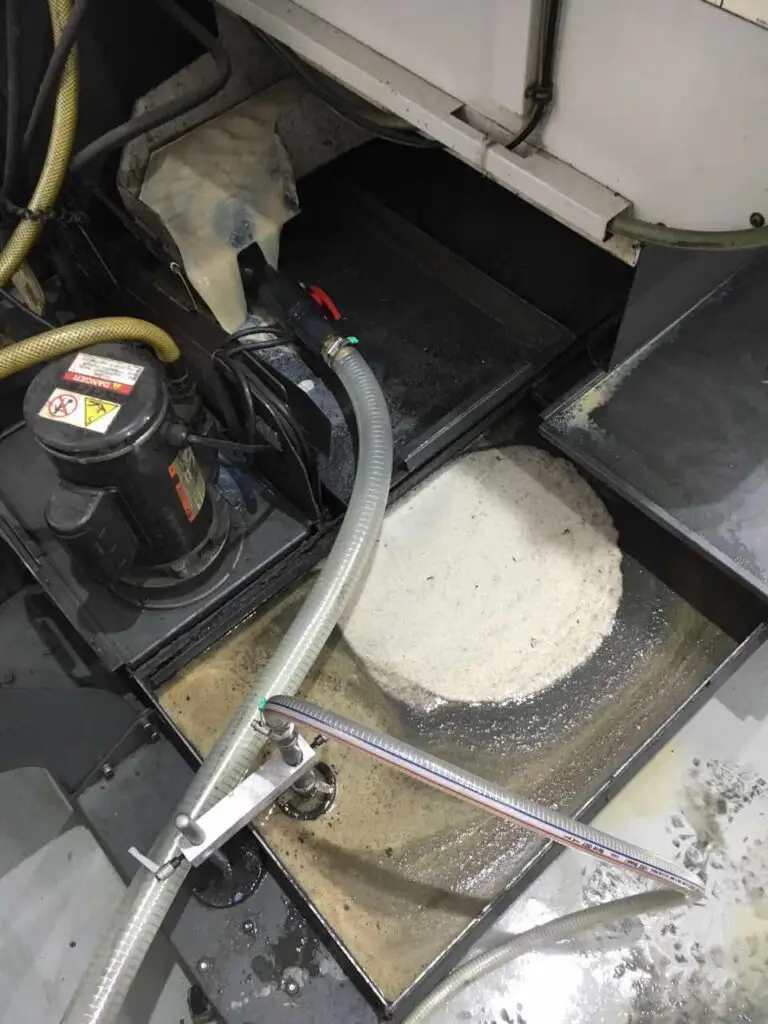
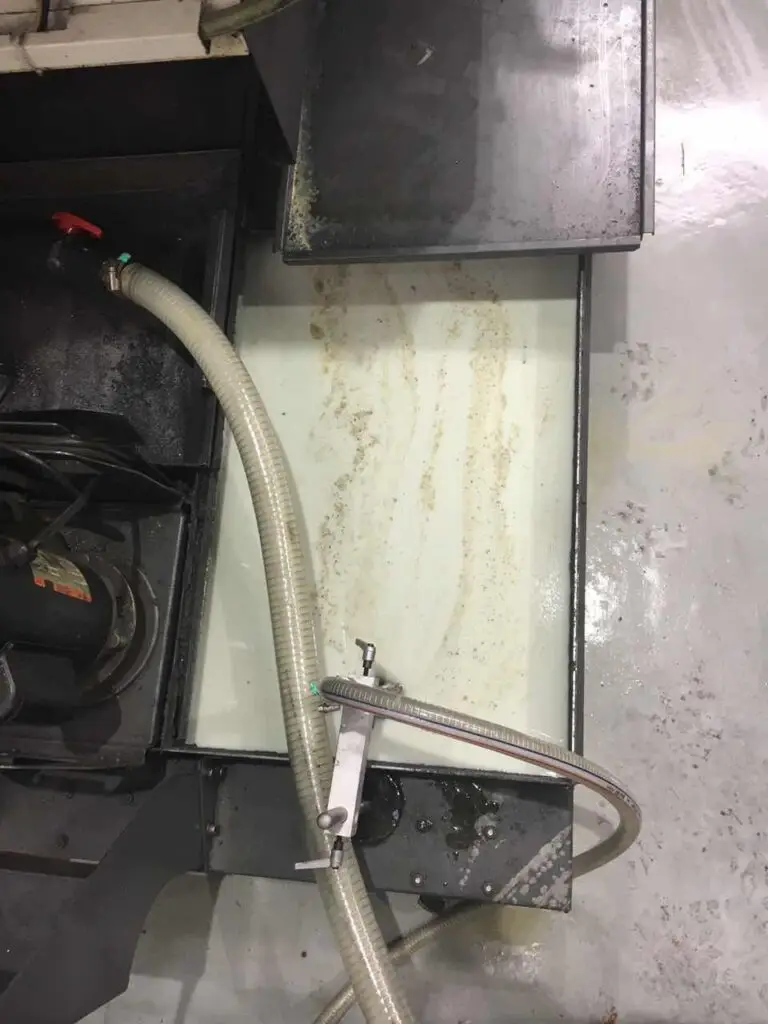
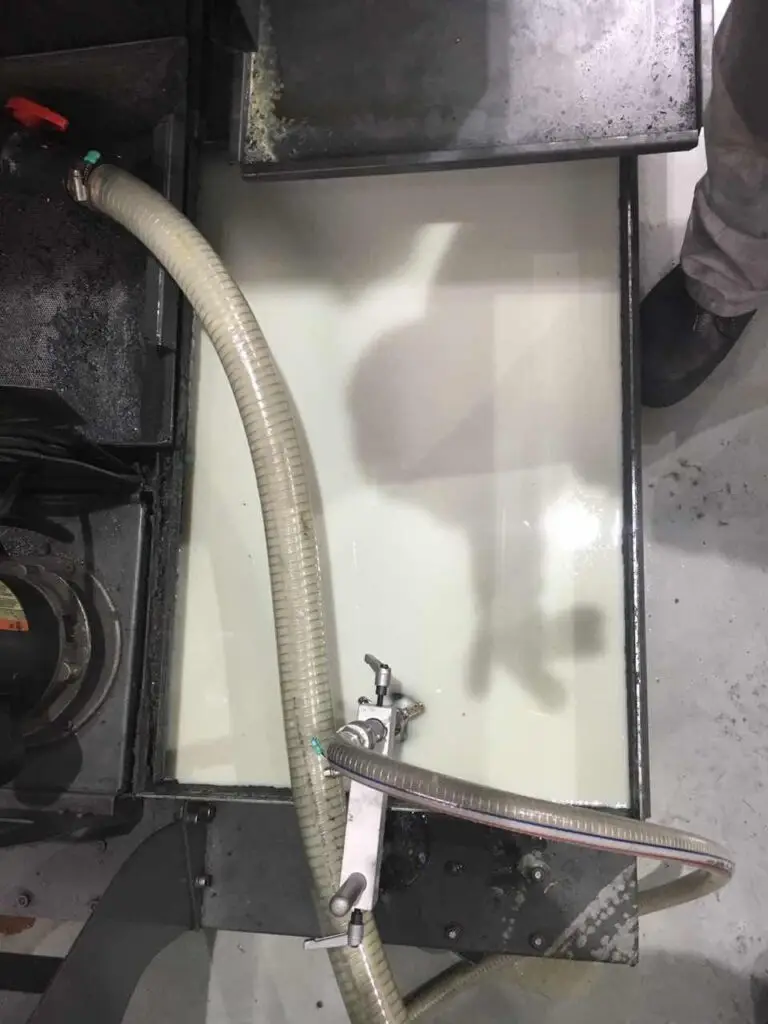
Field results: continuous removal of floating oil from coolant
The field photographs below show the liquid surface before, during and after SMT500C bypass treatment. Actual results and the time required depend on tank volume, floating-oil load, fluid properties and operating time.
SMT500C frequently asked questions
What tank capacity is suitable for the SMT500C?
Tank volume alone is not sufficient for selection. Oil load, target turnover and available daily operating time must also be considered. With a nominal flow rate of 600 L/h, the treatment time and rotation cycle for each tank should be determined from actual site conditions.
Can the SMT500C remove chips and metal powder?
The standard 350 μm stainless-steel basket filter intercepts larger chips and solid particles. For fine ferromagnetic metal particles, the optional FRIESS FMF 240 magnetic filter provides filtration down to 1 μm. Fine non-ferromagnetic particles require a different filtration technology.
Does the SMT500C affect the machine’s existing fluid supply?
Normally not, provided the unit is connected correctly and the flow is properly set. The SMT500C draws liquid from the tank in an independent bypass circuit and returns the treated liquid by gravity, without changing the machine’s existing fluid supply system.
Can the SMT500C separate emulsified oil?
The SMT500C is designed to remove floating oil and coalescible dispersed oil droplets. It is not suitable for oil that is stably emulsified in the water phase. If the contamination state is unclear, please provide a fluid sample or site photographs for assessment.
Can one SMT500C serve multiple tanks?
Yes. Its compact castor-mounted design allows one unit to rotate among multiple machines or tanks. The appropriate rotation cycle depends on tank quantity and volume, oil load and available daily operating time.
Does the SMT500C include UV, ozone or disinfection equipment?
No. The SMT500C uses stainless-steel basket pre-filtration and physical coalescing separation; it does not include UV, ozone or other disinfection equipment. Where microbial control is required, it should be combined with suitable disinfection or fluid-management technology.
Get SMT500C selection, configuration and operating advice
Tank volume, level variation, fluid properties, floating-oil load and solid-particle conditions affect equipment configuration, operating time and tank rotation. Submit the application data below and we will assess suitability, recommend the standard configuration or optional FMF 240, and propose an operating plan.
- Number of tanks and effective volume
- Liquid-level variation and surface area
- Fluid type, concentration, temperature and viscosity
- Type of floating oil, oil-layer thickness or approximate oil loading
- Type of solid particles and whether they are magnetic
- Target treatment time and available daily operating time
If possible, also provide photographs of the complete tank, liquid-surface contamination and proposed installation location so that we can recommend the configuration more accurately.
Other Product Options
Depending on your required flow rate, mobility, and oil removal needs, you may also consider the following products.
Separates floating oil, removes particles and circulates coolant for purification. Its modular configuration supports higher treatment demands and helps maintain stable coolant quality in demanding machining operations.
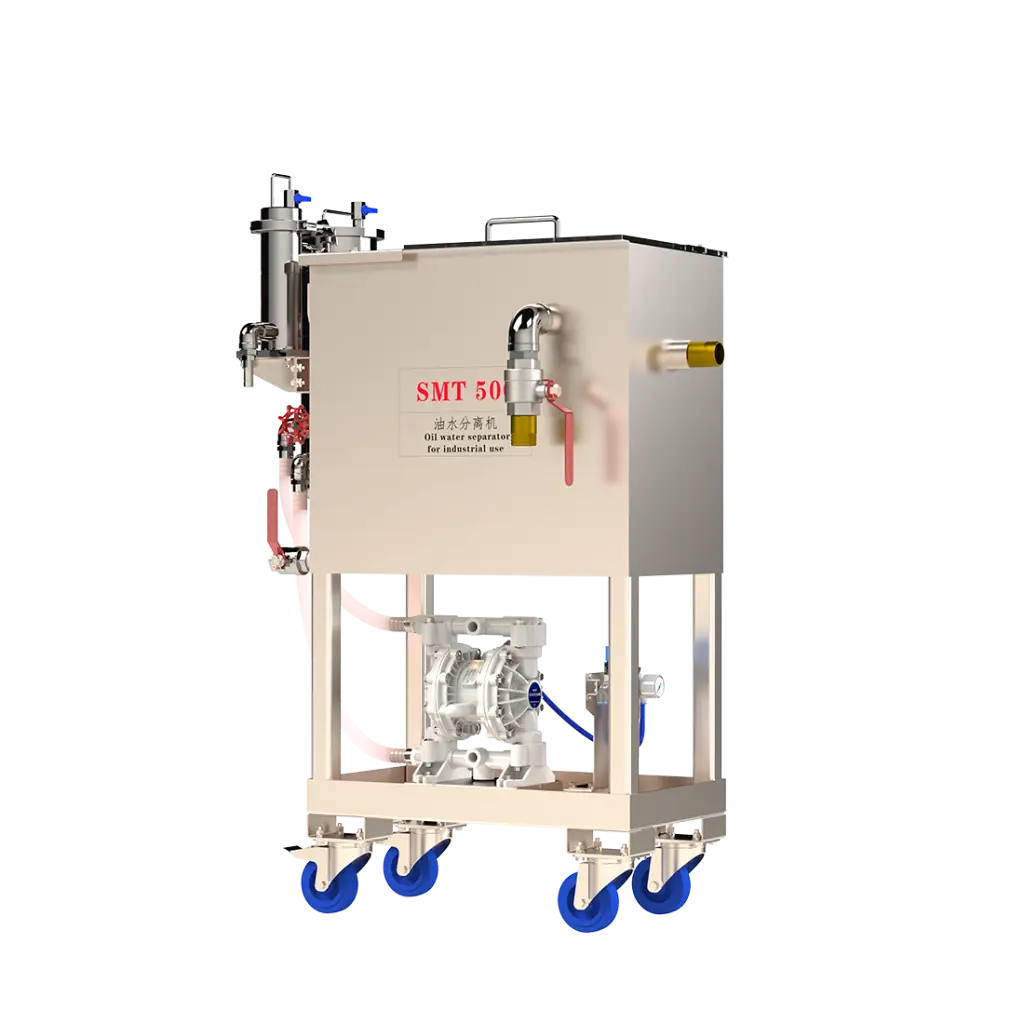
Combines proven FRIESS 1U oil-skimming technology with continuous oil-water separation. It reliably discharges separated floating oil, helping keep coolant cleaner and reduce manual tank maintenance.

Beyond direct cost savings, FRIESS oil skimmers, electrostatic oil cleaners, magnetic filters, coolant purification systems, oil-water separators and vacuum oil purifiers provide many additional operational benefits.
We would be pleased to explain how these solutions can support your process.