Remove fine contamination. Extend hydraulic oil life.
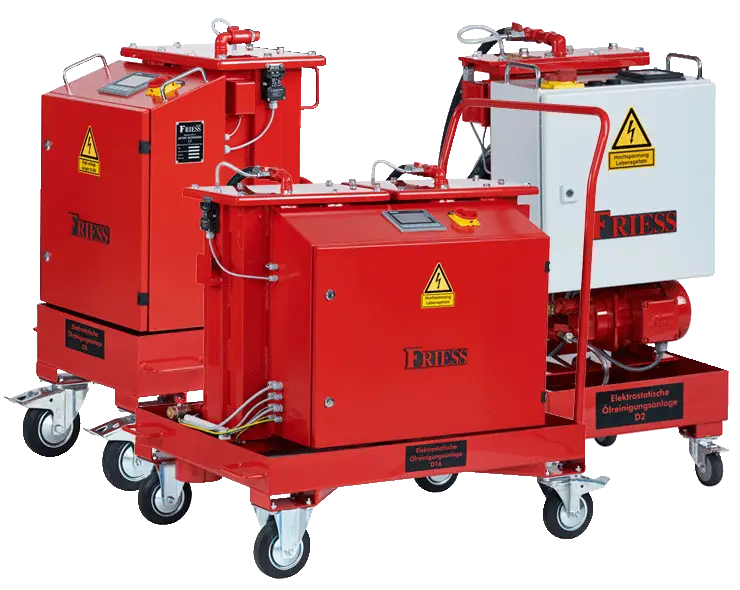
FRIESS DSD Electrostatic Oil Cleaner
Continuous bypass cleaning for non-conductive oils. Electrostatic separation removes fine particles, resins and oxidation products to help reduce hydraulic-system faults and oil-change maintenance.
D2, D4, D8 and D16 for different oil volumes. Oil water content must be below 500 ppm. For wetter oils, ask about a configuration with dehydration.
An electrostatic field can be established only when virtually no electrical current flows. During purification, the conductivity of the treated fluid must therefore remain as low as possible.
Water in the oil has an adverse effect on this requirement. For electrostatic oil cleaning with the FRIESS DSD series, the oil must be suitable for the process from the outset—its water content must be below 500 ppm. Only then can the electrical resistance remain sufficiently high.
Water content is one suitability criterion, not the only one. Confirm oil conductivity and additive compatibility as well. If water content or conductivity is unsuitable, assess dehydration or another treatment method first.
Model Selection and Tank Connections
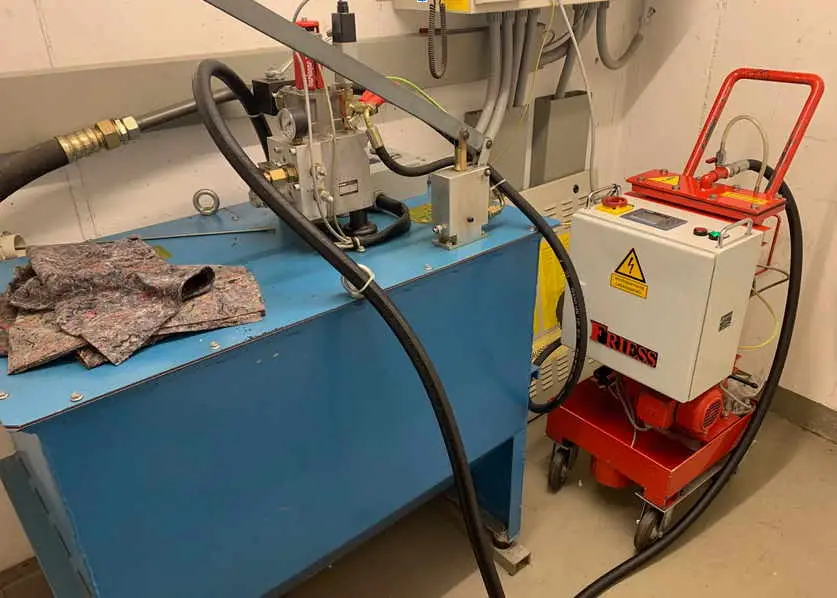
FRIESS electrostatic oil-cleaning systems can use different control configurations for one large reservoir or several smaller tanks. Confirm the connections and operating arrangement for the site.
How Do You Choose D2, D4, D8 or D16?
The flow rates in the technical data are the unit’s circulation flow, not reservoir capacities or a promise of treatment time. Select a model using system oil volume, initial contamination, continuing contaminant load and target cleanliness rather than pump flow alone.
For selection advice, provide the oil grade, system oil volume, operating temperature, viscosity at operating temperature, water content and a recent oil-analysis report. Confirm that oil conductivity and the additive system suit electrostatic cleaning. Include the connections for one or several tanks, available space and maintenance arrangements, then check the technical documentation for the specific supply configuration.
Verify benefits using oil analysis and operating records
Manufacturer-reported reductions in oil use and failures, and long service-life figures, describe application potential rather than a guarantee for every site. Cleaning does not restore exhausted base oil or additives. Base continued use or replacement on oil analysis and equipment requirements.
Technical Data
Models: D2 / D4 / D8 / D16
Flow rate: 2.5 / 4 / 8 / 16 L/min
Dirt-holding capacity per collector set: 0.3 / 1 / 2 / 4 kg
Oil temperature: max. 60 °C
Oil viscosity at operating temperature: max. 100 mm²/s
Power consumption: max. 500 W
High voltage: 14 kV
Power supply: 230 V / single phase
Water content in oil: max. 500 ppm
Dimensions (L × W × H):
450 × 400 × 940 mm
850 × 650 × 1080 mm
850 × 650 × 1080 mm
1065 × 780 × 1090 mm
Permitted oil types:
Hydraulic oils H / HL / HLP
Lubricating oils C / CL / CLP
PAO-based synthetic oils
Oils with detergent/dispersant (D) additives: confirm conductivity and electrostatic-treatment compatibility first.
Safety equipment:
Control-panel cover, drip tray with leak-protection system, and control cabinet with cylinder lock
Advantages
Helps reduce contamination-related faults; oil service life is determined by condition monitoring.
Reduces maintenance, repair and oil-change work.
Reduces oil consumption from premature contamination-related changes.
Assess treatment against oil and equipment requirements.
A FRIESS EFC D4 electrostatic oil cleaner removed fine particles and oxidation products from hydraulic test-bench oil, visibly improving cleanliness within two weeks.
A European gearbox plant used a FRIESS EFR D8 electrostatic oil cleaner to reduce hydraulic-oil particles larger than 4 µm by about 90% in a 23-hour test.
Learn how ISO 4406 particle counts, wear metals, viscosity, TAN and PQ index reveal hydraulic oil contamination, filtration performance and maintenance needs.
An 11-year-old injection moulding machine failed every two weeks; FRIESS EFR D8 removed sludge, fine particles and oxidation products, reducing failures to zero.
A FRIESS EFR D16 removed oxidation products and varnish from two 12,000-litre aluminum extrusion press hydraulic systems and restored fault-free servo-valve operation.
Particle contamination causes wear and can impair hydraulic components. This guide explains oil analysis and electrostatic cleaning, with performance assessed for the oil and operating conditions.
Four FRIESS EFR D16 electrostatic oil cleaners treated 120,000 litres of HLP 46 hydraulic oil, removed oxidation products and reduced the MPC value from 60 to 8.
A FRIESS EFR D16 with automatic particle monitoring reduced hydraulic faults on four automotive presses by more than 80%, with payback in under six months.
In this injection-moulding case, EFR D8 cleaning reduced hydraulic failures and filter consumption. No oil changes were reported during follow-up; future replacement still depends on oil analysis.
A FRIESS EFR D8 electrostatic oil cleaner extended hydraulic-oil life from about two months to several years and reduced steel mill hydraulic failures by 70%.
Fine particles or oxidation products affecting your oil system?
Share oil type, system volume, temperature, viscosity, water content and oil-analysis results, plus any particle, sludge or varnish issues. We will assess suitability and recommend a DSD model and bypass layout.